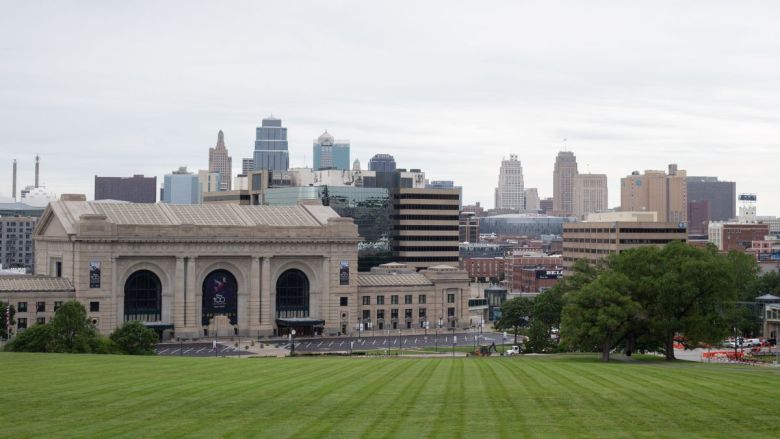
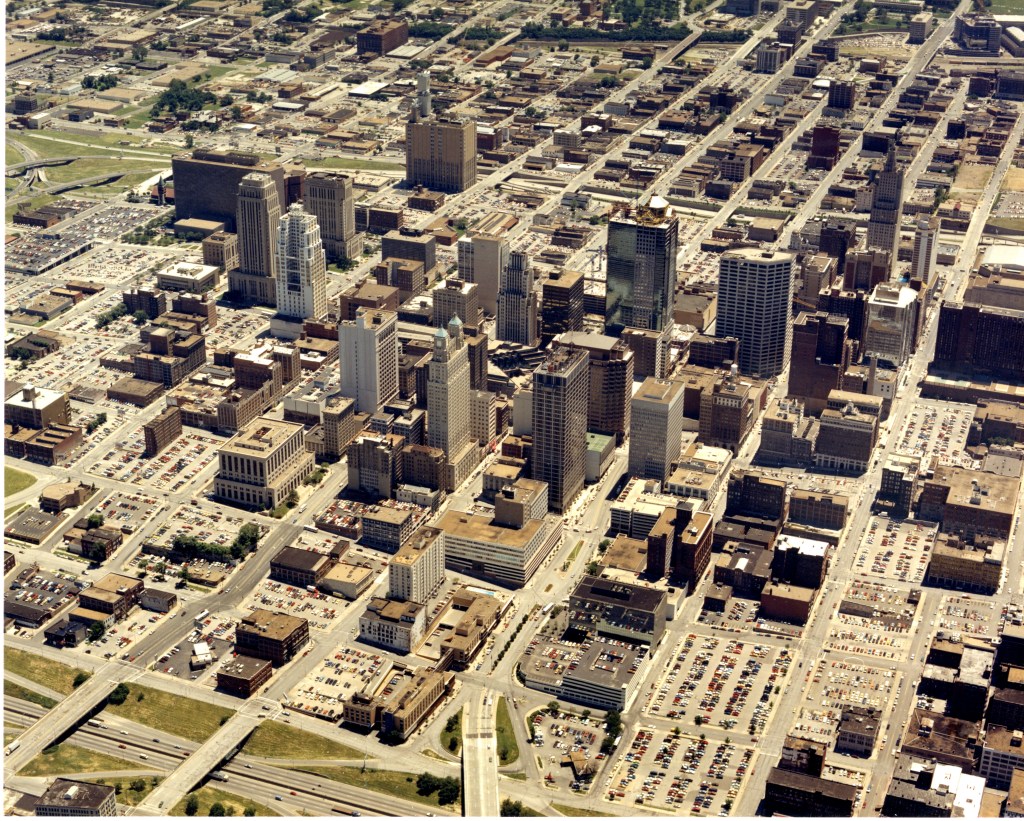
Before the Power & Light District became the hub of entertainment and economic activity that it is today, the area was blocks of unkempt parking lots and empty storefronts.
The district’s overhaul was in part financed through a piece of 2003 legislation called the Missouri Downtown Economic Stimulus Act, MODESA for short. The program expired and stopped taking new applications in 2013, but construction on projects with prior authorization, like the Power & Light apartment towers, continues.
Now, the same program could return and be used for upcoming developments like the Kansas City Current’s riverfront expansion and the Royals’ proposed ballpark at Crown Center.
Takeaways
- The Missouri General Assembly passed an economic development omnibus bill that authorizes new tax incentives and revives the dormant Missouri Downtown Economic Stimulus Act from 2003. It was widely credited with helping facilitate the development of the Power & Light District.
- The updated legislation expands where developments can be located. That means areas like the KC Current’s riverfront expansion and Crown Center would be eligible for MODESA incentives.
- Officials acknowledged that tax subsidy programs like MODESA have had issues, such as Kansas City stepping in every year to cover the debt payments from the Power & Light District’s development. Diverting revenue could also pose budgetary issues as the state makes cuts for the coming fiscal year and prepares to ask voters to eliminate the state’s income tax.
The updated program recently approved by the Missouri General Assembly allows the expansion of existing developments, two new developments per municipality and an expansion of what taxes can be collected to fund the projects.
Dan Moye, the vice president of land development for the Economic Development Corp. of Kansas City, said the program’s revival would be helpful in tackling some of the same issues the city faced during its first iteration.
“We still have a ton of vacant property downtown,” Moye said. “We still have a lot of aging infrastructure to work through, and so there continues to be both extra costs for large-scale development and revenues that don’t achieve a market return. That continues to be, while different, a similar set of issues to what we were facing 20 years ago.”
MODESA’s revival is part of a larger economic development omnibus bill that also would create Missouri Innovation Zones.
Within those areas, municipalities and businesses would be eligible for tax incentives relating to public safety upgrades, office-to-residential building conversions, angel investments, jobs that are relocated or created within the zone and employer retention and reinvestment. Taxpayers in those areas could defer some income tax liabilities when they reinvest into businesses or properties in those areas.
The bill would also create a capital investment tax credit through the Missouri Works program.
The bill received broad support from various economic development groups like Greater St. Louis Inc. and the EDC in Kansas City, which argued that the wide array of new incentives gives developers more tools as they pursue projects.
“I don’t think that any one of these (tax credits) in itself is a silver bullet,” Moye said. “But the ability to address things in different ways from different angles and craft structures that really match up well with the specific development just makes it easier to package a deal that makes Kansas City stand out.”
The bill awaits Gov. Mike Kehoe’s signature or veto. The deadline for decisions on bills this year is July 14.
How MODESA works
For each development project, the process starts with the municipality.
Municipalities apply for projects and select developers through a bid process after receiving approval from the Missouri Department of Economic Development, which administers the program.
The core funding mechanism for those projects works by diverting some of the new state and local tax revenue the development creates to reimburse project costs.
Under the original legislation, projects captured revenue primarily from property taxes and local incomes and sales taxes.
The updated version allows projects to capture 50% of new revenue from state and local income taxes, sales taxes, municipal earnings taxes and other economic activity taxes, such as the corporate tax.
Expanded development projects can capture up to 70% of new state income taxes if the DED determines the project is unlikely to occur without greater state contribution.
Jim Erickson, the director of strategic initiatives for the EDC, said the shift to emphasize more residential and retail taxes was necessary as markets have changed.
“I think in the early 2000s, the value of redirecting some of the taxes related to office development was a lot more lucrative than it is now,” Erickson said. “Now retail and residential make more sense, which is why the legislation’s kind of switched a little bit. That’s just where the market is right now, that’s where the value of it is.”

The program also requires local matches, meaning the municipality can issue bonds and accept payment in lieu of taxes to help fund the developments.
However, developers only receive these reimbursements after the project has proved it generates new revenues.
Sen. Kurtis Gregory, a Republican from Marshall and the Senate bill handler for a standalone version of the MODESA legislation, said during floor debate that payment only after investment was a key part.
“This bill is risk-free,” Gregory said. “The state does not have to put in a single penny, it doesn’t have to invest a single penny. … The private developers have to spend all of their own money, every single part of it, until the end. Only after it is completed and is proven to have generated new state taxes and new sales taxes, then and only then, do they get to share in a percent of those brand new revenues.”
Where could KC see new projects?
The bill allows for the expansion of existing developments and two new ones in eligible municipalities, but has some stipulations on where those projects can be located.
Development areas must be considered a blighted or conservation area and be in a central business district or the downtown area. New developments cannot be within a half-mile of an existing development or in a historic floodplain. However, properties can be exempt from the flood-plain rule if they are floodproofed in accordance with Federal Emergency Management Agency guidelines.
The statutory wording on what constitutes a “central business district” was left vague after language was removed that required the median household income of the area be $62,000 or less and buildings be 35 years or older.
A central business district is now defined as “the area at or near the historic core that is locally known as the ‘downtown’ of a municipality. The historical land use emphasis of a central business district prior to redevelopment will have been a mixed use of business, commercial, financial, transportation, government and multifamily residential uses.”
The expansion was necessary, Erickson said, because Kansas City’s understanding of what constitutes downtown has changed and expanded over the last two decades.
“I think just with the streetcar alone, some of the areas that did not feel like they were part of downtown — again, I would point to the riverfront — are now very much in downtown, where that would have been a fairly large stretch before,” Erickson said. “Boundaries change, because really, how we interact with downtown changed.”
Kansas City Mayor Quinton Lucas said he considers downtown’s boundaries to be the Missouri River to the north, 31st Street to the south, the state line to the west and Woodland Avenue to the east.
Those boundaries would mean much of the area inside and south of the downtown freeway loop would be eligible for MODESA projects. Moye said that could help bring new developments to areas like the Crossroads or the Grand Boulevard corridor.
Notably, Crown Center also falls neatly inside those lines. Lucas didn’t rule out potential MODESA use for the Royals’ ballpark.
“Past bond engagement does not foreclose future MODESA support,” Lucas said. “I don’t think that there’s really anything that’s off the table, as long as it fits the other statutory rules.”
A MODESA project or Innovation Zone designation could provide the city with another avenue as it faces an initiative petition that would put to a vote its $600 million bond proposal to help finance the new Royals stadium.
In addition to the expansion of downtown boundaries, the bill allows for new developments alongside riverfronts and in three areas not connected to a development in downtown.
That addition was largely included in order to connect St. Louis’ Ballpark Village to the nearby waterfront and Gateway Arch grounds, Sen. Steven Roberts, a Democrat from St. Louis, said during floor debate.
But a Kansas City riverfront MODESA project has already been floated after an ordinance was filed by Lucas on June 10 that would authorize negotiations with the KC Current to expand the women’s soccer stadium, add more mixed-use development along the riverfront and connect the area to the Berkley Riverfront Park.
As part of that deal, the city would support a future tax-increment financing district and issue $235 million in bonds to help finance the $1.4 billion project. It also directs the city manager to apply for state tax credits through the Missouri Development Finance Board and explore other programs, including MODESA.
The noncontiguous exception also means that areas like the Country Club Plaza could be contenders for MODESA projects.
The Plaza’s new owners, Gillon Property Group, have already petitioned the city for some financial deals. That includes a TIF district and property tax exemptions through Port KC. The property tax exemption discussion was tabled and the TIF district requires a final vote from the City Council, which has not indicated when or if it would be voted on.
With the city as the applicant in any MODESA project, any proposed development will need approval from the City Council before it can proceed.
Subsidies: Hurt or help?
While the bill passed both chambers of the legislature with little trouble, Lucas acknowledged that there are valid criticisms of the MODESA program and tax subsidies as a whole.
A primary issue opponents argue is that the state and city are oversubsidizing construction projects that already have ample funding opportunities from backers or owners.
The KC Tenants Union made that argument for the failed 2024 Jackson County stadium sales tax measure, and the Missouri Workers Center is making a similar one as it opposes the Crown Center deal.
They also point out that the city can end up footing the bill instead of developers.
Kansas City has had to step in every year since the inception of the Power & Light District projects to cover the cost of debt-service obligations as the revenue needed to pay them off has consistently fallen short.
The mismatch between real and expected revenue was due to lofty financial projections during a period of high economic activity, Lucas said. Since then, he said, the city has become more conservative in its financial analyses by basing it on current economic activity and the type of project it chooses to back.
“The responsibility in my city and all other cities is to make sure that we’re evaluating projects as a type of unique and very worthy project that merits the settlements,” Lucas said. “We should not be using it to build a 10th hotel next to who knows what.”
Officials also have to contend with the fact that the program diverts new revenue at a time when the state faces budgetary challenges.
Lawmakers already felt some strain from cuts when crafting the budget for the coming fiscal year, and it is likely to continue. Missouri Auditor Scott Fitzpatrick warned in a recent report the state is facing dismal revenue projections that could force it to implement emergency budget reductions.
This comes as the state is preparing to ask voters to approve an income tax elimination plan that would allow lawmakers to raise or expand state sales taxes without additional voter approval to achieve that goal. The question will appear before voters on the August ballot.
Kansas City-area officials have voiced concerns about how the plan could impact funding for local services and potentially push businesses searching for lower sales taxes to neighboring states.
Despite those issues, Moye and Lucas said that without that original investment, the Power & Light District as Kansas Citians know it today, or the surrounding areas, likely wouldn’t have happened.
“We thought it was vital really to have that area as an anchor, and even if you never go to the Power & Light District,” Lucas said. “Do you see some of the other steps that have happened over the past 20 to 25 years without that stability in the core?”