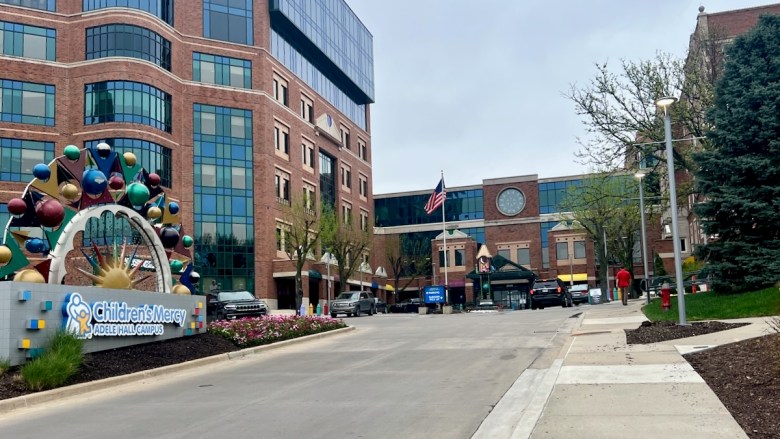
Later this month, Children’s Mercy Hospital is expected to formally announce a major expansion of its downtown campus.
Takeaways
- Children’s Mercy Hospital is planning a massive construction project on its downtown campus, filing a plan with the city that includes a 20-story patient tower and seven other buildings.
- The pediatric hospital has also been busy expanding into smaller communities, including Wichita and Springfield.
- Health economists said the hospital’s expansion is partly a play to find more potential patients for the profitable specialty services offered in Kansas City.
Plans filed with the city reveal a seven-phase project that may eventually include four new hospital buildings, two medical office buildings and two administrative office buildings.
Children’s Mercy officials declined to discuss the project, its cost or a timeline.
But even if only a portion of the plan is completed, it is likely to represent a substantial investment in the pediatric hospital’s flagship Adele Hall campus, roughly located between Gillham Road and Holmes Street on Hospital Hill.
The project also fits neatly into Children’s Mercy’s recent aggressive push to expand its footprint well outside of Kansas City.
Despite steadily declining birthrates in Missouri, Kansas and across the country, in the last year Children’s Mercy has announced major expansions in Overland Park, Wichita and Springfield. In 2025, the nonprofit hospital reported more than $2 billion in revenue and $418.5 million in excess revenue, four times more than a decade earlier.
Health economists said the hospital’s growth looks familiar among standalone pediatric hospitals. For many reasons, including shifts that occurred during the COVID pandemic, general acute-care hospitals are shedding pediatric beds, effectively making children’s hospitals like Children’s Mercy regional hubs for kids’ care.
“If a patient is in a smaller community hospital and they need a higher level of care, they only have so many numbers they can call,” said Dr. Sriram Ramgopal, an assistant professor of pediatrics at the Northwestern University Feinberg School of Medicine.
Children’s Mercy certainly fits the description of a regional hub. It is the lone children’s hospital serving Kansas and the western side of Missouri. For children with serious or specialized health problems, Children’s Mercy has become the only option.
Even the University of Kansas Health System, which had maintained a six-bed pediatric intensive care unit, this month confirmed that it would close the unit due to a “chronically low census.” KU will maintain its neonatal intensive care unit and continue to treat babies and children, but children in need of advanced care will be directed across town to Children’s Mercy.
In addition to its presence in suburban Kansas City and outlying parts of Missouri and Kansas, Children’s Mercy is affiliated with many of the primary care pediatric practices in the Kansas City area and has relationships with community health clinics like Samuel U. Rodgers, which recently opened a new pediatric wing.
All of that gives Children’s Mercy a tight grip on the region’s pediatric market and helps explain the hospital’s expansion plans — both the downtown campus project and growth into outlying markets. And they likely work hand-in-hand, health economists said.
The downtown campus project will make more room for the hospital’s specialized services, like organ transplants, complex cardiac surgeries and maternal fetal medicine. Those services also tend to bring in more money. And its growth into outlying communities will increase the number of potential patients who may need those specialized services.
“They’re going to widen the funnel just a little bit so they can keep bringing in those very high-end — what we call tertiary or quaternary — referrals,” said Kevin Holloran, a senior director with Fitch Ratings who follows the pediatric health sector, but not Children’s Mercy specifically. “You need a big population to do that. There’s only so many people that need that high-end stuff.”
What is Children’s Mercy’s plan?
Amy Fallon, Children’s Mercy’s president of regional operations, said the hospital’s expansion into smaller communities in Kansas and Missouri is mission-driven.
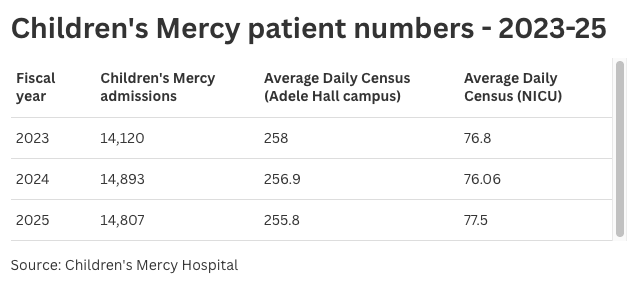
The 390-bed institution wants to take its kid-centered care to as many children as possible. That will help families who can’t easily get to Kansas City and relieve pressure on the hospital’s downtown facility.
“There are always going to be some unique things we can only do in Kansas City,” Fallon said. “But we want to keep kids in their communities. We want to keep them close to home as much as we can.”
Fallon didn’t dispute that the hospital’s regional expansion also has a clear business rationale. Pediatric health care can treat far more illnesses than it could even a few decades ago. But that treatment is expensive and has a smaller patient market than adult care.
“In order to grow and retain a really robust transplant program or maternal fetal medicine program or cardiology program,” Fallon said, “we really do have to think about how we extend our reach broadly across the region.”
Maintaining high-end specialized care in future years when the population of children will be even smaller, she said, requires moving into new markets.
“We’re really trying to think forward about what’s coming with regards to all aspects of how we deliver care,” Fallon said, “to be able to continue to be that robust service for kids across the region.”
In 2025, Children’s Mercy’s expansion looked like this:
- In March, the hospital said it would build a new clinic in Wichita to bolster the specialty services it already offers there. The 18,000-square-foot facility is expected to open this summer.
- In April, it announced a $152 million expansion of its Overland Park campus, including an expansion of surgical services, a new medical office building to consolidate outpatient services, and hospital renovations, expected to be finished by the summer of 2029.
- In August, Children’s Mercy announced a joint venture with Mercy Springfield Communities to manage the southwest Missouri health system’s pediatric services. Through that deal, starting last fall, Children’s Mercy took over Mercy’s pediatric services, including inpatient care, pediatric intensive care, neonatal intensive care, pediatric surgery and other services.
- And in November, the hospital said it would build a new pediatric outpatient facility in Springfield. The 40,000-square-foot, two-story building will be located on the Mercy South campus and house pediatric care and specialists.
The hospital’s move into Springfield may be particularly illustrative of the larger trend in pediatric health care. At the same time Children’s Mercy chose to expand into Springfield, St. Louis Children’s did the same, inking its own joint venture with CoxHealth and recently announcing plans to open a pediatric hospital there.
It just so happens that Springfield is in close proximity to Christian County, one of the state’s fastest-growing counties.
For the hospitals, it comes down to a simple truth, said Ciaran S. Phibbs, a health economist and professor of pediatrics at the Stanford University School of Medicine. Children’s hospitals have to attract as many patients as possible to their most profitable services so they can cover losses on other services.
“The hospitals are making rational economic decisions,” Phibbs said.
Shifts in pediatric health
Like other corners of health care, children’s hospitals face many economic headwinds. Not only is the population declining because not as many babies are being born, kids tend to be healthier and in less need of the high-margin specialized care hospitals need to sell.
On top of that, insurance companies tend to pay less for pediatric services. And half of children in the United States are covered by Medicaid, the government insurance program that tends to reimburse even less.
“There are a bunch of reasons why pediatric care is a difficult economic proposition,” said Olivia Zhao, a health policy researcher at the Harvard Business School.
But for standalone children’s hospitals like Children’s Mercy, the consolidation of pediatric care is proving to be an advantage.
In an August report on nonprofit children’s hospitals, Fitch Ratings found that the sector is bouncing back from the pressures of COVID faster than the wider hospital sector.
Although children’s hospitals, like all hospitals, are bracing for cuts to Medicaid expected due to changes adopted last summer under the Trump administration’s One Big Beautiful Bill Act, they generally have healthier balance sheets to help them weather the storm.
The Fitch Ratings report found that children’s hospitals, which tend to have strong philanthropic support, also have less debt than their general hospital counterparts. The median cash-to-debt ratio among children’s hospitals was 243.2% in 2024, compared to 16.92% among general acute-care hospitals.
Operating margins were also stronger. The report found that the median operating margin for children’s hospitals was 3.2%, compared to 1.1% for general hospital and health systems. Children’s Mercy’s operating margin was just over 5% in 2024.
Many health policy experts argue that the consolidation of pediatric care isn’t just good for hospital balance sheets, it’s also good for patients. Hospitals that can count on a broader patient base can afford to invest in expensive equipment and highly paid physicians to do complex, life-saving procedures. Beyond that, the doctors who do those procedures regularly will be better at them.
“You don’t want someone who dabbles in high-end stuff,” said Holloran of Fitch Ratings. “You want someone who does 1,000 of them a year.”
The Adele Hall expansion
Children’s Mercy’s downtown campus plan appears to be focused on increasing patient capacity, in addition to adding more space for administrative offices. The master plan, filed with the city in March, lays out a seven-phase project that would take years to complete. It is unclear when or if every part of the plan will be constructed.
But, according to the plan, the project would start with two new patient-focused buildings near the corner of 25th and Holmes streets. Those include a five-story building on the hospital’s existing emergency room parking lot, just west of Holmes, and a three-story expansion on top of a nearby existing ambulance canopy.
The second phase calls for demolishing two buildings near 25th Street and Gillham Road and replacing them with a 20-story hospital tower. Future phases include a 10-story medical office building, an additional 10-story building, a nine-story building and an eight-story medical office building.
The master plan, which includes a rezoning request, is scheduled for a hearing before the City Plan Commission at 9 a.m. April 15. From there, the plan will need approval from the full City Council.
Children’s Mercy officials, who are planning a major announcement about the project at the end of April, declined to discuss it, including revealing how much it will cost. But Holloran estimated that for a new pediatric facility, requiring expensive and sophisticated technology, the cost in the Kansas City market would be between $1 million and $1.5 million per bed.
In a written statement, the hospital said it is “in the preliminary stages of planning an expansion to our Adele Hall campus in Kansas City that will meaningfully enhance services for the children and families we serve.”
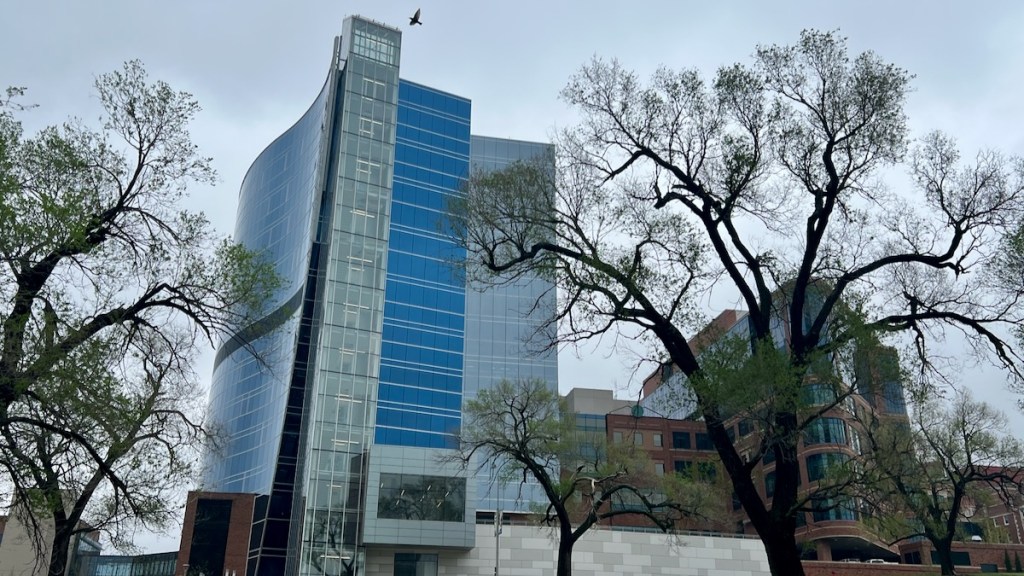
The last major construction project Children’s Mercy completed downtown was a research tower that opened in 2021. That project, estimated to cost $200 million, received $75 million pledges from both the Hall Family Foundation and the Sunderland Foundation.