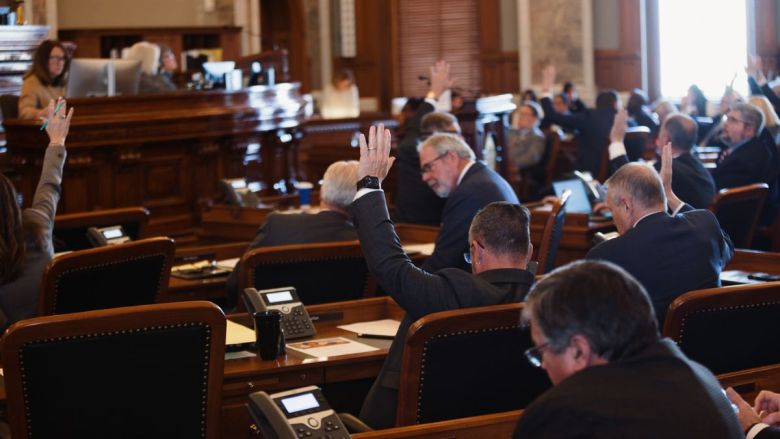
The 2026 Kansas Legislature session is over with bills on elections, free speech and welfare programs all passed by lawmakers.
Gov. Laura Kelly vetoed dozens of bills, and Republicans overrode a majority of the vetoes to make the bills into law. The Beacon compiled a list of significant legislation. This isn’t a complete list, but a highlight of some noteworthy bills.
Property tax relief
Lawmakers passed a bill that would cap local government spending. Municipalities could only increase their budget by either 3% or the Midwest Consumer Price Index. If the budget increased too much, 10% of residents in that municipality could sign a petition to block the budget.
This bill barely passed the House and Senate. Some Republicans and Democrats joined together to vote against it.
Supporters of the bill say families are cutting back on spending, so local governments should as well. They say keeping the government from spending too much would ease the property tax burden.
Opponents of the bill say it doesn’t provide real tax relief and is too harsh on local governments. A small group of voters could block a budget supported by the majority of residents.
Kelly vetoed the bill. No veto override was attempted because other property tax legislation was considered.
Citizenship status on driver’s licenses
Republicans want citizenship status listed on every driver’s license in the state. Kansans wouldn’t need to get a new driver’s license immediately, but the next driver’s license they get would have citizenship status listed.
It is possible noncitizens were naturalized and didn’t get a new license before an election. Anyone with a noncitizen driver’s license would vote with a provisional ballot and could return to the elections office to prove they are a citizen.
Noncitizens who are legally in the country can get a driver’s license. It looks like any other driver’s license, and that can confuse poll workers on election day, supporters of the bill argue. Listing citizenship status makes it clear who can and cannot vote.
Opponents of the bill say it opens noncitizens to discrimination. People may only vote twice a year, but they show their ID to buy alcohol, get into bars or for other reasons way more often. Noncitizen voting is also extremely rare.
The veto override was not attempted. The bill is dead.
SAVE Kansas Act
Kansas Republicans are trying to mirror the federal SAVE America election legislation.
The bill requires certain state agencies to issue quarterly reports on election administration. For example, the director of the Division of Motor Vehicles would give quarterly reports on noncitizens issued driver’s licenses. It requires the state to check federal databases for noncitizens. State agencies that register people to vote will have to share personal data, like a Social Security number, with the Kansas secretary of state’s office.
It also prevents Kansans from registering to vote on any website, unless that website has a .gov ending or is state-approved. That means certain popular websites that help people register to vote wouldn’t be eligible.
Supporters of the bill say this makes voter rolls more accurate. State officials have more tools to remove people from the registration list if they’ve moved, died or shouldn’t have been registered in the first place.
Opponents of the bill say the data sharing requirements are illegal. They also say running these checks for noncitizens could accidentally flag U.S. citizens who had a right to vote. Similar mistakes have happened in other states.
The veto override succeeded. This bill is law.
Free speech
The KIRK Act, for Kansas Intellectual Rights and Knowledge Act, was named after conservative activist Charlie Kirk, the conservative icon who was killed last year.
Republicans say the bill protects free speech on college campuses, and it prevents universities and other taxpayer-funded institutions from picking who can and cannot speak. Colleges can be sued for violating the act. Minimum damages are $500 for the initial violation and $50 for each day a violation continues, which could include a restrictive university policy.
Kelly vetoed the bill, saying all these protections already exist. She said the bill would only create new and confusing case law for colleges that get sued for violating the act.
The veto override was successful. The bill is law.
Student protest ban
Kansas Republicans want to prevent students from joining walkout protests. A provision in the state budget would require parental approval for their child to join a school walkout. Schools could also be punished if staff encourage or facilitate a student walkout, and student walkouts wouldn’t count as instruction days.
Schools face financial penalties for protests considered improper. That fine is equal to the superintendent’s base pay for every day the walkout happens.
Supporters of the provision say K-12 schools are about education. Kids shouldn’t have the chance to walk out of class whenever they want — they should be learning.
Opponents of the proposal say this undermines free speech. Students should be allowed to join a protest if they want.
The veto override succeeded. The budget provision is law.
Pregnancy resource centers
Lawmakers want to give pregnancy resource centers $3 million. The Pregnancy Compassion Awareness Program gives pregnancy resource centers state money. Those centers have received $7 million since 2022.
Kelly vetoed all the funding for this year’s allocation. Kelly also vetoed a bill to expand protections to these centers, but that bill was previously overridden.
Supporters of pregnancy resource centers say these facilities help families. They work with new mothers while providing diapers and other necessary supplies.
Opponents of these centers say they push an anti-abortion agenda. They say these centers talk women out of abortions and push medically inaccurate information.
The veto override was successful. The budget provision is law.
One Big Beautiful Bill Kansas
Republicans passed their own version of the Trump administration’s One Big Beautiful Bill Act.
The One Big Beautiful Bill was a federal law with sweeping changes to social services programs, like food assistance. The Kansas bill prevents people from self-attestation, which is when someone will say how much money they make or how many people they live with and state agencies wouldn’t double-check that information. State agencies were limiting self-attestation even without the bill.
Republicans say this bill is necessary to safeguard public dollars. They also claim it’ll lower the food assistance error rate. The bill requires agencies to do more regular checks of eligibility, but agencies that run welfare programs say checking more often leads to more human error and actually increases error rates. Some checks also aren’t necessary.
Democrats opposed the bill because they say it will take food away from people who are eligible — one Democrat estimated 13,000 Kansans will lose food assistance.
The veto override was successful. The bill is law.
Expanding landlord rights
Republicans wanted to ban cities from clamping down on landlords who reject housing vouchers.
Lawrence passed a city ordinance that said landlords can’t reject tenants who receive housing vouchers.
Supporters of the bill said requiring landlords to take housing vouchers comes with new sets of regulations. These properties need more inspections and have red tape that could delay when new tenants move in, costing landlords money. Republicans say landlords should be able to rent out their property however they want.
Opponents of the bill said housing vouchers are legal income, and letting landlords reject legal income isn’t right. They also say this is a local issue for cities to sort out themselves, not something for the state government to regulate.
The veto override succeeded. The bill is law.