


There are a lot of reasons Yenifer is working on learning English.
There are the big ones, like communicating with a brother-in-law who doesn’t speak Spanish, improving her career prospects or one day helping her community with interpretation.
Then there are the day-to-day things, like being able to enjoy the movie theater again, ordering in a restaurant or asking for help at Walmart.
Yenifer, who spoke to The Beacon in Spanish and asked to be identified by only her first name because of her immigration status, said she’s already made progress by attending adult English classes at Johnson County Community College, a convenient and affordable option.
“That’s changed my life,” she said. “It’s frustrating when you want to express something and people can’t understand you, or when someone says something to you and you can’t understand. So this has really helped improve my quality of life, my self-confidence.”
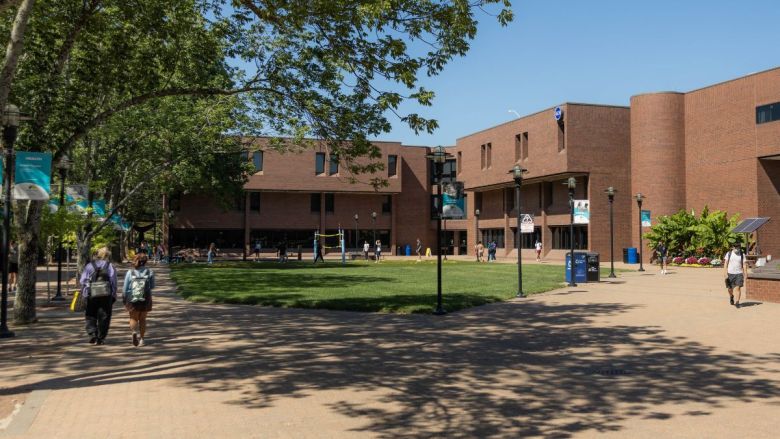
There’s still more Yenifer wants to learn. But her plans to continue studying at JCCC suffered a major setback when the college announced changes to its registration process for adult education — a category that covers GED preparation, English language classes and Accelerating Opportunity: Kansas.
The changes don’t currently affect the college’s other programs or eligibility for in-state tuition in Kansas.
According to an announcement on the college’s English language learning page, adult education students are required to submit proof of citizenship or their most recent immigration documents in order to register.
The decision follows guidance from the U.S. Department of Education, prompted by an executive order, that changes the interpretation of a federal law on public benefits. Previously, immigrants who weren’t eligible for most public benefits could still access adult education. Now, many — including some with permission to be in the country — won’t qualify.
That’s a challenge for Yenifer. She and her husband have been waiting for a U visa, granted to victims of serious crimes who cooperate with the police, for nearly six years.
Chris Gray, vice president of strategic communications and marketing at JCCC, said in an email that it wasn’t good practice to speculate on potential impacts to enrollment or to attempt to explain federal requirements.
The federal government recently froze funding for adult education programs, then said it was releasing the money with “guardrails” to ensure they are “not used in violation of executive orders.”
“JCCC’s compliance with federal requirements in this matter allows us to continue to serve qualified individuals for our JCAE (Johnson County Adult Education) programs,” Gray wrote.
But for Yenifer, the new policy makes it harder to continue along the path she’d imagined.
“I really think that they’re causing us great harm by restricting us from something as important as education, which really should be for everyone,” she said. “It shouldn’t be just a privilege.”
Who is eligible for adult education at JCCC
When Daniel Tyx applied for a job as a part-time English language instructor at JCCC, he asked if the college discriminated based on immigration status.
“They said, ‘Absolutely not. We would not do that,’” Tyx said. “I was not going to take the job if that was the case. When it became clear that that was going to be the case, I was like, as a matter of conscience, I can’t work here anymore.”
Tyx said there were about 800 returning students in the adult English language learner program and estimated that about half could be affected, based on his conversations with students. The revised policies also apply to other adult education programs such as the GED prep program and Accelerating Opportunity: Kansas program.
Although the college links to a list of common immigration documents in an information box at the top of several webpages, it doesn’t make clear which immigration statuses or documents mean a student will be admitted and which would get them rejected.
At the time of publication, Gray had not responded to a follow-up email from The Beacon asking if there is a list of eligible and ineligible categories.
In an explainer of the new federal notices, the National Immigration Law Center said the following categories of immigrants are normally qualified for public benefits:
- Lawful permanent residents (green card holders)
- Refugees
- People granted asylum
- Certain survivors of domestic violence and trafficking
- Certain Cuban and Haitian nationals
- People residing under a Compact of Free Association with Palau, Micronesia and the Marshall Islands
Immigrants normally disqualified include:
- People with temporary protected status (TPS)
- People with nonimmigrant visas, including U visas, student visas and work visas
- People who have applied for asylum or a U visa
- People granted deferred action, including Deferred Action for Childhood Arrivals (DACA)
- Other undocumented and documented immigrants
That means that if JCCC follows those categories, Yenifer wouldn’t be eligible for classes even if she were to obtain a U visa. U visa holders are eventually eligible to apply for a green card.
Tyx said that during part of a training day he attended before resigning, an administrator specifically mentioned that recipients of DACA and TPS would not be eligible.
DACA is granted to certain immigrants who were brought to the United States as children, while TPS is for those whose home countries are temporarily unsafe due to conditions such as armed conflict or natural disasters. Both provide work authorization and protection from deportation to immigrants who are otherwise undocumented.
Logistical issues
Tyx said he didn’t know whether to blame Johnson County Community College for restricting immigrant students or to put the responsibility on the federal government.
Throughout much of July, the federal government froze — but eventually unfroze — some education funding, including for K-12 students and adult education.
The policy also comes after a February executive order from President Donald Trump telling agencies to ensure that public benefits don’t go to undocumented immigrants, and after the July 10 guidance about adult education programs from the Department of Education.
But he said the college seemed to have moved faster to change its policies than similar area programs, and that he wasn’t aware of state or federal instructions it was following about precisely how to implement the executive order.
“In my ideal world, the college would have pushed back and said, ‘We are not going to take further action until we receive specific guidance from the government about what this means,’” Tyx said.
The way JCCC has acted is also confusing for instructors who are being asked to operate outside of their area of expertise, Tyx said. “Aside from, like, the moral and ethical issues, there are a lot of logistical issues,” he said.
Instructors were notified that the college canceled its original plan for returning students to enroll and was instead requiring instructors, who typically work part time, to handle verification appointments with students at a later date.
Some instructors had questions, Tyx said, such as whether they’d be held liable for mistakes, how to tell if documents were authentic and what happened if a student’s status was revoked.
“Immigration lawyer was not in my job description,” he said.
The Beacon contacted several local providers of adult English classes — Kansas City, Kansas, Community College; Metropolitan Community College and Literacy KC — to ask how they are handling the federal guidance but had not received a response by the time of publication.
The impact of the changes at JCCC
Many students are devastated, Tyx said.
Some want to advance in their jobs, including those who have high-level professional experience in their home countries and would like to work in their original field, Tyx said. Others are preparing for the citizenship test. Increasingly, young people who want to transfer to regular college classes enroll.
“For every student, the impact is different,” he said. “What all the students have in common is that they have invested a lot of time and energy and effort into learning English.”
Students have to follow strict attendance requirements, spend about six hours per week in class and do two hours of homework, Tyx said. Some study for multiple years.
In Tyx’s morning classes, many students have come from working the night shift.
“They work all night, and they come to class in the morning, and then they study for three hours and they go home and sleep,” he said. “For some of my students, education is more important than sleeping.”
Immigrants learning English have an impact on the broader community as well, Tyx said. They often become more productive employees, are bridges between managers and their co-workers, or become managers themselves.
“Being able to speak English just opens doors for families, for children, for parents,” Tyx said. “So many of my students tell me, like: ‘I want to be able to talk to my neighbors. I want to be able to talk to people at church, right? I want to be able to talk to people at the store, at the restaurant.’”
Yenifer said her remaining option is to study English online. But that doesn’t work as well for her.
“I learn a lot more if I go to class, if I have a professor in front of me whom I can ask any questions,” she said.
Not being able to have that is a setback.
“It was a dream, it was a goal to be able to continue learning English and to study something later that could help the community,” she said. “If I can’t study, well, obviously that won’t happen. It’s going to be a lot harder for me to keep learning the language.”

