


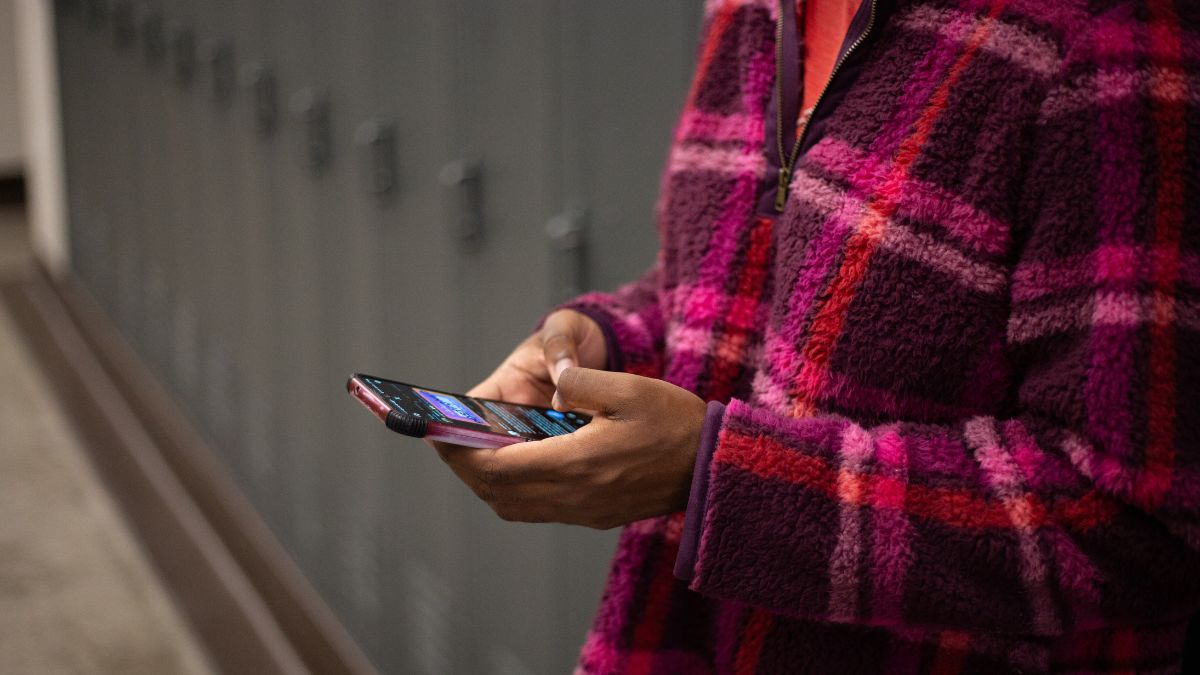
Students at Northeast Middle School in Kansas City used to run into one another “just like bumper cars” as they navigated the halls with eyes fixed on their cellphone screens, said school librarian Paula York.
That changed after a 2025 Missouri law banned students’ personal electronic devices such as cellphones during the entire school day, York said.
“They’re actually looking at people and not running into people. Their focus is much better in school. Their attention span is much better, and they’re learning that … they have to have manners, because they can’t hide behind a screen,” she said.
Takeaways
- The most recent school year was the first under a 2025 Missouri law that prohibits students from using cellphones and other personal electronic devices during the school day.
- Some educators say the law helped students focus in class and socialize with their peers during lunch and breaks.
- Others say a more balanced approach would allow students some access to personal devices, as long as it doesn’t distract them from instruction.
In contrast, Ruskin High School Principal Ernest Fields couldn’t think of any positive effects of the new law.
“Cellphone usage during instructional time is what the main problem is,” he said. “To ban it even during personal time, I think that’s an overreach.”
Fields said enforcing the law during class time has itself become a distraction. He said some students beat the ban by bringing multiple phones, distracting themselves with laptops instead or hiding in the bathroom to check messages.
“Students do have real tasks outside of school,” he said. “They end up having to take care of their little brothers and sisters. They have jobs they call. … It’s just not as easy as saying, ‘Just take it away.’”
You would be hard-pressed to find someone who thinks students should be distracted by technology during class.
But after the first school year under Missouri’s new law, there’s no firm agreement on where schools should draw the line on electronic devices, or whether the state was right to make that decision for them.
Some teachers and administrators said they appreciate the legal backup to existing school policies and see benefits to students socializing instead of scrolling during lunch and other breaks.
Others described downsides. They say that the law can unnecessarily restrict helpful uses of technology such as communicating with parents or employers or using personal devices to make up for the shortcomings of school-issued technology.
Christy Moreno, the national organizing director for the National Parents’ Union, said the policy and advocacy group polled parents and found that most support “balanced approaches” that allow students some access to their phones in case of emergency or during breaks.
“It’s not like parents want their kids to have access to playing games on their phone or sharing memes on social media,” she said. But “we’re not in a place where we can trust schools to communicate with us in a timely and effective manner.”
How the cellphone ban works
Missouri’s law restricting cellphone use in school doesn’t actually include the word “cellphone.” Instead, it refers to “electronic personal communication devices” and defines that as “a portable device that is used to initiate, receive, store, or view communication, information, images, or data electronically.”
That definition could also apply to other devices including smart watches, tablets and laptops not issued by the school.
Public school districts and charter schools must make policies about those personal devices that stop students from using or displaying them during the whole school day, not only during class but also during study halls, meals and breaks.
The policies must include exceptions if the devices are needed to accommodate disabilities, health issues or special education needs. They can also include exceptions for emergencies and when students are directed to use the devices for an educational purpose.
The law doesn’t say the devices have to be left at home or locked up.
Individual districts and charter schools can set stricter policies, and some have experimented with keeping students’ phones in locking Yondr-brand bags. But several local districts are simply requiring that devices be silenced and kept out of sight, meaning that many students would still have phones accessible in case of an emergency or if needed before or after school.
Missouri’s ban on personal electronic devices is part of a nationwide wave of legislation.
According to a report card from a coalition of groups that support cellphone restrictions in schools, 24 states and Washington, D.C., have adopted “bell to bell” bans on using cellphones.
Kansas’ 2026 ban is one of the newest and one of the strictest. It’s one of only four states to specify that cellphones can’t be accessible to students at all during school, according to the report.
An additional eight states prohibit cellphones during class time only, and nine require a cellphone policy but don’t specify what it should include. Cellphone bills have failed in four states and are pending in four others. Only Montana has not introduced a bill.
Backing up existing policies
Before Missouri’s law went into effect, schools were grappling with how to handle cellphones.
In 2023, a Kansas City charter high school, DeLaSalle Education Center, decided to lock up students’ cellphones in Yondr pouches during the whole school day.
The following year, the school said the policy had been a success but that it was considering making it less strict outside of class time in response to student feedback.
Other schools were less strict. Some let teachers set policies for their classrooms. Some allowed students to use their phones during lunch and/or breaks between classes. But while Missouri’s law goes further than some policies, it also helps reinforce existing measures.
York, the KCPS librarian, will enter her 40th year as an educator this fall. She said some younger teachers at KCPS were more open to incorporating phones into assignments, but then struggled to get the students to put them away.
“We had kind of a war between the younger teachers and the old crusty ones like me,” she said.
York — who was referred to speak to The Beacon by the district’s director of communications, Shain Bergan — thinks most teachers came around to the stricter rules after the ban went into place.
“They call it ‘the backup,’ because we tell the kids, ‘Well, it’s a state law. That’s just the way it is,’” she said.
Independence School District teachers and a student described a strictly enforced ban on phones except during lunch before the state law. Students who didn’t comply could be “Yondr-ed” or have their phones confiscated.
Jorjana Pohlman, president of the Independence National Education Association, the district teachers union, said the state law brought a “sigh of relief” from many teachers because they could refer back to the state law rather than feeling like the “bad guy.”
Nathan Muckey, principal of Lee’s Summit High School, said that before the law passed he already had a strong stance that cellphones should not be impeding learning, though they were allowed during breaks between classes and lunch.
Having the cellphone ban in state law made conversations with students more straightforward, he said, and helps teachers hold the same firm line on technology.
“Teachers don’t have to play good cop, bad cop anymore. It’s everyone’s on the same page,” he said. “If kids are saying, ‘Well, Mrs. X, Y and Z (are) allowing us to do this,’ well, they’re violating the law at that point.”
Fields, the Ruskin High principal in the Hickman Mills School District, also thinks teachers appreciate having the law as backup when telling students to put their phones away.
“It pushes it back on someone else instead of the teacher having the power,” he said.
But Fields said that goes against his philosophy that teachers are more likely to enforce rules they make themselves. He previously allowed teachers to set their own cellphone policies and promised to back them up on discipline as long as they’d made expectations clear.
If rules are imposed from above, “they don’t want to enforce it with fidelity, because it’s not really their thing, it’s someone else’s rule,” he said. “If it’s your rule, you have a passion about it, and you’re going to enforce your rule in your classroom.”
Tighter restrictions
After the ban on personal electronic devices in school went into effect, Jacob Gragg found a practical application for his debate skills.
While cellphones were the primary target of the bans, Gragg and his friends at William Chrisman High School in Independence were dismayed to learn that they were also barred from using laptops that weren’t issued by the school.
A 2026 graduate who is headed to debate nationals this summer before starting at Washington University in St. Louis in the fall, Gragg said the policy particularly affected high achievers.
Many tasks related to Advanced Placement or dual-credit courses, extracurriculars or college applications aren’t possible on the school-issued Chromebooks, he said.
For example, students might need to view YouTube lectures from a college professor, use dual-factor authentication to log in to the College Board website, open large files for college applications or run Mac-based programs for debate preparation.
“Pretty much all of the students who try to push themselves really hard, they just don’t use” the school computers, Gragg said. “Even on a cheap personal device, it’s just 100 times better than the stuff that they give us.”
Gragg said after students advocated for themselves — including some who spoke at a school board meeting — the issue was resolved about six weeks into the school year.
The district didn’t apologize, he said. It simply reiterated its existing policy and quietly began interpreting it more flexibly.
In response to an interview request, the Independence School District sent a statement.
“The Independence School District has long supported a balanced approach to student electronic device use, prioritizing both safety and learning before the State Legislature’s cellphone restrictions,” according to the statement.
“Under ISD policy, students may use electronic devices for educational purposes when authorized by a teacher or school official as part of planned instruction. This has not changed and preserves teacher autonomy in supporting student learning while ensuring devices remain available when needed for safety and communication.”
After the personal laptop issue was resolved, Gragg said he saw both positive and negative effects of the law. He thinks socialization increased during lunch, but having to go to the office to get an important message from a parent felt like a burden.
Other restrictions — in Independence and elsewhere — have remained tighter than some educators and parents prefer.
Sarah Nelson, a high school English teacher in Independence who also serves on the Missouri National Education Association board and as the high school at-large representative for the Independence National Education Association, said the more complete ban from the state is an adjustment for families who were used to being able to communicate during the day.
“It requires discipline on the students’ part and the parents’ part not to rely on them being able to access that technology all day,” she said, “and sometimes that’s just not feasible. It also creates a hardship on the office when you have to send students down to the office to call a parent, or the parent has to call the office to send a message to their kids.”
Moreno, the National Parents Union advocate, said it’s important for students to be able to contact emergency services or stay in touch with parents.
She suggested phone companies could develop a “school mode” — similar to airplane mode — that automatically limits distracting apps within the bounds of a school but still allows students to make 911 calls, access educational programs and reach a few important contacts.
Socialization
When Carter Taylor sees “cheesy posts” from people who stepped into a school and were delighted to hear the voices of children no longer engrossed by their phones, she’s skeptical.
“First of all, I do not believe that you actually spend any time in a school if that’s your reaction, because these kids are always talking,” said Taylor, an elementary teacher for Kansas City Public Schools and legislative chair of the district’s teachers union.
It reminds her of overblown claims that “the world is healing” during pandemic-era reports of wildlife sightings — some of them false — such as dolphins in the Venetian canals.
When they “scapegoat” phones, “It feels like someone trying to preach to me instead of actually engaging in the issues that cause the deficits that they saw in the first place,” she said.
Taylor said she opposed the ban because teachers already restricted phones during class time, and she thinks phones can be used for prosocial behavior at other times.
She said politicians are trying to use the phone ban to address issues such as low test scores and gun violence rather than tackling the issues directly through funding and legislation.
“They’re the ones who have the power to make sure we have resources … and they won’t do that,” she said. “They blame everything on these phones, but these were problems before the phones, and there’s still problems after the phones.”
National research shows the intended benefits of cellphone bans haven’t panned out so far, Moreno said. She pointed to a study comparing 40,000 schools, some of which used Yondr bags to lock up phones. It found strict phone bans did reduce cellphone use but didn’t lead to higher test scores, better attendance or changed perceptions of online bullying.
The bans were initially linked to increased suspensions and worse student well-being, though those areas improved with time.
Moreno said parents and caregivers often didn’t get adequate input into bans, and now “the evidence is not there to support academic gains or any student well-being marker.”
Some educators, especially in older grades, say the reputed benefits for socialization and focus are real to an extent.
York said conflict used to be heightened on Mondays after students had spent the weekend insulting each other online, but that is no longer the case.
“I think it’s because they’re not on their devices almost eight hours a day when they’re at school,” she said, “so they’re learning how to talk with people, they’re learning how to interact with each other.”
In Independence, Nelson said she doesn’t know what disciplinary issues look like from the administration’s perspective but that she has observed a reduction in conflict.
“For students who really struggle with it, if they’re on their phone, they’re either addicted to it, or they’re usually stirring the pot of drama that they don’t need to be stirring during the school day,” she said.
But Nelson and other sources said students also need to be taught how to use — or not use — technology responsibly, even when they do have access to it.
When adults are excited about students playing card games after the personal devices ban, Moreno said, she wonders, “Why were they not doing that before?”
“We need better classroom management training. We need to make sure that our teachers are equipped to teach responsible use of technology,” she said. “It’s not just about banning something, it should be about embracing it positively and regulating it wisely.”
Nelson said she intentionally started encouraging interactive activities like playing Uno before the law change, as students returned from COVID-19 social distancing.
Merely taking away cellphones does have some effects on socialization, she said, but isn’t the whole picture.
“If you don’t have phones at lunch, what are you going to do? Sit there and just stare at each other in silence?” she asked. Students are “in a way forced to talk to people … But I think a part of it is also teachers finding ways for students to interact with one another that doesn’t require technology.”

