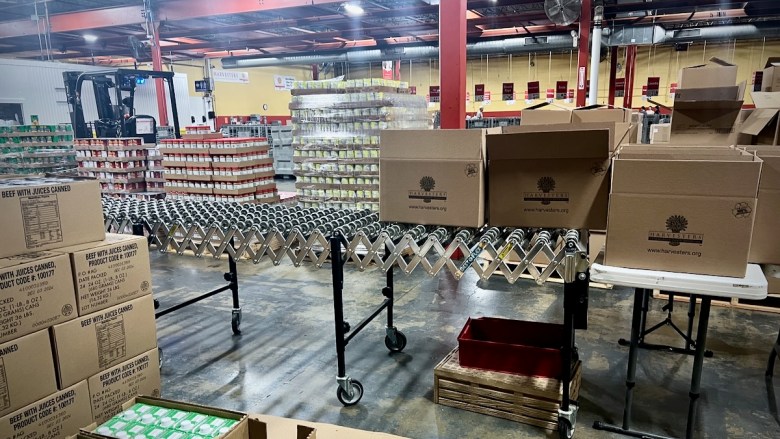
In the weeks since President Donald Trump took the country to war against Iran, Harvesters — The Community Food Network has seen a 33% jump in what it is paying for freight transportation.
Rising gas and oil prices, triggered by supply disruptions in the Middle East, have driven the shipping cost for a food delivery from Arizona, for example, from $3,500 a few weeks ago to $5,000 today. The freight on a shipment of eggs coming from southwest Missouri has nearly doubled to as much as $1,500.
Meanwhile, the spiking price of diesel — averaging $5.268 a gallon in Missouri on May 12 — has made filling up the food bank’s own fleet of trucks, used for pickups and deliveries closer to home, substantially more expensive, too.
“At the end of the day, we’re kind of a trucking company when it comes down to it,” said Matt Hamer, the organization’s communications manager. “Most of what we do is just moving things around.”
The jump in transportation costs is the latest in a string of challenges Harvesters has been forced to confront since the Trump administration returned to office.
In addition to higher food costs, Harvesters has dealt with supply disruptions caused by trade tariffs, declining food donations and the elimination of federal commodity food programs that had distributed meat, eggs and other commodities to food banks around the country.
Harvesters estimates that 3 million pounds of food were lost last year due to supply disruptions, rising costs and the federal cuts, which began in March 2025 when deliveries of thousands of cases of milk, eggs, cheese, chicken and fruit — already loaded onto trucks — were abruptly canceled.
“None of us knew that any of these events would play out — and for sure not in the sequence that they have or as quickly as they have,” said Monic Houpe, the organization’s chief operating officer.
At the same time, the food pantries, shelters and meal programs that Harvesters distributes to are facing steadily growing demand as more people struggle to afford prices at the grocery store.
Food chain disruption
The price of fuel is felt across the food supply chain. And the effects could be long-lasting.
Farmers — facing not only higher fuel costs, but also inflated fertilizer prices — are planting less, diminishing the food supply. Rising fuel costs also affect farmers who rely on gas-powered equipment. And food manufacturers are producing less to reduce their costs.
Meanwhile, tariffs are pushing up costs too, making imported foods like citrus or tomatoes from outside the country and aluminum used to package canned goods all cost more.
“For that little can of ravioli, or whatever it is, you’re probably paying 2 cents more than you were previously paying,” said Lupe Aragonez, Harvesters’ national food sourcing manager.
The fuel inflation comes as food costs are already soaring and food insecurity continues to climb.
Based on its 2023 report, Feeding America estimates that more than 951,000 people in Missouri face food insecurity — 15% of the population. And 411,000 Kansans face food insecurity — 14% of the population.
The situation is likely to be worse by the time the organization releases its 2025 report this summer, Hamer said.
Changes to federal requirements in the Supplemental Nutrition Assistance Program, known as SNAP, are expected to force 2.7 million Americans to lose food assistance in coming years, which will put more pressure on Harvesters and other organizations that try to address food insecurity.
The federal law known as the One Big Beautiful Bill Act enacted work requirements for a broader swath of the population receiving SNAP. The administrative challenge of regularly submitting documentation to the state is expected to be a barrier for many people to getting and maintaining the benefits, even if they are working.
Since work requirements took effect Nov. 1, SNAP enrollment has already dropped.
According to the U.S. Department of Agriculture, 42.8 million people participated in SNAP in January 2025. By December, a month after work requirements took effect, 39.2 million were participating. And 38.5 million were participating in January 2026, a 1.7% drop from the previous year.
Closer to home, the numbers look far worse. From January 2025 to January 2026, Kansas saw a 7% drop in individuals participating, and Missouri saw a 5.5% drop.
In addition to new SNAP requirements, the version of the federal farm bill recently approved by the House could cause more people to fall off coverage if it passes the Senate, said Gina Plata-Nino, director of SNAP policy and advocacy with the Food Research & Action Center, a national nonprofit that studies policies affecting hunger. The bill would allow states to privatize benefit verification to outside call centers, which could risk accuracy, delay benefits and potentially lead to more people losing benefits, she said.
Food banks and other organizations working to help get food to people can’t make up for SNAP, she said.
“Every meal a food bank provides, SNAP provides nine,” Plata-Nino said. “Even though they are doing amazing work, they can’t do what SNAP is doing. They can’t make up for federal disinvestment.”
Here to help
In 2025, Harvesters distributed 60.3 million pounds of food, providing almost 53 million meals in its 27-county region, which stretches into eastern Kansas and western Missouri.
Houpe said that Harvesters is relying on philanthropic donations to make up for federal losses and higher prices. The organization has had to purchase more food than planned because of the supply challenges and growing demand.
“That’s how we’ve been able to absorb these costs,” she said. “People have rallied around. They understand what’s going on in the economy. They understand what’s going on in the political environment, and all of the uncertainty that exists today.”
In 2025, Harvesters reported private donations totaling $19 million, accounting for the bulk of its $26.8 million in revenue. Houpe expects that need for community support to continue as more people lose food aid and fuel costs continue to be felt as higher prices.
She wants people to know that anything they can donate — even one canned good — can make a difference.
“That is the power of the food bank,” Houpe said. “We’re able to bring all those donations together, small and big, and help make an impact in the community. … All donations, big and small, whether they’re funds or food, make a difference.”
The organization also wants people to know that if they don’t have enough to eat, they should go to a food pantry or meal program and ask for help.
“Just because we’re having a hard time meeting the challenges doesn’t mean you should feel bad using our services,” Hamer said. “If you need help, come get help.”