


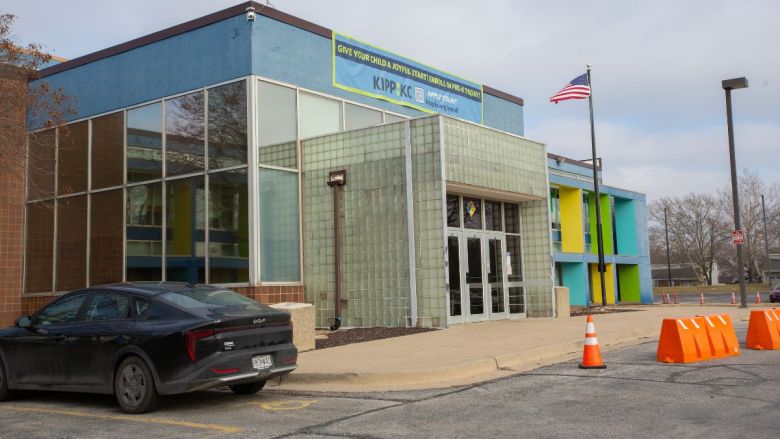
KIPP Kansas City’s charter school sponsor said in its latest annual report that the school overall “does not meet” performance standards.
Takeaways
- KIPP Kansas City received an overall rating of “does not meet” in its annual report.
- The charter school was still invited to apply to renew its permission to operate, but that doesn’t guarantee the application will be successful.
- During school board meetings, KIPP KC officials have reported financial struggles and declining enrollment.
But the sponsor — the Missouri Charter Public School Commission — invited KIPP KC to apply to renew the five-year charter that gives it permission to operate. The current charter expires in mid-2027.
“An invitation to renew is not a renewal decision,” the commission’s Deputy Director Martha McGeehon said. “It is simply an invitation to continue through the process.”
The commission will decide whether to renew KIPP KC’s contract in the fall or early winter of this year, McGeehon said.
KIPP KC now has a chance to convince the commission to support it staying open despite recent challenges and shortcomings documented in its annual report.
A Beacon investigation published in January found KIPP KC has had low state performance scores, high turnover among leaders and other educators and dropping enrollment.
But McGeehon said the commission takes a comprehensive view when determining whether a school should stay open, looking not only at its scores but at whether there are signs it’s on a path to improvement.
“There isn’t a formula or a black and white A plus B equals C when it comes to these decisions,” she said.
In KIPP KC’s case, the school has made changes to leadership and organizational structures “that have already yielded some positive impacts,” McGeehon said. “Because of that, we determined that at this stage we don’t have enough information to make a determination about whether we will renew them or not.”
KIPP KC and commission leaders have pointed to the hiring of Executive Director Dayna Sanders and the changes she’s made as positive signs.
But some current and former employees have attributed problems at the schools to Sanders’ leadership and publicly called on the board to remove her.
At its board meetings in February and April, KIPP KC officials presented data showing that enrollment has continued to decline throughout the school year. They also said a $1.1 million clawback from the state and unexpectedly high expenses for transportation, legal services and substitute teachers have contributed to financial stress.
McGeehon said that KIPP’s stable test scores amid turmoil could be a positive sign.
“Typically, when there is that much turnover and change and volatility, we would have seen (test scores) probably fall pretty dramatically,” she said. “Since that did not happen, we felt like there must have been some positive things that took place in the building.”
KIPP students are doing Missouri Assessment Program testing around this time of year, McGeehon said.
“We’ll have that data (by the) end of summer,” she said, “and that will be really telling to us, whether or not the changes that the board has made warrant a renewal or not.”
The Beacon reached out to KIPP KC in late March to ask if the school would like to comment on the annual report or if members of the board or administration would agree to speak about the report, updates from the February board meeting or the suspension of several staff members.
Spokesperson Saki Indakwa said in early April that the school was collecting information and later said KIPP KC would be able to share information after the April 27 board meeting.
A week after the board meeting, Indakwa said district officials were too busy with “end-of-year priorities” for interviews and encouraged The Beacon to examine updates from the board meeting.
KIPP Kansas City’s background
KIPP KC is an independent local branch of the national KIPP charter schools network. Founded in 2007, it has added grade levels over the years and now includes two schools in separate buildings: KIPP Legacy High School and KIPP Endeavor Academy.
Its enrollment peaked at more than 1,000 students last school year, which was also the first time it had a high school graduating class.
The Beacon reported in January that KIPP KC’s enrollment plunged by nearly 20% from last school year to this school year, during a timeframe when overall charter school enrollment in Kansas City dropped by less than 2%.
According to data KIPP KC reported to the state this school year, less than 40% of the employees KIPP reported last school year still worked there.
High school Principal Josh Swartzlander told the school board in a public meeting that leadership turnover was a particular problem, causing issues with daily operations. He is among those who have asked the board to remove Sanders.
Since the investigation was published, The Beacon has also continued to hear from current and recent former staff members about turnover and other problems at KIPP KC.
Emails shared with The Beacon in mid-March show Swartzlander, listed as KIPP KC’s longest-serving educator in data reported to the state, will be “out of the office until further notice” after a controversy over students attending a St. Patrick’s Day parade.
In an email, Indakwa said the KIPP KC is “unable to comment on personnel matters. Any discussions related to employees are confidential, and we are committed to respecting the privacy of our staff.”
Despite staff complaints, KIPP KC’s board and administration touted Sanders’ arrival in mid-2024 as evidence of the school’s commitment to serious transformation after it received the lowest annual performance report (APR) scores in the state for the 2023-24 school year.
For the 2024-25 school year, the first year of data reflecting Sanders’ leadership, state performance scores rose 21 percentage points. The scores incorporate factors including test scores, graduation rates and whether the school submits required paperwork on time.
But the scores were still among the lowest in the state and KIPP KC’s academic performance prompted a “letter of concern” from the commission in early 2026 and the “does not meet” rating in its 2024-25 annual report, published in late March 2026.
Unlike traditional public schools, charter schools are not accredited by the state. So although KIPP falls below the 70% APR score threshold a school district would need for accreditation, it’s not designated as accredited or unaccredited based on its APR scores.
Instead, its sponsor evaluates it based on whether it meets the goals in its contract.
What’s in KIPP KC’s annual report
KIPP’s annual report from its sponsor covers the most recent complete school year, 2024-25. It uses the most updated performance data from the state and information from a school visit in fall 2024.
A letter introducing the report says it “is one item in the comprehensive body of evidence used in evaluating schools sponsored by the Commission.”
“KIPP: KC did not meet any of their academic contract goals,” the letter says.
But it adds: “While concern remains, the Commission does acknowledge that KIPP: KC is in turnaround and is making adjustments to help improve academic performance. … MCPSC recognizes that the board has already taken bold action with new leadership and
turnaround strategies.”
The report reflects the third year of KIPP’s five-year contract and the second year in a row that KIPP scored “does not meet.” The current 2025-26 school year is the fourth year of the contract.
“Does not meet” is the second-lowest of five levels, which range from “falls far below” to “exceeds.”
In most areas, such as operations, governance and learning environment, KIPP scored “meets,” the highest level for nonacademic measures. But the commission determined its financial performance only “partially meets” and its academic performance “does not meet” the standards outlined in its contract.
The report breaks down academic performance into four areas: state and federal accountability, student academic performance, student academic growth and school-specific goals.
KIPP KC received a score of “partially meets” for accountability and growth, “falls far below” for performance and “does not meet” for school-specific goals.
The report then goes into further detail about specific benchmarks for English, math and science, such as scoring within a certain range, matching or exceeding Kansas City Public Schools’ scores or decreasing the percentage of students with low scores.
The measures include academic achievement — how well students are performing — and growth, which measures how much they learn in a year no matter where they start.
Some of the goals are part of the commission’s standard framework for evaluating charter schools and some are specific to KIPP KC’s contract with the commission. McGeehon said schools set individual goals based on their mission or areas where they want to improve.
For nearly every academic item, KIPP scored “does not meet.” The comparisons to the local school district on English and math are low points: KIPP scored “falls far below.” A high point is growth in math: KIPP surpassed its goal and earned a rating of “exceeds.”
While KIPP generally scored well in nonacademic areas, it didn’t have enough unrestricted cash on hand and didn’t meet its goals for attendance and parent engagement.
A narrative section of the report based on a school visit reflects an earlier time period at KIPP KC.
For example, the report notes increased enrollment of more than 1,000 students as a positive sign that could help bolster the school’s finances. But The Beacon found that KIPP lost about 20% of its students from fall 2024 to fall 2025, according to preliminary state data.
In November 2025, KIPP KC and its sponsor agreed to modify its contract because its enrollment was not close enough to the number previously agreed upon.
Updates at KIPP KC board meetings show enrollment continued to decline from 845 in the state’s preliminary fall numbers to 818 in December, 759 in February and below 750 in April. The April enrollment number is more than 30% below KIPP’s original target for the year, 1,083.
During the February board meeting, Chief Financial Officer Sean Kerrigan also noted that KIPP’s net income for the year is now projected to be negative. He attributed the shortfall to higher than expected expenses in several categories:
- An additional $500,000 for transportation.
- An additional $300,000 for legal expenses.
- Higher substitute teacher costs to fill vacancies.
KIPP is also still affected by a state clawback of $1.1 million dollars, he said.
Kansas City charter schools had to pay back a combined $11.8 million to the state this year because of an update to how Kansas City Public Schools’ share of tax dollars was calculated. The calculations had used 2019-2020 data for several years but switched to using more recent data that reflects higher KCPS attendance.
If the clawback from the Missouri Department of Elementary and Secondary Education hadn’t happened, KIPP KC would be “$700,000 to the positive at this point,” Kerrigan said.
He said that knowing the impact of the clawbacks, the Missouri Charter Public School Commission had suspended the requirement to have 60 days cash on hand during this fiscal year. In February, KIPP KC expected to have only 46 days of cash on hand at the end of the year. By the April meeting, it expected to have 43 days of cash on hand by year end.
That number is calculated by dividing the district’s cash balance at the end of the year by its average daily expenses, according to KIPP KC’s slideshow presentations during the meetings.
The annual report on KIPP KC from the commission also notes unease after leaders were required to reapply for their jobs. That decision preceded extreme staff and leadership turnover, not only during the summer — the normal time for school employees to switch jobs — but during both the 2024-25 and current school years.
McGeehon said that although there’s a time lag between the reports and the present day, the commission takes more current information into account for its decisions.
“We are collecting data constantly about our schools. We are in conversations with our schools very regularly, and all of that data goes into our decision-making,” she said. “If we found out something about any of our schools today that caused us enough significant concern, we would take action on that information. We would not wait until the annual report was issued.”
What the annual report means for KIPP KC
The overall negative assessment on the report could jeopardize KIPP’s ability to renew its contract, which could lead to the school’s closure. But that’s not a foregone conclusion.
In recent years, other commission-sponsored charter schools with shaky performance have had varying outcomes.
Lee A. Tolbert Community Academy wasn’t invited to apply for renewal at all and will close after this school year, though another charter school will expand to take over its building.
The commission also declined to renew Genesis School’s contract, but the school will stay open after St. Louis University agreed to take over sponsorship.
During its March 27 meeting, the commission voted to renew Hogan Preparatory Academy’s contract for middle and high school despite it also receiving a “does not meet” rating for academics. Hogan’s elementary school will close, however, and the building will be taken over by another charter school.
McGeehon said there was a stark difference between Hogan’s elementary school and its middle and high schools. The latter had made “significant and drastic changes in leadership (and) instructional quality.”
KIPP’s contract goals will also become easier to meet next year, according to a contract amendment from August 2025.
For example, the original contract says KIPP was supposed to decrease the number of students scoring below basic in English language arts on the Missouri Assessment Program test by several percentage points each school year. That put its goal for the 2024-25 school year at no more than 25.1%.
This year, KIPP didn’t come close to that goal. More than half of students scored below basic.
The contract amendment still requires KIPP to improve by five percentage points each year. But it resets the starting points, using data from a year when its scores were worse.
The new goal for English language arts will be no more than 43.7% scoring below basic in 2026 and no more than 38.7% in 2027.
McGeehon said some schools were allowed to reset their baseline because of the COVID-19 pandemic.
“The things that we thought would be true for schools coming out of the pandemic were not true,” she said. “All of our schools slid pretty far, and it took them a lot longer to catch up… When those goals were written, they were written based on pre-pandemic numbers that just were unrealistic once the dust settled from the pandemic.”

