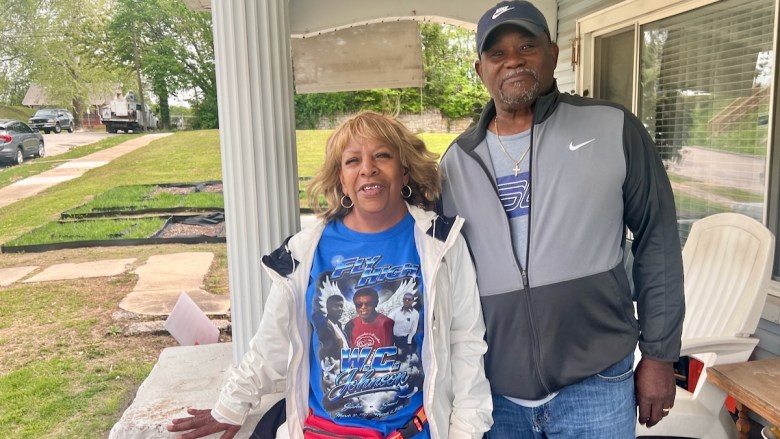
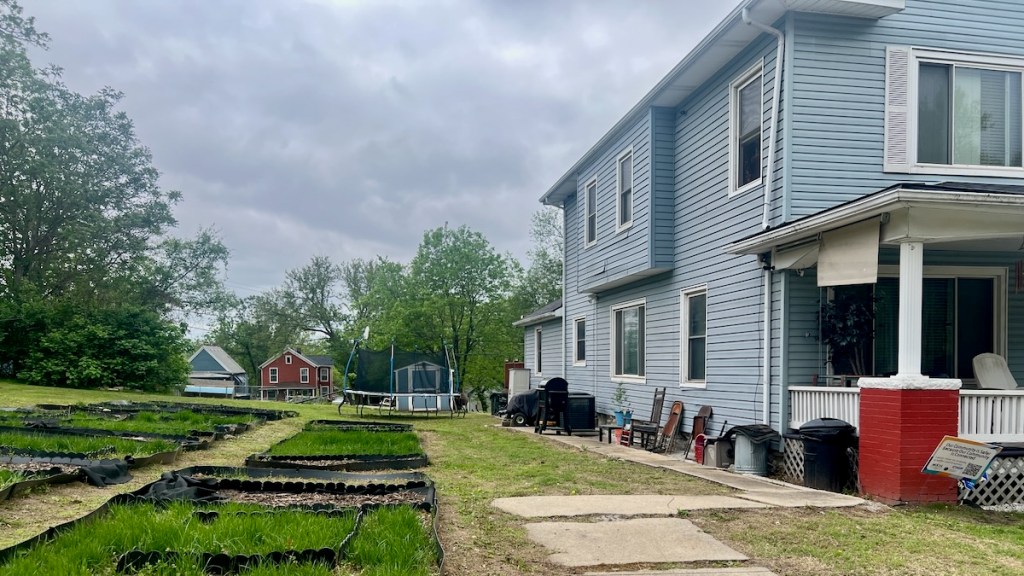
When people see the small rectangular plots cordoned off next to Vanessa and Kenneth Robinson’s house, they sometimes ask what they are growing.
Takeaways
- Lead, the most common contaminant in urban soil, lurks in two-thirds of Kansas City’s vacant lots. Kansas City, Kansas, also has high levels of lead in some urban neighborhoods.
- No amount of lead is safe for humans. It can cause serious and lasting health problems.
- Leaders on both sides of the state line are working to clean up contaminated urban lots owned by the cities.
But the sprouts of green aren’t a garden. They are a laboratory for testing and treating soil. Three years ago the Robinsons learned that the ground surrounding their northeast Kansas City, Kansas, home is riddled with lead.
The toxic metal could have seeped into the soil from the remains of burned-down houses buried beneath nearby vacant lots. It could have come from the shuttered gas station — now a liquor store — a few blocks away. Or perhaps the lead is the result of years of leaded gasoline spilling onto the ground or lead-based paint slowly chipping off houses.
Even if the reason isn’t clear, the consequences are. Without costly cleanup work, the Robinsons can’t let their grandchildren play in the yard when they come to visit. And they can’t have a garden.
“The dirt is contaminated,” Vanessa Robinson said, gazing out her dining room window where vegetables used to grow.
Throughout the Kansas City area, people living in older neighborhoods, often in the urban core, are waking up to the same reality. Toxins that once infused everyday life, like lead in paint and asbestos in building materials, remain in the soil, leading to health risks still lurking decades later.
“It’s a 50-year-old problem that’s essentially been kicked down the road,” said Kansas City Councilmember Melissa Patterson Hazley, who has been leading a push to test and treat vacant lots in some of Kansas City’s neighborhoods. “I don’t think anybody really wants to talk about it.… Once you start digging into it you realize how massive a problem it is.”
Lead-tinged dirt
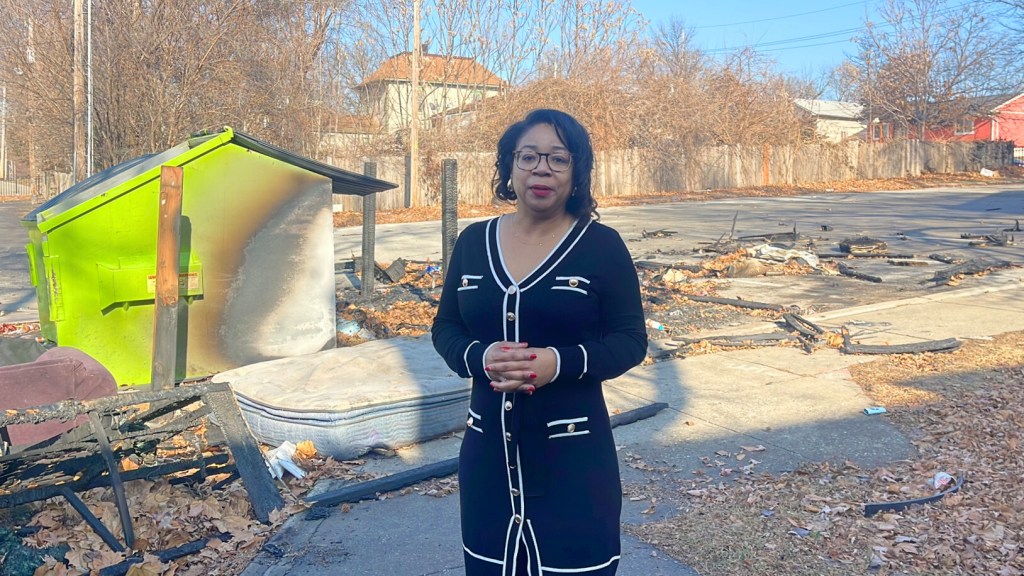
The Environmental Protection Agency estimates there could be 1 million parcels of land across the country contaminated to some degree with harmful substances. Those properties, known as “brownfields,” can be large-scale industrial sites or individual residential lots, many of which have high levels of lead contamination.
In Kansas City, 60% to 65% of vacant residential properties that have been tested exceed safe lead levels, according to Andrew Bracker, the city’s brownfield coordinator. That number varies widely across the city, with newer neighborhoods having contamination rates as low as 5% and some older neighborhoods showing lead contamination rates of more than 80%.
But any lead-tinged dirt that kids can potentially put in their mouths, or that can stick to vegetables grown in toxic soil, is a concern.
“Lead is toxic to every organ system in the body, so there’s no safe amount of exposure,” said Neal Wilson, a research associate with the Center for Economic Information at the University of Missouri-Kansas City. “These are well-established facts.”
Lead, the most common contaminant found in urban soil, can cause serious and permanent damage, and children and pregnant people are considered particularly vulnerable. Once ingested or inhaled, lead moves throughout the body, potentially causing harm.

Children who are exposed may have lower IQs and can suffer from attention impairment and behavioral issues, among other health concerns. And exposure in adults can lead to reproductive problems, memory issues, high blood pressure and joint pain.
While medical treatments and nutritional changes, like getting adequate calcium and iron, can help stem the harm, the body stores lead in bones and teeth for years after exposure, so the toxin is always lying in wait.
The Kansas City Health Department has made public awareness about the dangers of lead a priority. Since its Lead Safe KC program began in 1997, lead paint hazards have been removed from more than 2,200 homes, including 46 last year, the city said. The program, which received $6 million in federal funding in 2024, tested 669 children for lead exposure last year and provided case management for 536 children with elevated levels.
Still, only about a third of children who should be tested actually are. Although the city is making progress, Health Director Marvia Jones said, there is much more that needs to be done.
“I know there are a lot of folks who are still being exposed, and that gives me a lot of heartburn,” Jones said. “But I am heartened by the fact that people every day are having their situations improved by the work that we’re doing.”
The main message health experts share is that avoiding lead exposure in the first place is the safest way to prevent issues. But that can be a tall order.
Until relatively recently, lead was ubiquitous in daily life. Before 1978, lead was an ingredient in household paint. Water lines and solder containing lead were allowed in new construction until 1986. And lead in gasoline remained legal until 1996. So remnants of lead can be hard to avoid.
“The good news is that over the last 50 years, things have been trending in the right direction,” said Wilson, who studies lead exposure in children. “But that’s not consistent across all geographies.”
City lots can have patches of ground with high levels of lead — perhaps near a house where leaded paint once chipped off and accumulated in the ground. But unless people are testing, they won’t know it’s there.
Contaminated urban lots
In the Kansas City area, residential brownfields are easy to spot in Kansas City’s urban neighborhoods, where hundreds of vacant lots, many likely contaminated with lead, sit dormant.
The Robinsons’ house on Parallel Avenue sits next to two vacant lots held by the city land bank that are designated as brownfields. And the nearby Douglass-Sumner neighborhood of Kansas City, Kansas, has 220 vacant Land Bank parcels, 57 in need of cleanup.
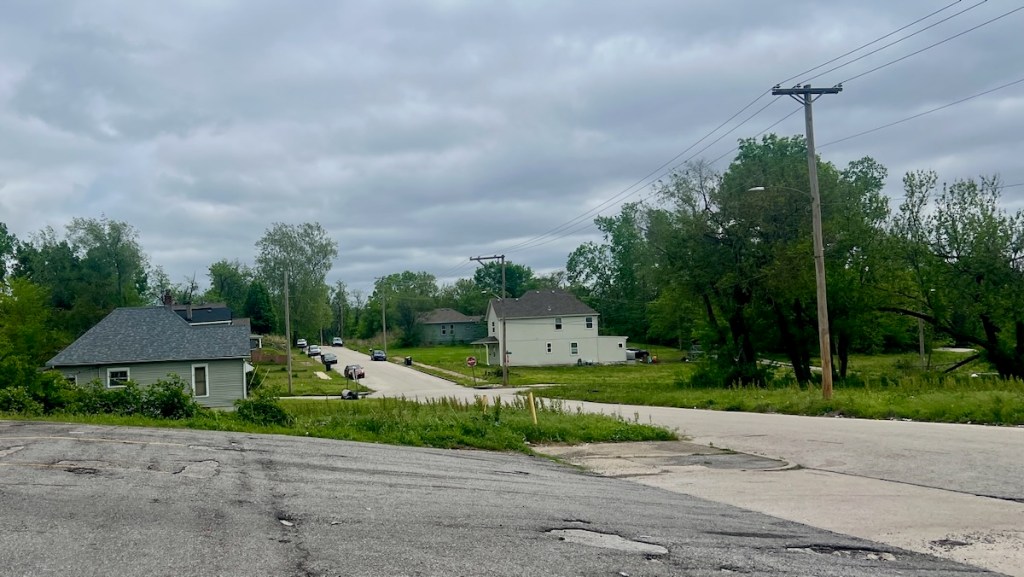
The Unified Government of Wyandotte County and Kansas City, Kansas, has applied for $3.7 million from the EPA to begin that work. And the city has already determined that 163 of 220 Land Bank properties were not contaminated.
Across the state line, in Kansas City’s 3rd City Council District, $6 million in federal funding is being used to clean up contamination in the Washington-Wheatley neighborhood, west of Interstate 70 between 18th and 27th streets.
Patterson Hazley, who represents that district, pushed for the funding to test properties and clean up as many as possible. That work is already underway on 79 lots. And the city is pursuing another $4 million in federal funding to clean up another 115 lots.
Patterson Hazley said she intends to keep going. She has her eye on 384 vacant lots in the Blue Valley neighborhood. If the lots, owned by the city’s Land Bank, can be tested and cleaned up before being sold to developers, they will have better prospects of being transformed into desperately needed housing, she said.
“We’ve already dealt with what’s in the ground,” Patterson Hazley said. “That’s more expensive. But I feel like it’s worth it. Can you just imagine what a neighborhood is going to look like when they have new houses and new multifamily buildings and all the huge empty lots are gone?”
A similar vision is unfolding in Kansas City, Kansas. Ultimately, spending resources to save the urban core will help Wyandotte County as a whole, said Warren Adams-Leavitt, director of resource development with Build WyCo, a nonprofit working to clean up and develop some of the city’s contaminated properties.
“Our interest is to rebuild the stability of the older neighborhoods by investing in both the community and in the households,” he said.
Jacob Wagner, a professor of urban planning at UMKC and a founder of the Center for Neighborhoods, has been watching the contaminated urban landscape grow in cities across the country for years. For the most part, there’s been only limited interest and few resources to fix it.
But he is hopeful that the economic arguments playing out in Kansas City around the growing demand for affordable housing could finally help move the needle on addressing the issue.
“What’s different is perhaps the city is seeing it now as an obstacle for real estate development,” Wagner said. “And they’re seeing it needs to be addressed.”
Very real health concerns
Bracker agreed that demand for housing could be driving a growing political will to address the problem of contaminated urban landscapes. The loan and grant programs his department oversees have seen more interest and requests for funds in recent years.
In addition to work in the Washington-Wheatley neighborhood, Kansas City’s investments in cleaning up brownfields include several smaller projects along with two large ones:
- $7.5 million from the brownfields loan program used for abatement work on the Historic Northeast Lofts, a development that will include affordable housing, social services and small businesses located on portions of the former Hardesty Federal Complex.
- And $2.5 million from the loan program, which is going toward demolition work at Parade Park Homes in the 18th and Vine district.
But Bracker said he thinks people are also waking up to the health risks of ignoring environmental contamination.
“I think it is both factors,” he said. “Health and money.”
But while federal funding for large-scale cleanup costs is often available, funding isn’t as easy to find for individual homeowners trying to clean up the lots they live on.
Robin Kundis Craig, an environmental lawyer and professor at the University of Kansas School of Law, said there is some funding when brownfield properties change hands, but that funding isn’t available to existing owners.
That leaves people who have lived in old houses for many years with a difficult dilemma, she said. That is whether to test their soil to learn if it is contaminated, which could be important for health reasons, or to remain ignorant.
“One of the peculiarities of the law is, you are often better off as a homeowner not to know and to be able to honestly say you don’t know,” Kundis Craig said.
Even if the cause of contamination is an old dry cleaning shop or shuttered gas station, the homeowner will likely be left with the responsibility of cleaning it up.
The Robinsons learned three years ago that their soil contained unacceptably high levels of lead after they dug some up and took it to a community event. Alyssa Marcy, who leads the Unified Government’s brownfields program, confirmed that their sample was the highest tested at that event.
“Because of those results,” Marcy said, “we planted a few dozen native plants on their property to help with lead absorption.”
And the lot next door, which the Robinsons own and which once held their garden, has been enrolled in a brownfields assessment study being conducted by scientists at Kansas State University.
A cheaper way to treat soil
Ganga M. Hettiarachchi, the Kansas State professor of soil and environmental chemistry leading the study, is looking at whether treating soil with phosphorus will make contaminants less likely to be absorbed in the body’s bloodstream.
Hettiarachchi has already done research across the state line, trying various types of phosphorus fertilizers to see which have the best success. Now, she is studying the Robinsons’ property and 10 land bank lots, set aside for the study at a March meeting of the Unified Government’s Neighborhood & Community Development Committee.
She is hoping her work will lead to less expensive ways to treat smaller, residential plots with lead contamination. Mixing phosphorus into soil would cost significantly less than traditional lead abatement, which involves taking out layers of soil and replacing it. And that could leave more resources for cleaning up the bigger contaminated sites.
“That could be really beneficial,” Hettiarachchi said.
And it may be the best answer for homeowners like the Robinsons who can’t afford the more expensive abatement process and so far have been unable to get government help with the cleanup.
It could also be the best hope for getting life back into their neighborhood, which used to have grocery stores, skating rinks and a sense of community.
“Now it’s just land,” said Vanessa Robinson, who serves as president of the neighborhood association.