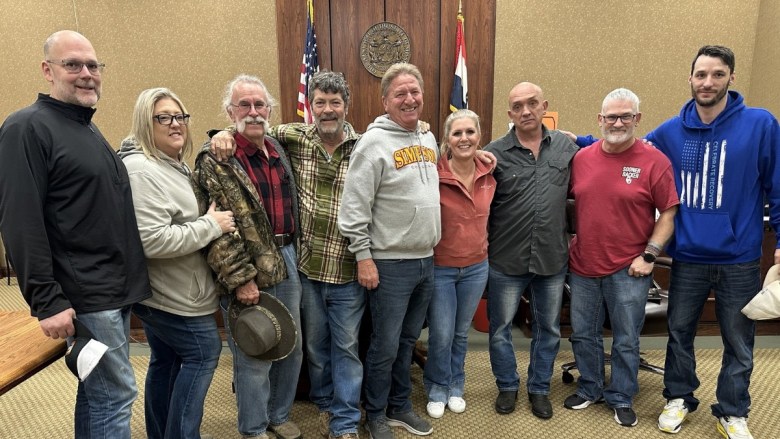
When men arrive at Jason Ponder’s sober-living home in Shell Knob, Missouri, they usually have nothing.
Takeaways
- Missouri is receiving nearly $900 million in opioid settlement funds over the next 15 years, but local spending varies widely.
- Research shows treatment and recovery services are the most effective ways to reduce overdose deaths, but access is limited in much of the state.
- Missouri has little oversight of how the funds are spent, leaving local governments to make big decisions about how to spend their millions.
Many sober-living homes require payment for some upfront costs — something Ponder said can prevent those who need help most from getting it.
Instead, when they arrive at Victory House, Ponder and his wife take them to Walmart to buy them everything they need — sometimes $500 worth of items — just to get going.
“I just buy it,” Ponder said. “I don’t think money should ever keep someone from experiencing recovery … But graduates come back to us and say, ‘Nobody’s ever trusted us from the start, not knowing us, and loved us like that.’”
He charges very little in rent, but the men living there must have jobs, savings accounts and work on centering God as they rebuild their lives.
“What I realized in my life, nobody ever told me, ‘Hey, there’s an amazing plan for you to do good work that God has prepared for you,’” said Ponder, who recovered from a yearslong addiction.
Victory House is expanding, thanks in part to a grant funded by Missouri’s nearly $900 million in opioid settlement funds. Ponder is planning to build a welding school on-site to help residents find stable, well-paying jobs.
“That was the first time we’ve reached out and asked for money,” Ponder said. “We were able to create a better environment and better program with more resources for these guys.”
For experts, Ponder’s approach is just one effective way to help reduce opioid deaths. Community, a safe place to live and a sense of purpose are all important aspects to getting sober, research shows.
Across Missouri, communities are taking different approaches with the tens of millions of dollars they’ve received since 2023 to address the opioid epidemic. Those approaches range from funding treatment and recovery programs to buying patrol vehicles or license plate readers.
Or, in some communities, not spending the money at all.
Addressing the opioid crisis in Missouri
The funds come from several lawsuits against pharmaceutical companies like Johnson & Johnson, Cardinal Health and McKesson and with the goal of abating the harms of the opioid crisis.
“We really want to see this money going back into communities that were most affected by the opioid crisis to abate those harms, reduce overdose rates, to support people getting to treatment and getting the sort of help that they need,” said Abigail Winiker, the program director of the Bloomberg Overdose Prevention Initiative at the Johns Hopkins Bloomberg School of Public Health.
In Missouri, the state spends 60% of the money, while the other 40% is split among cities and counties to spend on opioid-related programs and purchases. Local governments largely decide where to send it as it arrives over the next 15 years.
The good news as they make plans on how to spend the settlement? Opioid overdose deaths are trending down in Missouri, with 14.7 opioid overdose deaths per 100,000 people in 2024, compared to 25.63 in 2021.
But that means investing in prevention and treatment is essential to continue the positive trends, Winiker said.
“We’re still in the midst of the crisis,” Winiker said. “There are a huge proportion of people with opioid use disorder that are not able to access the treatment and recovery services they need.”
It’s something that the sheriff in northwest Missouri’s Andrew County took note of as the settlement came in. In 2025, the department spent its $40,000 allotment for treatment, hospital stays and medication for pregnant women in the county with opioid use disorder.
“There’s nothing in our area for that kind of treatment,” Andrew County Chief Deputy Sheriff Charlie Donahoo said. “The biggest problem we have is getting them into treatment. Knock on wood, but we’ve actually had a pretty good decline in (opioid-related) calls in the last eight or nine months.”
Donahoo credits the wide availability of naloxone for the drop in calls. But the women in Andrew County who struggle to get treatment are not alone.
The University of Washington Rural Health Research Center found that rural Medicaid enrollees with opioid use disorder had to travel an average of 70 miles to receive treatment, compared to their urban counterparts, who traveled an average of 32 miles.
Because of those challenges, counties across Missouri are doing their best to find the most effective ways to allocate the money in their communities.
Many funded repair projects to sober-living homes, similar to the grant Ponder received for Victory House. Others sent their money to treatment programs to help them hire peer support specialists who have experienced addiction and recovery to help others going through the process, while others reimbursed transportation costs to get people to treatment and made investments in medication alternatives.
In Polk County in southwest Missouri, Citizens Memorial Hospital is using $265,000 to cover medicine that can be used as alternatives to opioids after surgeries, a class of drugs that are not covered by public insurance in Missouri.
Missouri’s lack of oversight leaves counties alone to make big decisions
Although the funds are meant to be used for abating the opioid crisis and preventing opioid-related deaths, there’s little oversight over how municipalities spend them.
It echoes the use of tobacco settlement funds of the late 1990s, when states similarly received billions of dollars and promised to use them on reducing tobacco use. Those funds were used to research and develop plans for tobacco cessation, said Brandon Del Pozo, an assistant professor of medicine and health services at Brown University.
“Over the years, between legislation, regulation, prevention, the right types of treatment, smoking has gone way down,” said Del Pozo, a former New York City police officer who then ran the Burlington, Vermont, Police Department.
Despite that, a 2016 report gave 40 states and Washington, D.C., failing grades for spending less than 50% of what the Centers for Disease Control and Prevention recommends on tobacco cessation best practices.
Smoking rates “didn’t go down because a bunch of town-level departments decided they were going to do their own thing as best as they could,” Del Pozo said.
But for many municipalities who may have few resources, or where larger programs were funded by the state’s share of the money, it can be difficult to know where to spend it.
For example, in 2025, Missouri State Auditor Scott Fitzpatrick took a closer look at how Kirkwood spent its funds after it became public the city purchased a $30,000 snowplow with the money.
“It’s hard for me to imagine a very good explanation for how the snowplow falls into any of the allowable categories of spending that money,” Fitzpatrick told First Alert 4 at the time.
He recommended the General Assembly consider legislation during the 2026 session to increase oversight over how the funds are spent. Currently, the only oversight on the books in Missouri is a 2023 law that orders local governments to spend it on costs related to opioid use disorder treatment and prevention. The state has no process for holding local governments accountable on their spending, and no agency is dedicated to enforcing the law.
It’s something that harm reduction experts predicted as talk of billions in settlement funds began to materialize, said Jose Martinez, the capacity building and hepatitis C coordinator at the National Harm Reduction Coalition.
“It was a big concern for us,” Martinez said. “Are we going to know the money is going to get to where it’s supposed to be?”
Missouri has higher reporting requirements on the funds than other states, Winiker said. Some don’t require counties to report their spending at all, while others have stricter guidelines over how it’s spent.
Counties aren’t required to spend their money every year. More than 50 cities and counties across Missouri spent nothing from their settlement bucket in 2025. That includes Jackson County, which left nearly $4 million unspent, after investing its funds from 2023 and 2024 into a partnership with University Health for a new mental health treatment facility.
In Callaway County, commissioners haven’t fully decided how to spend the money.
Commissioners are planning to set aside some of the funds to help reopen the position that runs family drug court in the county. Previously, Callaway County had been part of a five-year grant to fund the position and saw noticeable improvements. After the grant ended, the county was forced to eliminate the role.
Still, the commissioners don’t have clear paths for how the rest of the money will be spent, and are planning to gather stakeholders to brainstorm.
“I think we need to go back to that table again and bring some of those people in,” said Curt Warfield, the eastern district commissioner in Callaway County. “Because it’s been a while, and it’s easy to get sidetracked.”
Large chunk of Missouri opioid settlement spending goes toward law enforcement
Commissioners in Callaway County have also considered finding ways to get treatment into jails, where many people are incarcerated because of mental health or substance use problems.
“Some of those people could maybe start getting some help while they are there,” Warfield said. “Unfortunately, our jail system gets used as a mental health facility and drug facility.”
Data shows that people who need and receive treatment for opioid use disorder in jail have better outcomes than those who need treatment and don’t receive it.
Studies show that people who receive treatment in jail were linked with a 52% lower risk of fatal opioid overdose.
Law enforcement officials are often responding to calls about substance use disorder, and thinking creatively about how to leverage those interactions is an important factor for departments.
“The definition of addiction is when the behavior becomes health-threatening and socially problematic,” Del Pozo said.
“Police are going to be called to a lot of those (incidents),” Del Pozo said. “So how do you make the right public safety investments to handle that? If you use those police encounters to protect health and improve outcomes, it helps public safety too. Fewer problematic behaviors equals more public safety, less crime.”
“If we get this right, I think it’s a win-win,” he said.
The National Settlement Tracking Project, a partnership between the Johns Hopkins Bloomberg School of Public Health and KFF, found that more than $61 million of the settlement funds were spent on law enforcement in 2024.
Still, much of the spending on law enforcement in Missouri is what Del Pozo and Winiker consider misaligned with the goal of reducing overdose deaths.
In Dent County in southeast Missouri, commissioners allocated more than $110,000 to purchase a Flock license plate reader system for the sheriff’s office, which they said would be used for drug-related investigations in the county. The county also invested in recovery programs and medical equipment.
“License plate readers have an important role in public safety for solving certain types of crimes,” Del Pozo said. “But it is so rare in my experience that license plate readers have had any meaningful role in a narcotics investigation.”
The Dent County Commission and sheriff’s office did not respond to additional requests for comment.
Across the state, other counties used funds for narcotics scanners, body scanners, jail equipment and patrol vehicles, while fewer directed funding toward treatment.
In other cases, counties spent money on programs like D.A.R.E., which research has shown has little effect on reducing drug use.
Across Missouri, counties reported spending about $200,000 on D.A.R.E. programs in 2025, including Shelby County in the northeast, which spent more than $20,000 on the purchase of a new vehicle and a wrap to go with it.
“It’s just an unfortunate misconception that (D.A.R.E.) is an effective program,” Winiker said. “This does not align with evidence, then also, you can’t really make the case that spending on an ineffective strategy is going to save lives.”
Taken together, the spending reflects trends nationwide: Local governments are being asked to spend millions to address a public health crisis, but have little guidance on the best ways to do so.
But for Ponder, who sees the crisis every day, the answer is simple.
“The moment the guys realize that they have value and that you actually care for them as a person, it’s going to change the trajectory of their recovery,” he said.
As the state continues to spend hundreds of millions in opioid settlement funds, how communities continue to spend the money could determine whether more Missourians get that chance.