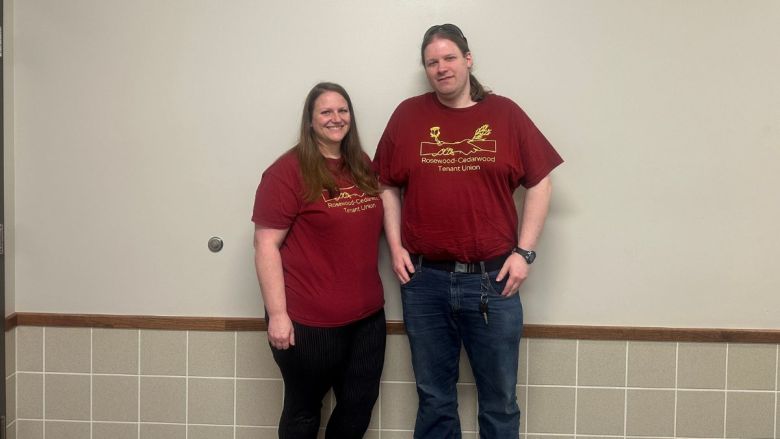
Bradley Breier had just settled in Cedarwood Terrace, an affordable housing complex in Springfield, when the notice arrived that all of the tenants were being evicted from their apartments.
Takeaways
- Renters across Missouri are forming tenants unions to push back on rising costs, unlivable conditions and threats of non-renewals on their leases.
- Missouri has 27 affordable homes for every 100 extremely low-income households, leaving many with few options if they are forced to move.
- Tenants say collective action through a union gives them leverage, but many face pushback in the face of union organizing.
The owners planned to exit a federal low-income housing program at Cedarwood Terrace, and to convert another property they controlled, Rosewood Estates, into luxury senior living.
After living with his aunt, Breier moved into Cedarwood with his parents in March 2024. But he was only there for a month when residents found out about the property owners’ plans.
Breier, now a leader with Springfield Tenants Union, said residents began talking about the future and trying to find new places to live, but there were few options that met people’s accessibility needs and budget.
“Everybody was in a similar situation,” Breier said outside a courtroom in the Greene County Courthouse. “We were going to be homeless, a lot of people, I’ll tell you that.”
Organizers from the Springfield Tenants Union gathered at Cedarwood Terrace and Rosewood Estates, where residents found themselves in the same situation. After chatting with residents, they quickly formed a tenants union.
They filed a class-action lawsuit arguing the former and current owners illegally opted out of the low-income housing program years before 2032, when the program was initially set to expire.
Now, as the case moves through the courts, Breier and other Rosewood and Cedarwood tenants union members see collective action as the only path forward for staying in their homes. Without a win in the courts, over 60 residents of the two properties will need to find new places to live by August.
“They don’t listen to us. It’s like they have one vision for one thing, and it’s not us,” Breier said of the former and current property owners, including Zimmerman Properties and some of its subsidiaries, Bryan Properties, GPS Property Management and the Missouri Housing Development Commission, whose lawyers denied a request to comment on pending litigation.
“It doesn’t include us, or what we’re struggling with,” Breier said.
For Breier and his neighbors, organizing was the last resort. But across Missouri, more renters are turning to unions as housing becomes harder to find and afford.
Missouri has 27 affordable and available rental homes for every 100 extremely low-income renters, leaving a shortage of nearly 130,000 rental units across the state, data from the National Low Income Housing Coalition found.
Missouri’s affordable housing strain
The organizing at Rosewood and Cedarwood wouldn’t have happened without Springfield Tenants Unite, which launched in 2020 as a response to housing difficulties people ran into during COVID-19.
One of the founding members was Vee Sanchez, now an affordable housing policy manager at Empower Missouri, which is building a statewide guidebook for tenants organizing. At the time, she was working at a restaurant and struggling to make ends meet amid the pandemic.
“A lot of people were losing their jobs. I was one of those people, our whole staff got laid off, and rent was still due,” Sanchez said. “I had never been involved in local politics prior to that … But I knew that I was coming up against some really hard times, and I started talking to my co-workers and neighbors, and I knew they were in the same boat.”
Stagnant wage growth, housing availability and rising prices can make it difficult to find affordable places to live in Missouri. Across the state, a full-time worker needs to make $21.61 an hour to afford the average fair market rent for a two-bedroom rental home in Missouri, data from the National Low Income Housing Coalition found.
For Emily Hester, who is a leader in Cedarwood and Rosewood and a single mother of five, it was essential that she get involved in the union. She’s thankful for the last two years that the union has spent fighting the eviction.
“These last two years have definitely been hard,” Hester said. “I have dealt with depression myself with the whole situation, just because looking for another house within those first couple of months, I was endlessly scrolling looking for something that was big enough. Everything was $400 to $500 more than what I was paying then. Two years later, it’s like $1,000 more just to be big enough for my family.”
“This is all over the city, it’s all over the nation,” Hester said. “Affordable housing has gone to crap all over the nation.”
Missouri follows national trends when it comes to housing availability and pricing. Nationwide from 2001 to 2024, renter incomes rose by 9% while rents rose by 30%, data from the Harvard University Joint Center for Housing Studies found.
Across the country, rents are rising on lower-cost units while the inventory of higher-priced apartments rises, the Harvard research found.
Nearly 75% of independent landlords reported rising property ownership costs in 2025. But they also reported tenants staying in place longer, with tenants staying in place at five times the rate they are finding new places to rent.
“Our housing is everything,” Sanchez said. “So much of everything in our lives is really rooted in the stability of our housing. I think a lot of people do want to be able to have that type of security and find ways to really have a voice in that, but it can be really hard unless you’ve built this bigger collective voice.”
The drive to organize is spreading to other Missouri cities including Columbia, where renters launched a tenants union in 2025. Jack Dobbs, a founding member of the Columbia Tenants Union and recent MU graduate, initially looked to organize around the lack of leases available for students during the summer months.
He connected with Empower Missouri and organizers in the Springfield Tenants Union, who made trips to Columbia to train members how to canvass, how to have conversations about housing and handling contentious landlord relationships.
But after connecting with residents living in a handful of mobile home communities owned by the same company, Dobbs and the Columbia tenants began organizing among residents living in properties owned by Regal Communities.
Tenants there are pushing back against what they call excessive fees, nonrenewal threats and intimidation against organizing from Regal’s property manager.
“We’re trying to really get the first couple of wins here for these properties,” Dobbs said. “Hopefully we can inspire more movements to continue.”
In smaller towns the lack of affordable housing can hit communities hard. Empower’s organizers in Cape Girardeau are looking to reignite a tenants union organizing effort that struggled to make it off the ground years ago.
As the area sees population growth, more workers have moved to town, but housing supply hasn’t kept up with demand.
People will then start looking in communities near Cape Girardeau or in Illinois, said Erica Robbins, Empower’s affordable housing policy manager in Cape Girardeau.
“They come to Cape Girardeau and we get that inundation as well, which really does create a demand for rent,” Robbins said. “We don’t have enough units.”
Nearby in Perry County, the economic development authority conducted an analysis of the housing gap and found that 250 new homes will be needed in the next five years, and only nine were for sale at the time.
Organizers envision eviction protection measures for the future
Down the line, Dobbs and Columbia Tenants want to see policies passed that make it easier to be a renter in Columbia, such as a right to counsel.
“Every week, you can go to tenant court and see someone who is there and has to represent themselves against a corporate attorney,” ??WHO?? said.
In a typical year, landlords file 3.6 million eviction cases nationwide. In Missouri over the past 12 months, 6% of renter households had an eviction filed against them, according to data from Princeton University’s Eviction Lab.
In Jackson County, Eviction Lab data found that 22.3% of all eviction filings came from the largest 100 properties across the county.
In states like Missouri which have few renter protections, that imbalance can be especially stark, said Bridgett Simmons, a staff attorney at the National Housing Law Project.
“Tenants unions are a really powerful tool for readjusting the imbalance we see in the rental market,” Simmons said.
Very few states have explicit protections for renters written into law, although 21 states (not including Missouri) have passed legislation making it illegal to retaliate against residents for being part of a tenants union.
Data shows that evictions can have an outsized impact on someone’s health. One study of adults on Medicaid in New York found that evicted residents were more likely to lose their insurance and to fill fewer prescriptions.
A 2015 study followed low-income urban mothers in the U.S. and found that those who experienced eviction were significantly more likely to report poor health over the past year for themselves and their children, compared to those who hadn’t experienced eviction.
The study also found that evicted mothers were more likely to report depressive symptoms, while other research found that mothers evicted during pregnancy had significantly higher likelihood of preterm birth and low birthweight than mothers who went through an eviction outside of pregnancy.
That stress and confusion are familiar for the Rosewood and Cedarwood tenants who have been in limbo for two years about the future of their housing. For now, union members are hoping their collective effort will be enough to keep them in their homes in the years to come.
“When we first started this thing, it was almost like going from absolute hopelessness to ‘I have a chance to stay. We have a chance at having safe, affordable housing and staying here,’” Breier said. “I have people here that have my back, I have their back. They have my best interest at heart, and I have their best interest at heart. For me, it’s expanded from Rosewood Cedarwood Tenants Union.”
“There’s so much good that came out of this, way more than what I ever would have thought for such a bad circumstance,” he said.