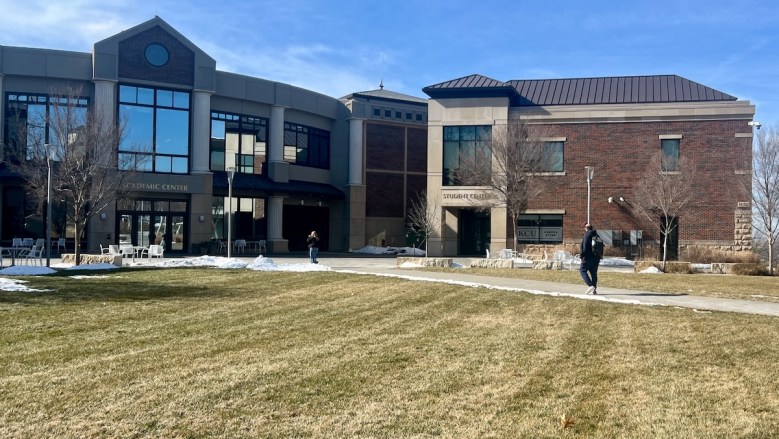
Dr. Marc Hahn, president of Kansas City University, expects to welcome 430 new medical students next fall. But he doesn’t know how many can afford to stay.
Changes to federal student loan regulations have raised concerns across the country about how medical students entering school in the coming academic year will be able to cover a medical degree’s daunting price tag.
“Will students get to the first day of classes and not know whether they’re going to be able to borrow the necessary funds to get through these professional programs?” Hahn said.
Takeaways
- Changes to the federal student loan program will limit how much students in medical school and other professional programs can borrow.
- Medical schools worry that the limitations will make it harder for students from less privileged backgrounds to attend medical school and exacerbate growing physician shortages.
- While private lenders are stepping up to fill the gap, private loans won’t be affordable for every student.
President Donald Trump’s One Big Beautiful Bill Act, signed into law last summer, included provisions to cap at $50,000 each year, or $200,000 over a lifetime, the amount of money students earning professional degrees can borrow through federal loan programs. The caps don’t affect students who are already enrolled.
In addition to medical degrees, the borrowing limit, which takes effect this summer, applies to degrees in dentistry and clinical psychology, which Kansas City University also offers. Degrees in pharmacy, veterinary medicine, chiropractic medicine, optometry, podiatry, theology and law also fall under the new cap, according to proposed rules published by the Department of Education. And the new rules place lower caps on other graduate programs, including nursing, and on undergraduate programs.
In addition to limiting borrowing, the law also eliminates Graduate PLUS loans, federal loans with no set annual limit that medical students have become increasingly reliant upon for things like rent and other living expenses.
Proponents of the loan changes say that limiting how much students can borrow will help cut the federal budget and ultimately force institutions to lower tuition, which they argue shouldn’t be allowed to climb year after year at a rate greater than inflation.
But opponents, including medical schools and professional physician organizations, warn about the unintended consequences of restricting the availability of federal loans. Limiting access, they fear, will worsen the country’s growing health care provider shortages and lead to a less diverse workforce.
“My biggest fear is that only kids from wealthier families will be able to go on to graduate and professional programs,” Hahn said. “We want kids from rural and diverse backgrounds to be physicians and dentists and psychologists because we know that positively impacts access to care for diverse groups.”
How much does medical school cost?
The cost of medical school has long been on an upward trajectory. According to a report by the Education Data Initiative, the average tuition and fees for medical school was just over $46,000 in the 2014 school year and climbed to almost $60,000 10 years later.
The report found that a 2025 medical school graduate paid on average $228,959 for their degree, including tuition and fees but excluding living expenses.
2025-26 Medical tuition and fees
| Medical school | In-state tuition and fees | Out of state |
|---|---|---|
| University of Missouri-Kansas City | $47,759 | $91,184 |
| University of Missouri-Columbia | $49,786 | $97,328 |
| University of Kansas | $43,264 | $75,942 |
| Kansas City University | N/A | $61,672 |
Source: School websites
While the cost of school varies substantially depending on the school and the student’s residency status, the cost is high enough that three out of every four medical students rely on federal loans to cover it. That amounts to $3 billion in federal loans annually going toward medical education.
But tuition isn’t the only factor. Medical students also have to afford a place to live and other expenses while they are in school.
Hahn said Kansas City University has worked to keep annual tuition increases at or below the rate of inflation. The school will charge $63,000 in the 2026-27 school year, less than many private institutions. But the university’s effort to control its own price tag doesn’t help with other rising costs students are facing.
“We can’t control whether a landlord in the River Market increases their rent by 5% or 6%,” Hahn said. “We can’t control that or the cost of gasoline. It’s all those costs that roll into what student debt looks like.”
A study by the Harvard Pilgrim Health Care Institute found that between 2008 and 2020, many medical students were borrowing more than the new loan caps will allow. According to the study, 40% of medical students borrowed more than $50,000 in a single year, while 14% had lifetime federal debt of more than $200,000.
Meanwhile, the study found that reliance on Graduate PLUS loans — the program being eliminated that has often helped students fill in gaps like living expenses — is going up. In 2008, 13% of medical students borrowed through the program. In 2020, 47% did.
Dr. Tarun Ramesh, a research fellow at the Pilgrim Health Care Institute and lead author of the study, said the research illustrates the importance of federal loans to many medical students and raises questions about what the coming changes will mean to the country’s medical workforce.
“Hopefully, we’re going to see decreases in medical school tuition,” Ramesh said. “But I fear that the real implication of this is that we’re going to see a shrinking physician workforce.”
Doctor shortages already exist
The pipeline of doctors entering the profession is already inadequate.
The Health Resources and Services Administration estimates that the United States will see a 113,000-physician shortage by 2028 — growing to more than 141,000 by 2038. According to the agency’s projections, Missouri will be able to meet only 91% of its physician needs by 2038, while Kansas will only be able to fill about 84% of its needs.
Certain parts of the country have more severe shortages, like rural communities and urban settings. But there are also shortages of certain medical specialties. Lower earning doctors, like primary care physicians, are among the most endangered.
A 2025 study found that almost two-thirds of doctors who train in internal medicine move on to higher-paying subspecialties rather than remaining in critical primary care jobs.
Dr. William Phillips, a clinical professor emeritus of family medicine at the University of Washington School of Medicine who authored the study, said future research will have to determine why so many new doctors ultimately choose not to remain in primary care. But, at least anecdotally, he said, money plays a part.
“We all meet medical students who have this idea that they will go to medical school because they want to be a general pediatrician in the town where they grew up,” Phillips said. “But they get into school and they’ve got $200,000 worth of loans, and they say, ‘I can’t afford to do that.’”
Restricting access to federal loan programs is unlikely to improve the situation, he said. And that’s especially true for students from disadvantaged backgrounds who may want to go back home to care for their community but find they can’t afford to if government loans are no longer adequate.
“If you curtail the loans, you’re going to curtail the number of American Native kids that are working as doctors in rural Montana, as an example, or working with farm workers in eastern Washington,” Phillips said. “That would be an unintended consequence that would be important to consider … If you want primary care and if you want rural medicine, capping the loans might have adverse effects.”
Looking to private lenders
Kristen Earle, student financial service director of the Association of American Medical Colleges, said in a written response to questions there’s little doubt that new federal loan rules will affect how many students can afford medical school.
“In a time of a significant projected physician shortage,” she said, “we should be making medical education more accessible, not less.”
Earle said the association is “deeply concerned” that changes will create financial barriers for students, and it is monitoring how the new law affects medical school enrollment.
“In a time of a significant projected physician shortage, we should be making medical education more accessible, not less.”
Kristen Earle, student financial service director of the Association of American Medical Colleges
For now, a spokesperson for the University of Missouri School of Medicine said, it is too early to know about how enrollment may change next year due to loan restrictions. He said incoming students are getting financial counseling to help them assess options for covering their costs.
“These caps have not been in place during an application period for the School of Medicine,” Christopher Ave, the spokesperson, wrote in an emailed response, “and we cannot predict how potential changes could alter the practices and priorities of the private lending market.”
Private lenders are stepping up. And medical schools are actively seeking their help. But even private lenders acknowledge that private loans can’t be the only answer.
“We believe private student loans are meant to complement, not replace, federal student loans,” Katarina Ellison, a spokesperson for the private lender Sallie Mae, said in an emailed response. “That’s why things like expanding Pell Grants and increasing access to scholarships should continue to be part of ongoing discussions.”
Ellison said there has been early interest in medical and dental loan options Sallie Mae is offering, but it’s too early to know the full impact of changes to federal loan programs.
At Kansas City University, administration officials have been actively meeting with private lenders in an effort to sell their students as a good credit risk, Hahn said. The school’s student loan default rate is less than 1% and its graduates are potentially high earners in the future, meaning they will have resources to make loan payments.
Hahn said private lenders have shown “significant interest,” even offering students with good credit interest rates of 5% to 6% — less than Graduate PLUS loans. But for students who don’t have good credit or parents with strong income to back up their loan, private lenders’ rates would be as high as 16%.
“Kids from disadvantaged backgrounds may be the ones that get squeezed out,” Hahn said. “And that’s a concern because we want our medical school and dental school and all of our programs to reflect the communities we serve, and we want to have a broad and inclusive student body.”
A greater reliance on private loans could also have unintended consequences for nonprofit organizations that also benefit indirectly from the use of federal student loans. New doctors can take jobs with rural hospitals or urban health centers and have federal loan debt forgiven in exchange.
Bob Theis, CEO of Samuel U. Rodgers Health Center in Kansas City, called the programs “so important” to his organization’s ability to hire enough doctors.
But it is unclear whether there will be similar incentives if new graduates enter the job market with private loan debt.
“We don’t know if there’ll be any type of program in which the government would help pay back private loans through this public service,” Hahn said.