


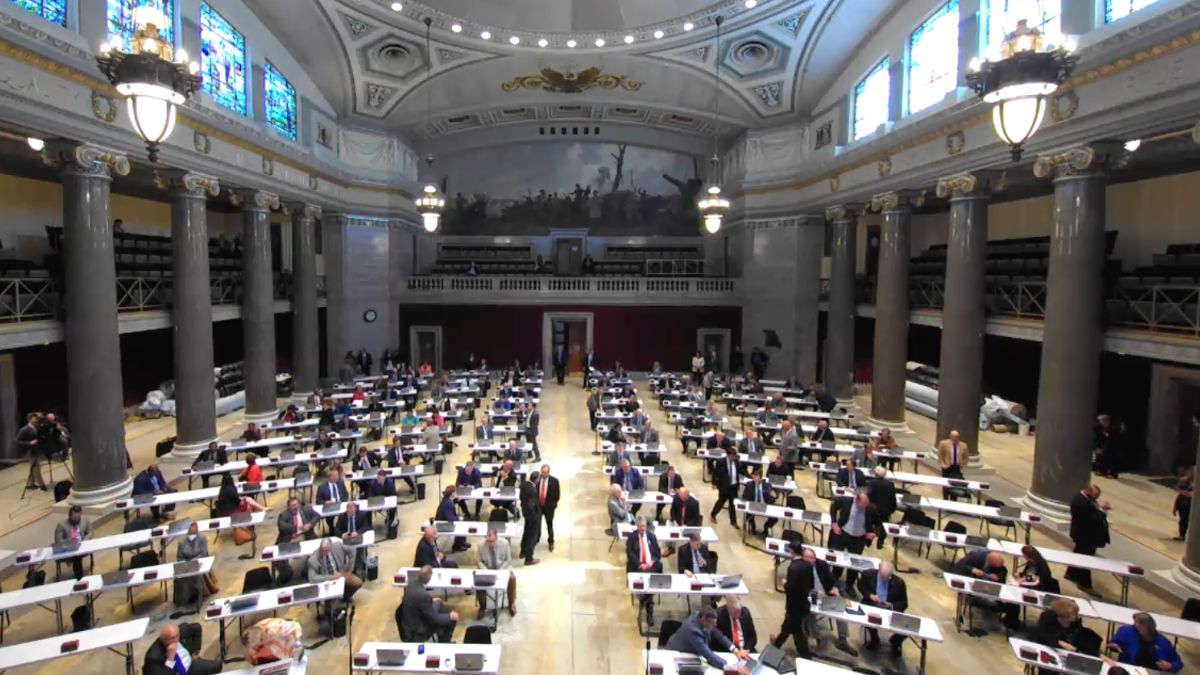
The Missouri House of Representatives approved its version of the over $50 billion state budget on Thursday, sending the package of bills to the Senate for further debate.
The budget tapped the remaining post-pandemic surplus to bridge a nearly $2 billion deficit and made changes or cuts to a number of programs as the state tightens its belt in preparation for reduced revenue next year.
Rep. Dirk Deaton, a Republican from Seneca and the chair of the House Budget Committee, said in a press conference he thought it was a responsible product. But, he acknowledged that tough decisions were made and more remain.
“The Senate will contend with that as they work through the process, and frankly, that’s something the General Assembly and state government will have to continue to navigate over the coming years as we wind down the surplus that began about six years ago and the influx of significant one-time federal dollars,” Deaton said.
Some of the biggest debates regarding cuts pertained to child care subsidies, K-12 education and higher education. Meanwhile, top Republican priorities were able to weather challenges.
Education, child care to see large changes
One of the biggest cuts came from the state’s child care subsidy program, which would see a $51.5 million reduction.
The cuts would eliminate the state’s “enhanced rate” subsidies that pay more than 100% of the market rate to help providers care for children with special needs and foster children. The language in the bill would also prohibit the state from paying based on enrollment, which Gov. Mike Kehoe championed in his campaign, and would revert to the current attendance-based system.
For public education, funding for the foundation formula remains the same as the current year’s budget and fulfills the constitutional obligation the assembly is required to meet. However, the formula would be $190 million short of being fully funded.
Higher education will also see changes. After years of discussion about creating a new formula to fund higher education institutions, the 2027 budget maintains the same level of funding but would put the funds into a pool and distribute it based on the number of full-time equivalent students.
Community colleges would receive roughly $3,650 per student and four-year universities would receive roughly $8,400.
Multiple amendments were introduced to tweak the proportion of funds that went into the general pool or to restore funding to align with Kehoe’s recommendation.
Representative Ed Lewis, a Republican from Moberly, offered an amendment that would only put 30% of total money into a general pot. He noted that without changes, the bill would result in a 53% reduction in state funding for Truman State University in Kirksville. Lewis withdrew his amendment after Deaton voiced opposition.
MOScholars, self directed support services hold onto funding
Among the few programs to come out unscathed or with increased funding were self-directed support services for those with disabilities and the MOScholars program for private school tuition vouchers.
Kehoe’s budget recommendations originally called for a steep reduction in funds for self-directed support services. The committee restored the funding in its version of the budget that was ultimately approved.
Legislators from both parties called it a rare bipartisan win, but cautioned that the Senate or the governor could still veto the funding.
Another Republican priority also survived the process. The MOScholars program would see an increase in funding, up to $60 million from the $50 million for the current fiscal year. That amount is still less than the $100 million that state Treasurer Vivek Malik requested.
Several amendments were introduced to strip the funding or use it for different programs, as Democrats decried the extra allocations while the foundation formula remained underfunded. All were defeated.
Rep. Betsy Fogle, a Democrat from Springfield and the ranking minority member on the budget committee, also said she was concerned about sending money to schools that can choose not to serve some students.
“I do think it’s incumbent on me and my caucus to continue our advocacy for our public school classrooms and continue to make sure that we don’t have our tax dollars going to schools that openly discriminate,” Fogle said during debate on Tuesday.
What’s next for the Missouri budget?
Those bills will now move forward to the Senate for further discussion, where other changes and restoration are possible.
Both Deaton and Fogle warned that the pain felt this session would likely continue for future budget years.
Deaton, who is term-limited in the House, said that while every item in the budget is important to someone, the assembly will need to find more ways to spend less money for future years.
“But it proves to be difficult,” Deaton said. “So, it’s going to take a lot of hard choices and discipline for the General Assembly, and it needs to proceed with caution.”
Fogle said that she is worried about the future of the state budget with the capital gains tax elimination, new federal Medicaid work requirements and a potential income tax elimination likely to impact the budget.
“Those cuts and that pain is only going to get worse in the next few fiscal years, especially if we consider and continue to have a conversation about the complete elimination of the income tax,” Fogle said. “In order to pay our bills as a state government, in order to fund all the services that members on both sides of the aisle have spoken in favor of, we have to have revenue to do it.”
