


💬 We asked readers to share questions they’d like us to ask the candidates. Their responses helped us select the questions for candidates this year.
Hickman Mills school board candidates are divided on whether the district has struck a good balance on taxes and school spending.
This April 7, voters will see five candidates on their ballots vying for three spots on the school board.
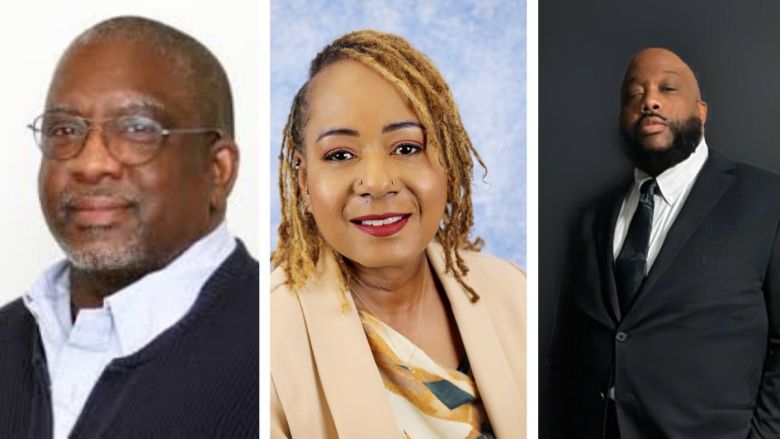
They include all three incumbents — Byron Townsend, April Cushing and Irene Kendrick — as well as two challengers, Evelyn Hildebrand and Matthew E. Williams.
Hickman Mills is a district of about 5,000 students covering 56 square miles, mostly in south Kansas City but also covering small parts of Grandview, Lee’s Summit and Raytown. It is provisionally accredited by the state.
We asked the candidates about their backgrounds, policy positions and priorities ahead of the election.
Hildebrand said she planned to respond to the questionnaire but had not completed it by the time of publication. She shared a press release about her candidacy with The Beacon. The other four candidates completed the questionnaire.
Their responses have been edited for clarity, grammar and AP style.
Click on a link to jump to a section of the questionnaire:
- School spending
- Immigration and Customs Enforcement in schools
- Teacher pay
- School choice
- Diversity, equity and inclusion
- The most important issues facing the district
- Managing a difficult time in Hickman Mills
Meet your Hickman Mills school board candidates
Byron Townsend (incumbent)
Occupation: Retired
Favorite school-related event: Any that my children participated in. Sports, music.
April Cushing (incumbent)
Occupation: Retired, president of Ruskin Hills HOA
Background and qualifications: I have a master’s degree and was on the board when Superintendent Dennis Carpenter was first hired.
Favorite school-related event: Theater performances of any kind.
For more information see: https://sites.google.com/view/voteaprilcushing/home
Irene Kendrick (incumbent)
Occupation: I am semi-retired. I currently serve as alderman for the city of Grandview Ward 2, and I substitute in the Grandview School District.
Background and qualifications: I have served on the Hickman Mills school board since 2020 including as president, vice president and co-president. I was elected to the Board of Aldermen of Grandview in 2023 and I am seeking reelection for both seats.
Favorite school-related event: The grand opening of the Real World Learning Center and our partnership with T&L Welding Academy.
For more information see: Facebook: https://www.facebook.com/irene.c.kendrick/
Evelyn Hildebrand
Hildebrand did not respond to the questionnaire by the time of publication, but she emailed The Beacon a news release about her candidacy. In the release, she said she was motivated to run by seeing the impact of past financial decisions on children. “While fiscal responsibility is essential, students should never bear the brunt of instability,” she wrote.
She said she wants Hickman Mills to become a place where educators are comfortable sending their own children and excellence is expected. She said she will prioritize transparency, strategic leadership and community engagement and is committed to “student advocacy, fiscal responsibility, and restoring hope within the district.”
Hildebrand is not a current board member but previously served on the board after she won a narrow victory, followed by a court battle over whether she could actually take her place on the board or was disqualified due to delinquent property taxes.
Ultimately, a judge ruled in her favor, she paid her taxes and the opponent who had initially taken her place resigned, allowing her to be sworn in as a board member.
Matthew Elisha Williams
Occupation: I’m an attorney with Stacee Cohn Law.
Background and qualifications: I’ve been a member of the community since I was adopted in 1982. Living near Ingels Elementary School, I graduated from Ruskin High School in 2000. My strongest skill as an attorney is negotiation, followed by simplifying and explaining complex topics.
Favorite school-related event: High school debate, forensics and mock trial. I am proud to be an alum of Ruskin’s program.
For more information see: Website https://bit.ly/TP4MWKC, Facebook: https://www.facebook.com/TP4MW/
Multiple-choice questions
School spending
In my district…
- We’re spending too little on schools, at the expense of students.
- We’re spending too much on schools, at the expense of taxpayers.
- We’ve struck a good balance on taxes and school spending.
Townsend: None of the above express my thoughts on this issue. I believe we are not spending enough on education, and the funding methods in Missouri (49th out of 50 states) are broken and inequitable.
Cushing: By trying to balance our budget, we are still optimizing students’ learning.
Kendrick: We had to eliminate the reading and math interventionist positions, which are essential to our children’s learning. These roles were instrumental in helping HMC-1 achieve the grade for accreditation, and it is unfortunate. Our children deserve better.
Hildebrand: Did not respond.
Williams: While I do believe there is not an overburden on taxpayers or students and their families, I do think the overall approach to money management and budget constraints needs to be overhauled into better long-term thinking.
Immigration enforcement in schools
If Immigration and Customs Enforcement (ICE) officials show up at a school, my district should…
- Cooperate as much as possible without getting into legal trouble.
- Cooperate as little as possible without getting into legal trouble.
- Other (please explain)
Townsend: Notify the building leader. There is a board policy for such circumstances.
Cushing: Cooperating as much as possible within our policies and procedures.
Kendrick: We as a board have to follow our policy, which is to protect our children, and ICE officers are now allowed on school property.
Hildebrand: Did not respond.
Williams: I am ethically obligated and will comply with legally required elements related to Immigration and Customs Enforcement. But acting in this capacity ALSO means protecting the rights of our students and staff. And I take that duty extremely seriously.
Teacher pay
Teachers in my district…
- Need a significant pay raise.
- Are paid too much already.
- Are making about the right amount.
- Other.
Townsend: Teachers in general are not paid enough. The teachers in our district are among the highest paid in the area.
Cushing: Our teachers’ compensation is taken seriously.
Kendrick: Although the old Hickman Mills was one of the highest-paying school districts for teachers considering the cost of living, budgetary concerns related to our district not receiving federal dollars could impact salaries.
Hildebrand: Did not respond.
Williams: Teachers have more consistent salaries now than in previous years, but more is needed. Teachers need better insurance and retirement benefits, a larger allowance for tax credits on supplies and more district level advocates at the capital.
School choice
Missouri lawmakers have proposed law changes to expand charter schools, allow students to switch school districts more easily and pay for more students to attend private schools. As a school board member, I would…
- Generally support these efforts.
- Support some, but not all, of these efforts.
- Generally oppose these efforts.
- Avoid advocating one way or another.
Townsend: These schools do not have a mandate to accept or keep any student that applies. They can accept (you one) year and decline you the next year. Charter schools enroll a student, receive the state funds, and they can keep the funds and return the student.
Cushing: The student’s funding should always follow the student no matter where they are.
Kendrick: I’m just not for charter schools or vouchers. These efforts could destroy a public school system.
Hildebrand: Did not respond.
Williams: I am against public funds going to private schools and their more lax education requirements. Private schools should cost private dollars. Otherwise, you should attend where you live. “Open enrollment” is a danger to the future of public schools.
Diversity, equity and inclusion
My school district….
- Overemphasizes diversity, equity, inclusion and belonging (DEIB).
- Underemphasizes diversity, equity, inclusion and belonging (DEIB).
- Puts about the right amount of emphasis on diversity, equity, inclusion and belonging (DEIB).
- Other
Townsend: Go to any district event (and) you will see all the students cheering each other. When you go into buildings you find a diversity of staff. If possible, every student should be able to see someone they see as themselves in a successful light.
Cushing: Every student should be welcomed and have a safe environment to learn.
Kendrick: Did not respond.
Hildebrand: Did not respond.
Williams: The current approach to DEIB is strong, but needs to include more community-level proactive decision making. That means messaging, communication, advocacy and outreach. How we approach student identities should expand.
Short answer
Name up to three specific things you would do on the board to address the most important issues facing the district.
Townsend: 1. The district will continue to apply for grants.
2. Look to the county to see if an agreement can be reached on sharing property tax revenue. Possibly sales tax as a last resort.
3. Keep in constant contact with all levels of government reminding them how tax incentives (for) development hurt school districts.
Cushing: I have been listening to staff and community concerning our deficit as well as accreditation. It has taken out-of-the-box thinking to come to a well-rounded solution.
Kendrick: Expand Real World Learning and career pathways, prioritizing highly certified teachers and reading and math interventionists and protect financial stability while investing in students.
Hildebrand: Did not respond.
Williams: 1. Fiscal restructuring: Make aggressive and difficult decisions now on a plan with long-term waypoints and metrics.
2. Development: Help the community believe in the district’s future health and prosperity by developing new leaders.
3. Negotiation: Have state level interactions with a different setup to our advocacy and negotiation teams.
The district is going through a difficult time, including a financial deficit, an audit from the state, school closure, cuts to staff and a lack of full accreditation. What are the most important things you can do as a board member to promote stability and support students?
Townsend: The board of directors has no administrative powers. The governor of Missouri wants to eliminate the accreditation system and go to a letter grading system (A, B, C, D, F). We should concentrate on increasing student achievement. The other listed issues should be handled with transparency, good or bad.
Cushing: Putting students first in our priorities to improve budget as well as academics. We are striving for sustainable improvements.
Kendrick: 1. We restore trust through financial transparency and strong oversight.
2. We protect classroom instruction and student supports. Students must remain the priority.
3. We implement a clear, measurable accreditation recovery plan with regular public updates and keep students at the center of every decision.
Hildebrand: Did not respond.
Williams: I’d start with hearing the concerns and problems that these issues are affecting and see what larger issue they are the symptoms of. Next, take aggressive actions to remedy them. And that means transparent, well-communicated, long-term solutions that feature outreach-based dialogue with the students and community by going to them directly.
