


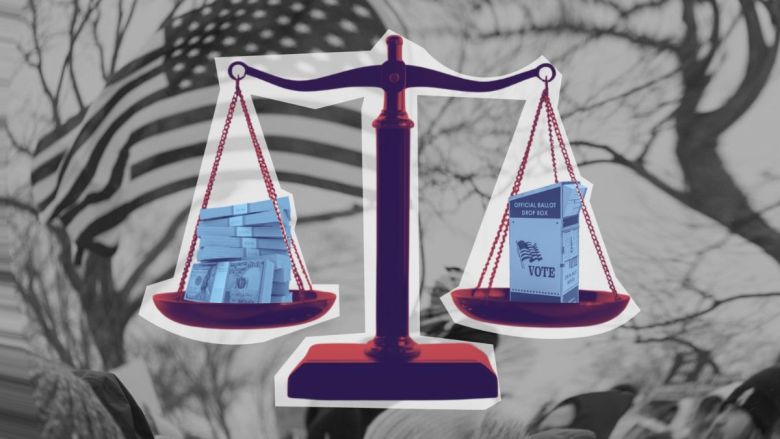
For decades, the influence of big money has been an unsolvable problem in politics.
Takeaways
- States like Missouri have been limited by decades of Supreme Court rulings when it comes to regulating campaign spending and big money in politics.
- American Promise, an advocacy group focused on campaign finance reform, is recruiting states to pass resolutions calling for a constitutional amendment to overturn those rulings.
- Missouri could be the 24th state to join that bipartisan coalition if the General Assembly approves a Republican-sponsored bill that has already received a committee hearing in both chambers.
Since 1976, federal courts have repeatedly struck down laws across the country attempting to restrict campaign spending, including foreign spending in elections and corporate spending on ballot measures.
Missourians have felt the consequences of those kinds of spending in elections statewide and at the local level.
When Jackson County asked voters to approve a sales tax subsidy for sports stadiums in 2024, the Royals and Chiefs dumped $3 million into the campaign — more than 250 times the $11,511 raised by the opposition.
And the 2024 Missouri amendment to legalize sports betting broke records as the most expensive ballot measure in the state’s history, with $46 million spent on the campaign. Among the biggest contributors were Boston-based DraftKings and New York-based FanDuel.
But if a campaign finance reform advocacy group dubbed American Promise gets its way, the era of mega-spending on political campaigns could come to an end by 2030.
Missouri could soon join a bipartisan coalition of states pressing for a constitutional amendment to overturn the Supreme Court decisions — culminating in Citizens United v. Federal Election Commission — that have made it difficult for states to regulate campaign spending.
No local or state remedies
As far as campaign finance reform advocates see it, the only way to get a handle on big money in politics is to pass an amendment to the U.S. Constitution.
That’s because a series of Supreme Court rulings has effectively fenced off the entire issue of campaign finance as something only federal judges and the Supreme Court can rule on.
“Right now, all campaign finance policy is essentially decided by unelected federal judges,” said Brian Boyle, the chief program officer and general counsel for advocacy group American Promise. “It’s been constitutionalized, and we’re trying to deconstitutionalize it.”
That legal issue dates back to a 1976 Supreme Court decision called Buckley v. Valeo in the years following the Watergate scandal.
“Congress made a determination on a cross-partisan basis that some guardrails were needed to protect the integrity of the electoral system,” Boyle said. “And the court stepped in and struck almost all of them down.”
The court ruled that the government cannot restrict what are called “independent expenditures” — or money that isn’t directly spent by a candidate.
“Most people think of it as a Citizens United thing, but it actually started in Buckley,” Boyle said. “If one multibillionaire wants to create a super PAC and spend billions of dollars in elections, the reason he can do that without any limit is because of what the court first said in Buckley, 50 years ago.”
The path to a constitutional amendment
Unless the Supreme Court decides to overturn that precedent, the only way to change that is to change the Constitution itself.
And it’s a high bar to approve a new constitutional amendment.
First, the amendment must pass both chambers of Congress by a two-thirds majority. Then, the amendment must be ratified by 38 states. The president cannot veto constitutional amendments.
That’s where American Promise comes in.
The organization is recruiting states to approve resolutions expressing support for a constitutional amendment to reverse Buckley v. Valeo and the 2010 Citizens United decision in which the Supreme Court ruled that corporations have a constitutional right to unlimited political spending.
The text of American Promise’s proposed For Our Freedom Amendment is below:
Section 1. We the People have compelling sovereign interests in the freedom of speech, representative self-government, federalism, the integrity of the electoral process, and the political equality of natural persons.
Section 2. Nothing in this Constitution shall be construed to forbid Congress or the States, within their respective jurisdictions, from reasonably regulating and limiting contributions and spending in campaigns, elections, or ballot measures.
Section 3. Congress and the States shall have the power to implement and enforce this article by appropriate legislation and may distinguish between natural persons and artificial entities, including by prohibiting artificial entities from raising and spending money in campaigns, elections, or ballot measures.
So far, 23 states have passed legislation that encourages members of Congress to pass a constitutional amendment and signals support for ratification. That includes blue states like Washington and California, as well as red states including West Virginia and Utah.
If Missouri passes a proposed resolution this year, it will become the 24th state on the list. Similar resolutions are proposed in 12 other states this year, which would bring the total to 37 — just one state shy of the 38-state ratification requirement.
A poll conducted by YouGov last year found that 63% of Americans — including a majority of Republicans — disagree with the 2010 Citizens United Supreme Court decision that said corporations have a right to spend unlimited money on political campaigns.
Three out of four Americans said that big money in politics makes them lose faith in democracy.
Boyle has focused this year on working with legislators in several states including Arizona, Indiana and Missouri. He recently saw a bill in the Arizona Senate unanimously recommended out of committee with support from four Republicans and three Democrats.
“Basically they were like, we can all agree that the current system is insane,” he said. “And it feels like we’re hearing more willingness to join. I mean, we had a hearing in Indiana where, in the hearing, people were raising their hand and saying, ‘I’d like to join as a co-sponsor,’ because it’s resonating with them.”
Missouri could pass a resolution this year
Both chambers of the Missouri General Assembly are considering resolutions this year to call on the Missouri congressional delegation to pass a constitutional amendment.
Those two resolutions are HCR 23, sponsored by Speaker Pro Tem Rep. Chad Perkins, a Republican from Bowling Green, and SCR 11, sponsored by Assistant Majority Floor Leader Sen. Curtis Trent, a Republican from Republic.
Both resolutions were heard by their respective committees this week, where they appeared to have mild bipartisan support. Neither committee held a vote on whether to move the bills forward.
Both Perkins and Trent emphasized the issue of federalism, arguing that the state of Missouri should have the power to regulate its own election laws, including campaign finance, instead of delegating that authority to federal judges.
“This is very consistent with the long-standing principles of federalism in this country,” Trent said during the Senate hearing, “and the way that our laws were set up for nearly 200 years, before federal courts began to intervene back in the 70s. And this will allow states to tailor their laws to the particular challenges of their state.”
Both Trent and Perkins declined repeated attempts to schedule an interview for this story.
But the Democrats in those committees seemed more suspicious of a resolution seeking the power to regulate elections.
“Since Citizens United, we have seen an explosion of money entering into politics,” said Rep. Eric Woods, a Democrat from Kansas City’s Northland and the ranking minority member of the elections committee. “With no appetite for federal regulation of campaign finance, I think it makes sense that something like this be returned to the states.”
But Woods, as well as Democrat Rep. David Tyson Smith from Columbia, wanted to know what specific regulations Perkins was interested in proposing.
Perkins responded that he was interested in restricting outside money being spent in Missouri elections — including out-of-state money but, more importantly, foreign money.
Democrats may be suspicious of any proposed resolution mentioning foreign money in elections because that argument has been used to undermine the approved Missouri amendment that legalized abortion in 2024. A conservative-leaning advocacy group alleges that a PAC used foreign money to donate $4.5 million to the abortion amendment campaign.
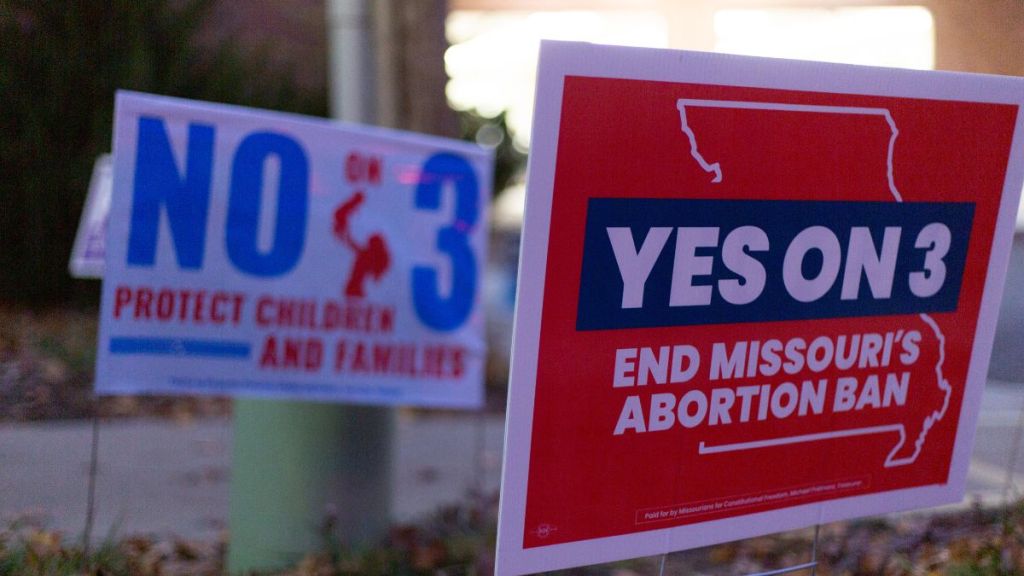
But on the other hand, Boyle said that foreign money from Quebec and Qatar has been involved in political campaigns over constructing a power transmission line through the forests of Maine.
“I can understand why people on either side of the aisle would maybe have their radar up for like, ‘What’s the angle here?’” Boyle said. “I would say the flip side is that both parties have also seen how outside money, whether it’s foreign or out-of-state, can just come in and really drown out the influence of constituents.”
He said the biggest benefit of returning the campaign finance issue to the states is that legislatures are much more able to experiment than federal judges. If a future campaign finance law ends up needing to be amended, state legislatures can simply vote to repeal and amend those laws.
He contrasted that against the current system, where campaign finance is cordoned off for the judiciary, making any lawmaking mistake an issue requiring a U.S. Constitution-level fix.
The bipartisan support for these resolutions across the country, he said, comes from a desire to return legislators’ focus to their constituents, rather than needing to spend time on fundraising and appealing to lobbyists.
“They look around and they see a handful of ZIP codes in the U.S. are responsible for the vast majority of money in the political system,” Boyle said. “It doesn’t necessarily seem like that’s serving the interests of their constituents, and instead can give rise to almost a hyper-nationalization of elections. And I think people might like the hyper-nationalized money when it benefits them, but they don’t like it when it doesn’t.”

