
A foster child at KVC Kansas’ residential program was trying to physically attack another child.
Takeaways
- Kansas lawmakers passed a bill that would increase incarceration limits for children.
- Lawmakers approved the bill saying something needed to be done because high-risk children are not being helped by the system.
- Opponents of the bill said this will only make things worse.
The 14-year-old attacker had two ankle monitors and was on probation for vehicle theft. One night while staying at the program, he ransacked the office and shut off all the lights. Foster children and agency staff barricaded themselves in a separate room and police were called — responding to the scene with guns drawn.
In another case, a child beat and hospitalized a security guard.
Both cases ended the same way. The children were arrested but couldn’t be detained because of state law. So both children were released back to the foster care agency.
Foster care agencies, judges and law enforcement are trying to close this gap in state law that sends high needs youth with criminal behaviors to foster care agencies instead of proper treatment programs.
“When folks talk about the decline of youth in incarceration, that is a positive thing,” Angela Hedrick, vice president of operations with KVC Kansas, told lawmakers in January. “But I also urge you to think about and understand where these youth are actually being served. They are coming to the foster care system.”
A bill recently passed in both houses of the Kansas Legislature:
- Increases detention limits for an entire case from 45 days to 90 days.
- Allows courts to put kids in juvenile detention if they had a gun when committing a felony, even if they didn’t use it. They could spend at least one year in jail and a maximum of two years.
- Reworks incarceration guidelines to allow moderate-risk kids to be imprisoned. Currently, only high-risk children can be incarcerated.
- Requires the state to get “non-foster home beds in youth residential facilities.” This would create group home placements for kids who need treatment.
- Transfer $10 million every year from a juvenile justice intervention fund to help create the group homes, though money to fund those homes would run out in a few years.
The bill passed with a veto-proof majority but will first head to a conference committee for the House and Senate to hash out amendments made to the bill. Once approved, it will head to the governor’s desk.
Only a few children are causing these problems. Supporters of the bill say 90% of children with criminal behaviors are being helped by the system, but it’s a small group of very high-risk kids who are slipping through the cracks.
These groups say relying too much on youth detention is bad, but these kids need alternative placement options. That’s why they’re pushing for legislative reform.
In summary, the bill allows Kansas to incarcerate more children for more reasons for longer times. That goes against research on how to best stop youth from breaking the law, said Malik Pickett, senior attorney at Juvenile Law Center.
Pickett said research shows that children’s brains are still developing until their mid-20s. Impulse control, emotional regulation, risk taking and weighing consequences just aren’t fully developed, which makes them more receptive to positive change, he said.
That’s why some states have shifted away from locking up kids who break the law.
“It’s kind of an antiquated way of thinking,” Pickett said.
The Kansas Department of Corrections and the Kansas Juvenile Justice Oversight Committee both opposed the bill, though some local jails supported the idea. The data on youth detention is conclusive and overwhelming: Arresting kids only leads to more crime in the future. It doesn’t matter how high-risk the child is.
A December 2020 study looked at 46,000 cases of kids who were incarcerated before trial. Incarceration brings a 33% increase in felony recidivism and an 11% increase in misdemeanor recidivism within one year. Recidivism rates increased 1% for each day the child was locked up.
Studies have found similar results for decades:
- A study of children in New York state found that 89% of boys and 81% of girls released from youth correctional facilities in the early 1990s were rearrested by age 28.
- A 2009 study of low-income boys in Montreal said that kids who were incarcerated were 38 times more likely to have a criminal record as an adult than kids with similar backgrounds.
- A 2011 report said that 70% to 80% of kids released from youth detention facilities were rearrested within a few years.
- And a 2015 study of Seattle kids found that children who stayed in a juvenile jail were four times as likely to be incarcerated as an adult when compared to peers who weren’t incarcerated.
In Kansas, juvenile recidivism rates were at 44% in 2015 before legislative reform. In 2020, youth recidivism rates were 23%, according to data from the state prison system.
Incarceration also hurts kids’ chances of graduating high school.
Three studies of Michigan, Illinois and Washington children found that incarceration decreased the odds of graduating high school by 13% to 31%.
Maximilian Mendoza, chairman of the Kansas Advisory Group on Juvenile Justice and Delinquency Prevention, said that he was incarcerated as a youth and that the time didn’t help him after release.
Mendoza never learned to articulate his emotions and manage conflict. He didn’t know how to set up a bank account or sign a lease. Mendoza had a few vocational certifications, but he lacked “all of these basic skills that we need as adults.”
“I was ripped from my community,” he said. “I did not have those community supports.”
Philip Lofflin, the president of the Kansas Juvenile Officers Association, also works as a police officer in schools.
Lofflin said the best way to help these kids is community programs, developing relationships and getting them help early before the problem grows. He supports the bill lawmakers passed and said there are some times when resources, community support and minor penalties just aren’t working.
“These serious cases are sometimes at a level where incarceration may be the only solution to keep the community safe at that time,” Lofflin said.
He said more kids are ending up with weapons, so something needs to be done. Lofflin likes that the bill isn’t just about incarceration — it requires the state to spend more money on congregate care beds.
But the congregate care treatment proposal is controversial. That very same treatment model — taking kids out of their communities and putting them in facilities — failed a decade ago, Mendoza said. That’s why all of them were closed down.
Robert Kinscherff, executive director at the Center for Law, Brain & Behavior at Massachusetts General Hospital, said congregate care facilities can work. Those facilities can have locked doors and remove people from the community temporarily, but they need to focus heavily on rehabilitative services.
A 2009 study of 361 cases found that therapeutic programs reduced recidivism by 12%. A 2014 study by the National Academy of Sciences said that incarceration can be necessary to protect public safety, but added that keeping kids incarcerated for too long is expensive and ineffective.
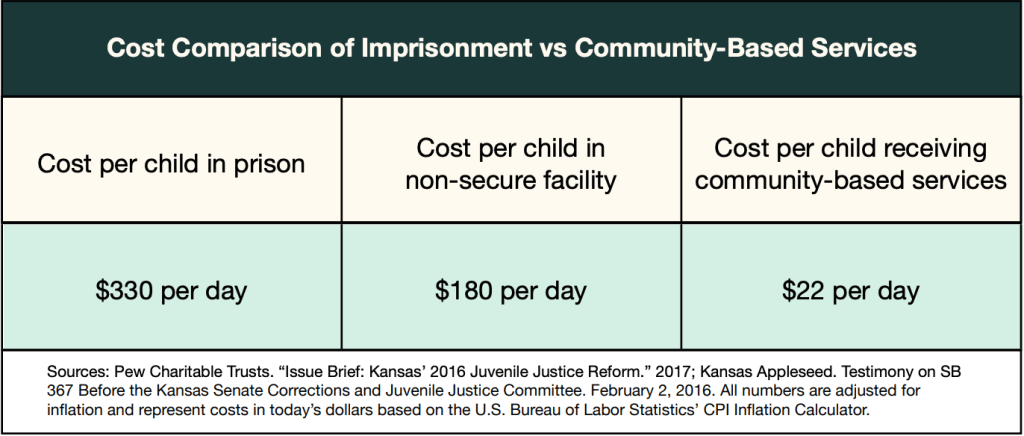
The more that facility looks and acts like a youth jail, the far less effective it will be, Kinscherff said. His advice to lawmakers is to design the juvenile justice system as if your own child would be living in these jails or congregate care centers.
“At the end of the day, these are kids and they’re somebody’s kids,” Kinscherff said. “Sometimes people think the way to deal with them is harshly. Except, I would remind the good folks of Kansas that the states who have the most punitive approaches … also have the highest recidivism rates and the highest violent recidivism rates.”
Correction: This story was updated to include information about the conference committee process.