



This story is part three of a series
At the December board meeting for KIPP Kansas City, a local charter school, KIPP Legacy Principal Josh Swartzlander said he was “stunned” not to have heard from the board about his public comments at a previous meeting.
Takeaways
- A letter, petition and public comments have called for the KIPP Kansas City board to take more action in addressing concerns about current leadership.
- A member said the board still has confidence in executive director Dayna Sanders but is taking feedback seriously.
- The board is creating more opportunities for communication with the public.
“How is it possible that after hearing from stakeholder after stakeholder, no one from this board reached out to a single person who spoke up?” he asked.
Swartzlander was part of a group of current and former employees who spoke during the board’s October meeting to raise concerns with leadership, employee turnover, operational problems and other issues at KIPP KC’s two schools, which together serve more than 800 students in grades pre-K-to-12.
He was one of several who directly asked the board to remove Executive Director Dayna Sanders.
As a charter school serving students within Kansas City Public Schools boundaries, KIPP isn’t controlled by the traditional, voter-selected KCPS school board. It also isn’t labeled as accredited or unaccredited by the state based on its performance scores.
But it does have a board of its own with similar responsibilities and a charter school sponsor tasked with holding it to the goals in its contract. It is part of a national network of KIPP schools.
Some current and former employees said they’ve tried to seek help through official channels — including by submitting internal grievances and contacting the organizations that have some level of oversight over KIPP KC — with few results.
The Beacon spoke with 12 current and former KIPP employees and one student, reviewed public comments from board meetings and was sent a letter and a petition calling for change. Some people asked to remain anonymous to protect their employment or because of potential litigation.
Two board members who spoke to The Beacon, Charles King and Christopher Perkins, said they encourage feedback but are confident that KIPP KC’s plan to improve itself, known as Reimagine, is starting to work.
KIPP KC’s Annual Performance Report score from the state, reflecting the 2023-24 school year before Sanders arrived, was 32.1%, lower than that of any other district or charter school in the state. In just a year, that score rose about 21 percentage points.
King said the board is discussing the public comments calling for Sanders’ removal but still trusts her. Sanders has experience leading transformation in a charter school network, managing a large staff and understanding strong academics, he said.
“Are we wavering in our confidence in the leader that we selected? The answer is no, the board is still confident in the work that Dayna is doing in her leadership,” King said. “Is it a concern that we do have longstanding members of KIPP as well as a principal that spoke directly asking for (her) resignation? Yes, that is a concern.”
Through a spokesperson, Sanders declined to be interviewed in light of “pending litigation.”
How the KIPP board works
Though charter schools are publicly funded and free to attend, they aren’t governed by the local elected school board. Instead, their boards vote in their own new members. Perkins said the board meets every other month and its committees meet monthly.
The board is subject to Missouri government transparency laws, including making its records and meetings open to the public.
But there’s little information about board meetings on KIPP KC’s website. And KIPP didn’t quickly provide additional records when requested.
After a delay longer than Missouri law typically allows, a spokesperson cited a cost of $300 to produce board meeting records for 2024 and 2025 and a list of information about current staff. The spokesperson said the information would take two or three weeks to gather.
The Beacon was ultimately able to obtain similar records from the state’s Department of Elementary and Secondary Education and the Missouri Public Charter School Commission for free within three business days of requesting the information.
Board members said they want dialogue with people who have concerns. Perkins said the board follows up with feedback “in every case.”
But King said the board didn’t reach out to speakers at its October meeting because public comment isn’t a forum for conversation. He wasn’t aware that the board had received written versions of the comments, though some commenters had received confirmation emails.
Board member email addresses haven’t been public on KIPP KC’s website. King said that’s typical for charter school boards and that some individuals know their emails or can ask KIPP to pass along communications.
During the December board meeting, board Chair NaTika Rowles said the comments have been heard and that the board is scheduling town halls in January and February in response.
“There also will be a KIPP KC board email shared, where folks can actually email comments as well, and feedback, just to ensure proper transparency,” she said. “We want to ensure that we hear you and that we don’t take your comments and concerns lightly.”
Lobbying the board to take action
Current and former staff members told The Beacon that they’ve given feedback, submitted grievances and contacted higher authorities to little apparent effect.
In February 2025, an anonymous letter alleged that no action had been taken after more than 25 “grievances, whistleblower reports and documented violations.” The five-page letter accused KIPP of leadership failures, unsafe classrooms, negligent hiring and financial mismanagement.
Records from the April board meeting include a summary of staff questionnaire responses indicating teachers were concerned with the scale of the change, high turnover and lack of resources. “Perceived ‘silence’ from the Board; seeking transparency,” one bullet point read.
In late October, eight current and former employees publicly asked the board to reevaluate KIPP KC leadership. Several of them — including Swartzlander, current high school Assistant Principal of Operations Erica Kenney and former English teacher Micah Rose Emerson —- directly asked the board to remove Sanders.
A Dec. 9 change.org petition calls for the board to initiate a formal review including an independent evaluation. It said areas of concern include leadership instability and turnover, lack of transparency, potential financial mismanagement and student safety.
“The Board of Directors has not yet taken meaningful or visible action, nor has it communicated a plan for addressing the concerns,” it says. “This lack of responsiveness has eroded trust.”
The petition vowed to call for the board’s resignation if it does not commit to the actions. It had about 270 signatures within a week.
Six people, including Swartzlander, Kenney, former KIPP counselor Jonna Skinner and KIPP high school senior A’iyanna Newman, gave public comments at the board’s Dec. 15 meeting. Some said the problems they had raised were ongoing or worsening.
“The board’s core responsibility is to hold the executive director accountable and to ensure that this region operates safely, legally and sustainably,” Kenney said. “At this moment, that responsibility is not being met.”
Historical context
KIPP’s 2024 Annual Performance Report scores from the state, which reflect the time before Sanders arrived, were the lowest in the state, 32.1%.
That’s far below the 70% threshold traditional school districts typically need for full state accreditation and the 50% threshold for provisional accreditation. Though the state doesn’t accredit charter schools, sponsors use some of the scores to evaluate them.
KIPP’s annual report from its sponsor, issued March 2025 and covering the 2023-24 school year, was also bleak.
Not only was KIPP not meeting the standards outlined in its charter contract, but the narrative section of the report described the year as “transitional, unstable, and without vision.”
Enrollment, teacher and leadership turnover and operations — especially transportation — were named as issues. During the Missouri Charter Public School Commission’s visit, KIPP KC had no permanent executive director and two interim executive directors were on leave.
The commission issued a formal warning in the report and in a January 2025 letter of concern that KIPP KC was not on track for its charter to be renewed.
About KIPP Kansas City
Founded: 2007
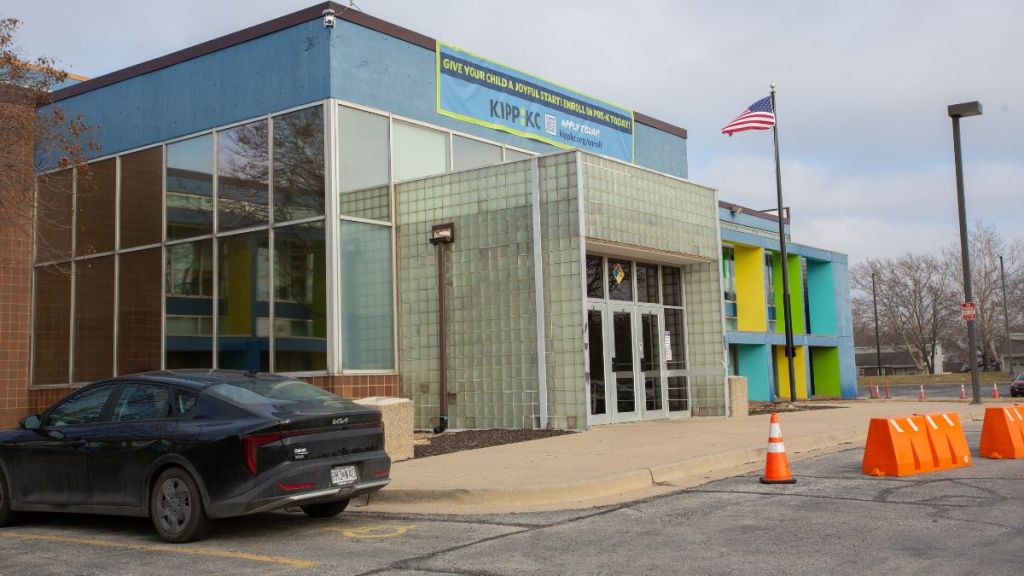
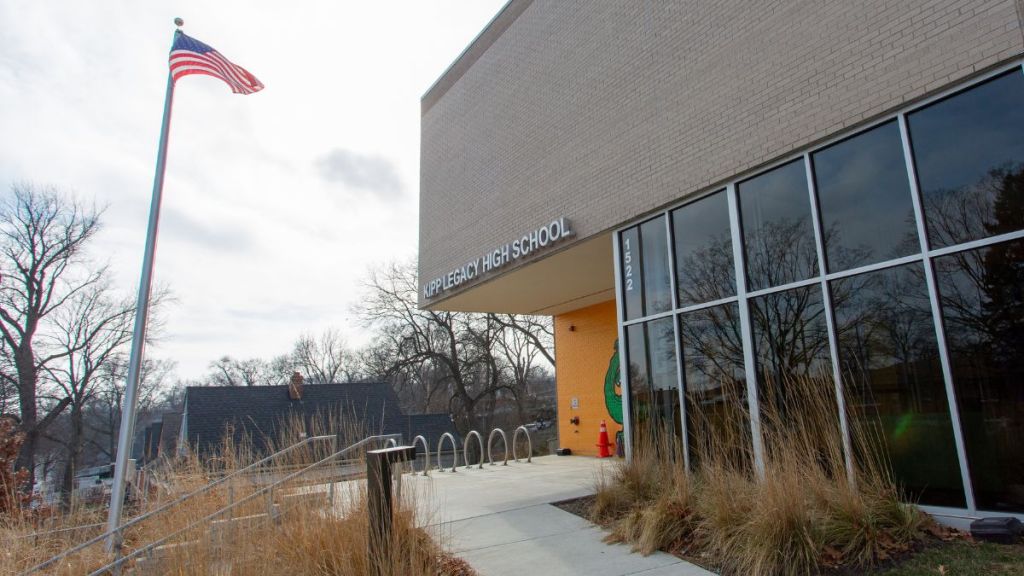
Schools: KIPP Endeavor Academy (grades pre-K-to-8) and KIPP Legacy High School (grades 9-12)
Affiliation: Part of a national network of KIPP charter schools, which operate independently of one another.
Governance: KIPP KC board, which votes in its own new members.
Oversight/Charter school sponsor: Missouri Charter Public School Commission
2024-25 school year enrollment: 1,049
2025-26 school year enrollment (preliminary data): 845
Executive director: Dayna Sanders (since mid-2024)
Executive director salary: $200,000
2025-26 budget: More than $20 million
Number of staff anticipated in budget: 161
Number of staff included in fall 2025 reporting to the Missouri Department of Elementary and Secondary Education: 113
After Sanders arrived, KIPP’s APR score increased 21 percentage points to 53.4% and the performance component of its score went from about 27% to more than 60%.
In social media posts promoting enrollment for the 2026-27 school year, KIPP KC highlighted the 21-point increase and said it demonstrates “significant academic growth and continued excellence across our schools.”
During the December meeting, Jonna Skinner, a former KIPP counselor, cautioned against being overly impressed by the increase. She told the Beacon the statement she read at the meeting was written by a former KIPP KC administrator who wanted to remain anonymous.
The statement said some of the additional points — like those for graduation rate — recently became available to KIPP simply because it added a senior class.
“This is not the resounding success I’ve seen shared on social media,” Skinner read. “Almost all of the measurable gains are attributable to the work of our high school team, not to the regional redesign, not to the KIPP Foundation and not to the plethora of consultants that have been brought in.”
“And it is those very educators, the ones responsible for the only real areas of growth, who are now standing before you raising alarms about the current trajectory of this organization. So far, their concerns have been met with silence from this board.”
In an emailed response to questions sent by spokesperson Saki Indakwa but not attributed to a specific individual, KIPP KC said the APR scores were partially driven by adding a senior class but “primarily driven by strong gains in academic growth, particularly in mathematics and science across grade levels.”
“These improvements reflect a sharper focus on instructional coherence, increased use of data to guide teaching, and targeted academic supports for students,” the email said. “Those gains reflect consistent, day-to-day instructional work in classrooms, and educators at every level deserve credit for that progress.”
“The results were supported by both school-based leadership and teaching teams, as well as regional academic systems and coaching designed to strengthen instruction. Overall, the improvement is best understood as a shared effort across the organization, rather than the result of any single factor or group alone.”
Reimagining KIPP KC
Board members told The Beacon they know KIPP KC isn’t where it needs to be academically.
But they said the Reimagine plan is working.
A statement from KIPP KC quotes Sanders as saying: “Our focus has been on building strong instructional systems, supporting our teachers, and ensuring students experience challenging and engaging learning experiences every day. We are encouraged by our progress.”
The statement said KIPP has improved human resources, payroll, communication and staff support such as professional development, mentoring and compensation.
In statements that echoed some of each other’s language, KIPP KC and the KIPP Foundation, which supports the national KIPP network, called Sanders a “transformational leader” and said that “change at this scale inevitably brings challenges” but is necessary.
King said key aspects of the plan include reorganizing leadership and improving curriculum.
KIPP wants more of its teachers to be fully certified, Perkins said, and to add support for teachers such as coaching and paraprofessionals.
At the December board meeting, an administrator said about 82% of teachers hold full, provisional or substitute certification. It’s not clear how many are fully certified.
Some teachers who spoke with The Beacon, including Emerson, praised their instructional coaches, who can help develop course materials and give feedback on teaching. Some also said they have better curriculum resources this school year, although materials may contain mistakes or signs that they’re created with artificial intelligence.
But the board members said not all teachers like being evaluated, and that some found a new system of more standardized discipline to be a challenging adjustment.
The board members said hiring and turnover in critical roles have been barriers to enacting the plan in its ideal form, but they can already see differences between areas where staffing has been a problem and those where Reimagine is going according to plan with supportive, qualified teachers.
Data presented at the December board meeting showed dramatic differences in student growth this year by grade level.
Robbyn Wahby, then-executive director of the Missouri Charter Public School Commission, said improvement can’t be immediate, but that KIPP KC seems to be taking real action. It won’t have limitless opportunities to better itself, though.
Wahby spoke to The Beacon in September and stepped down as executive director at the end of 2025.
As KIPP KC’s sponsor, the commission tracks its performance, holds it to the goals in its contract and will decide whether to renew that contract, which expires in mid-2027 and is required for KIPP to operate.
“A bunch of citizens and educators have attempted to make a school that will be successful, and when so many kids do not have access to a high quality school right now, that attempt is worth it,” Wahby said. “But what we can’t do is persist. If it’s not working, then we remove it.”
