


Editor’s note: This story has been updated to reflect actions taken Jan. 7 by the Department of Housing and Urban Development to assist the relocation of Olive Park Village residents.
Passion Paris and Amber Fanning stood outside their apartments — among boarded-up and burned-out buildings — on a dreary January morning, trying to figure out what to do next.
The Olive Park Village residents had scrambled to find new places to live. They filled out housing assistance paperwork. They waited through the holidays for Department of Housing and Urban Development inspections that would let them escape the deplorable conditions at the apartment complex where they have lived for a combined 25 years.
Takeaways
- Olive Park Village residents have until Jan. 9 to move as the city responds to safety concerns at the deteriorating property.
- HUD barred Olive Park Village’s parent company Millennia and its CEO from new federal contracts for five years in 2024; the local housing authority stopped dispersing payments to the company in December 2025.
- The Independence Plaza Neighborhood Council filed a civil nuisance lawsuit seeking to force repairs or court-ordered receivership.
That morning they got the call that their prospective new homes had failed inspection, which must pass before they can move. Facing a communicated deadline to vacate their current apartments in just four days, the two women were back where they started.
“God, I don’t know (what to do) besides sitting here crying all day,” Paris said. “Right now, in my brain, we are homeless.”
Paris and Fanning said they were cycling through anger, sadness and stress. Their families were packed and ready to go, but neither had a place to stay if the new homes didn’t pass reinspection in time. Fanning described a drawn-out process that hovered over their holidays.
“I’ve been asking for weeks where everything’s at,” Fanning said. “I feel like I’ve been left in the dark.
‘Deplorable conditions’
The urgency to move comes after city inspections found what officials call “significant habitability and safety issues” and HUD cut off federal subsidies to the property owner Dec. 1, 2025. Though the complex has not been formally condemned, the city has told the remaining families to relocate.
HUD on Jan. 7 activated an emergency relocation program for Olive Park Village residents. All remaining residents will receive hotel placement if needed, moving services and storage assistance.
The need to vacate came after neighbors and residents had made dozens of complaints to the 311 call center in recent years that have escalated as the large out-of-state property management company has been unable or unwilling to resolve numerous code violations.
Residents of the complex at Ninth and Olive streets in Kansas City’s Independence Plaza neighborhood say they have endured flooding, ceiling collapses, mold, mice and rodent infestations. Neighbors took notice of break-ins at unsecure and vacant units that have led to illegal activity, theft and fires.
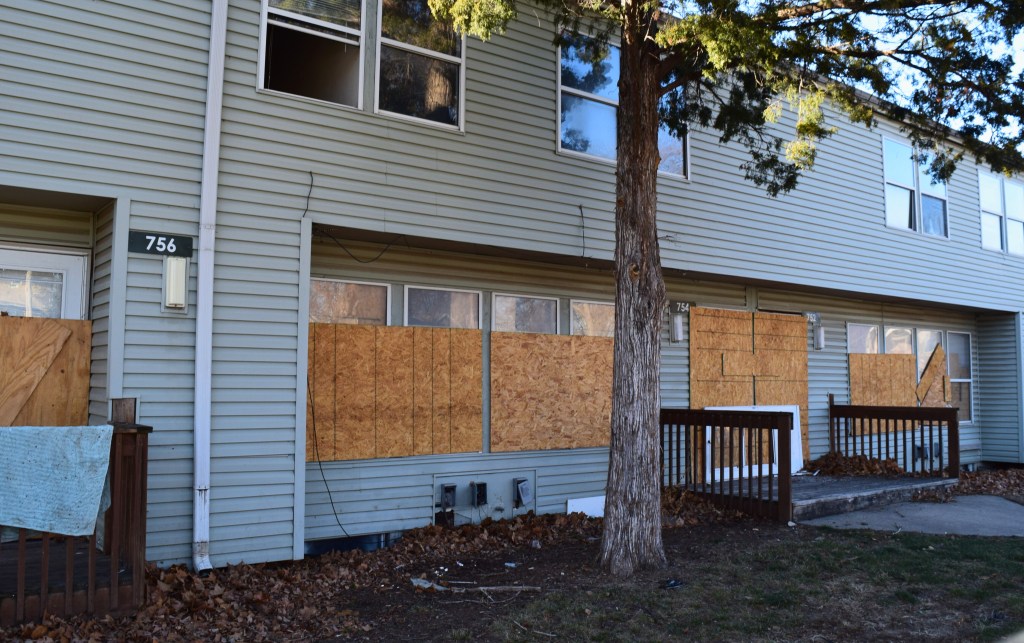
“A bit over a year ago, the first building burned down, and that’s when (the decline) became extremely visible,” Chloe Willett, nearby resident and member of the Independence Plaza Neighborhood’s housing committee, said in a December press conference.
“The residents in the apartment complex and in the houses surrounding it deserve safety and security,” Willett said. “I am so disappointed and disgusted with how this apartment complex has been managed.”
The property owner — a shell corporation managed by Cleveland-based Millennia Housing Management — collected federal subsidies from HUD meant to provide safe, affordable housing while allegedly letting the 52-year-old mixed income complex crumble. Residents say management stopped responding to maintenance requests almost entirely over the last 12 to 18 months and let buildings go.
Paris estimated that six remaining families were still living at the property with only days remaining to move. That’s down from about 30 before Thanksgiving in a complex that formerly boasted over 130 units. City officials, residents and neighbors say the blame for this displacement rests with the property owner who has failed to respond to requests to remedy issues at the increasingly unsafe complex.
Millennia Housing Management and on-site management did not respond to requests for comment from The Beacon.
Years of decline
Paris and Fanning describe steady deterioration at Olive Park Village that began long before the current crisis. Paris has lived at the complex for 12 years and raised her three children while watching the property’s descent from decent housing to dangerous conditions.
“It was nowhere near this bad in the beginning,” Paris said. “They used to keep things up, then it just stopped.”
Olive Park Village LLC, the corporation managed by Millennia, bought the property in 2016. Fanning also says things looked OK at first, but she began filing complaints with the Kansas City Health Department about maintenance issues as early as 2018 or 2019. When the pandemic hit, management refused to enter units at all, and the problems snowballed from there.
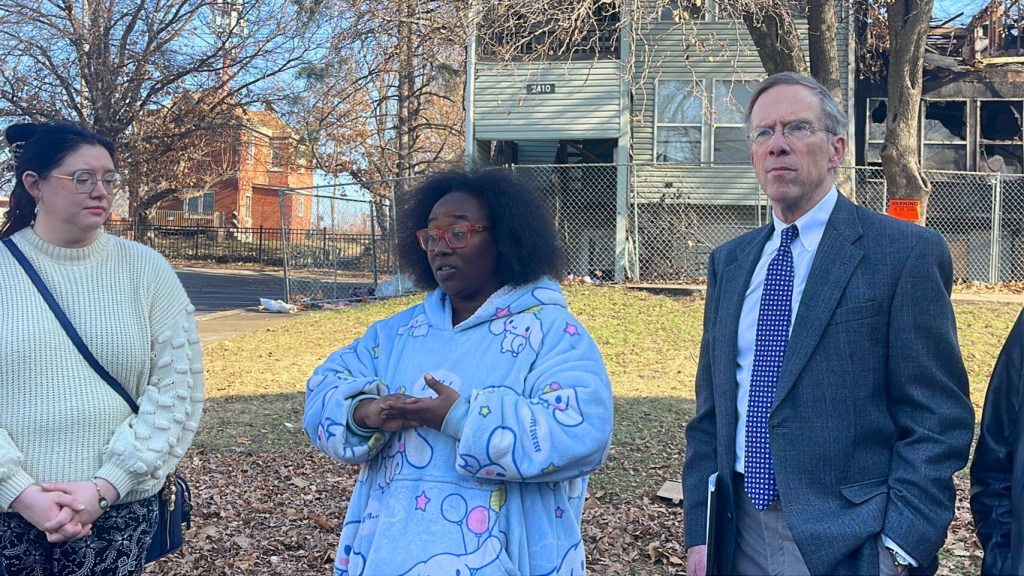
“I honestly quit giving requests a long time ago for the simple fact that I knew that they would never fix any of it,” Fanning said.
Roughly a year ago, Fanning says she was moved from one unit to another after her bathroom ceiling collapsed from water damage and floors began caving in. But the new unit also had problems.
“It really doesn’t matter what unit you put me in,” she recalled telling HUD inspectors. “They’re all the same. They all have the same issues.”
Paris dealt with infestations, faulty electrical switches and mold. She’s witnessed several fires at the complex over the years, sometimes waking her up in the middle of the night.
“You hear a bunch of sirens outside. You look out the window, and boom, it’s a fire every time,” Paris said. “You can’t sleep that night because you feel something is wrong, and then you smell a fire.”
Both say they use space heaters to stay warm because the surrounding apartments have so much mold from water damage that they fear circulating mold through the furnace. Each has also reported electrical issues in their separate buildings.
Since just before Christmas, when people broke into vacant units and stole metal pipes, Fanning hasn’t had running water. She’s resorted to filling large jugs from a spigot near the office and boiling water to bathe and cook.
Fanning sees the thefts, the fires and the deterioration as part of a larger pattern.
“I think they bought (Olive Park Village) with clear intent not to take care of it in the first place,” said Fanning.
Nationwide pattern
Millennia Housing Management controls more than 280 apartment complexes in 26 states, housing approximately 86,000 people, according to its website. Across that portfolio, federal regulators, journalists and tenant advocates have documented a pattern of neglect and alleged malfeasance.
- In March 2024, HUD barred Millennia and CEO Frank Sinito from receiving new federal contracts for five years. According to HUD’s December 2023 notice of suspension, nearly $4.9 million was “missing or was improperly taken from 19 HUD-insured or HUD-subsidized properties.”
- In October 2024, federal agents from HUD and the U.S. Department of Agriculture raided Sinito’s home in Waite Hill, Ohio, executing a search warrant. The investigation remains ongoing. No charges have been filed.
- In a May 2025 ruling, a HUD administrative law judge found facts establishing more than $3.1 million in unauthorized transfers from HUD-insured properties were undisputed.
- At Forest Cove Apartments in Atlanta, conditions became so dangerous that a judge condemned the complex in 2021. The city spent millions of dollars relocating nearly 200 families before demolishing the buildings. Civil rights attorney Ben Crump is now building a class action lawsuit against Millennia on behalf of former tenants.
- Incidents at Millennia properties have resulted in at least eight deaths, including three people killed in a gas explosion in Arkansas and a mother and child killed by a carbon monoxide leak in Mississippi.
- In Oklahoma, HUD terminated Millennia’s Section 8 contract at Elm Terrace Apartments in Duncan effective Dec. 1, 2024, forcing approximately 40 tenants to relocate.
Sinito and Millennia brought a lawsuit against HUD which has since been dismissed. Sinito stepped down as Millennia’s CEO in June 2025.
Millennia is shifting away from affordable housing projects following their five-year HUD debarment.
The Kansas City Housing Authority stopped disbursing funds to Millennia properties on Dec. 1, 2025.

City and neighborhood response
Kansas City officials and community organizations have mobilized to help displaced Olive Park Village residents, though the process has faced hurdles.
HUD has issued tenant protection vouchers to help residents find new housing. However, the relocation process requires finding available housing, passing HUD inspections, paying security deposits and covering moving costs.
The United Way of Greater Kansas City stepped in to help pay security deposits for residents needing to relocate. Meanwhile, the city’s Public Safety Task Force has boarded up 20 units at the complex to secure them from illegal entry and planned to secure the remaining buildings after tenants leave.
Attorney Gregg Lombardi of Neighborhood Legal Services sent a formal notice letter to Millennia on Oct. 20 giving the company 60 days to remedy the violations. Millennia did not respond to the letter or make any improvements during that time frame.
“If you look at the property over the course of the last four or five months, it looks abandoned,” Lombardi said. “They really have put in absolutely minimal effort and sucked out every last dollar they could of federal funding and rent.”
The Independence Plaza Neighborhood Council filed a civil nuisance lawsuit in Jackson County Circuit Court Dec. 23, seeking to force the property owner to repair the complex or face court-ordered receivership. Lombardi said he hopes new owners will purchase the buildings and bring back safe affordable housing.
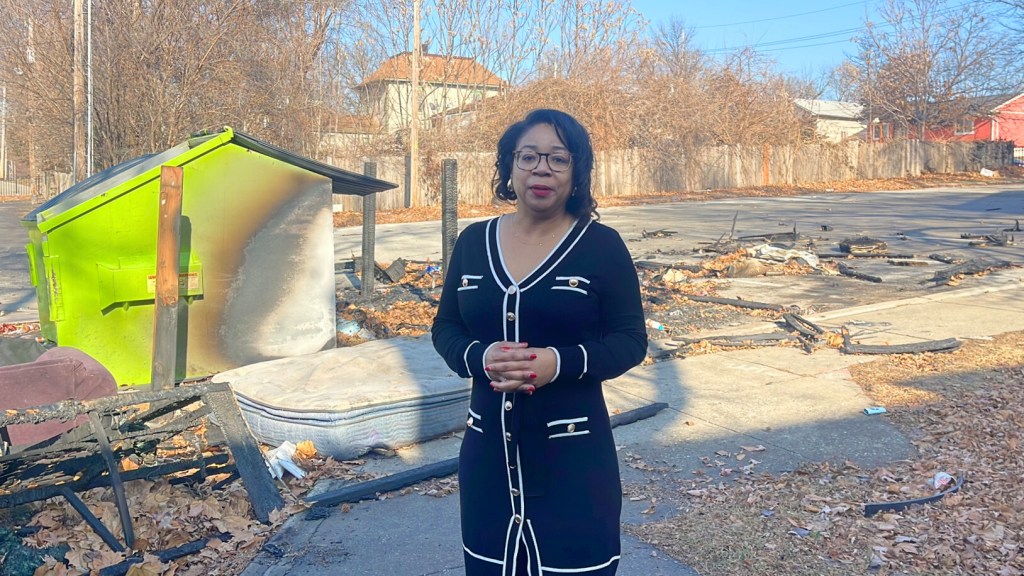
City Councilwoman Melissa Patterson Hazley, who represents the 3rd District at large, has worked to bring city assistance to residents and has called the living conditions at the complex unacceptable.
“Kansas Citians depend on affordable housing and should not be exploited because they don’t have a lot of money,” said Patterson Hazley. “What has taken place at this particular property is really inhumane, and it’s a shame.”
Despite the support mobilizing around them, Paris and Fanning remain frustrated and frightened about their immediate futures — and angry at the company they hold responsible.
“I think they need a permanent ban and never be allowed to own property ever again here in Kansas City or anywhere in the United States,” Fanning said. “They need to be thoroughly blacklisted.”
Paris said she’s grateful for those who stepped in to help, telling attendees at a December press conference that she was glad people were finally paying attention to the problems.
Living with uncertainty
For Paris, the uncertainty has been relentless. She couldn’t cook a full meal for Thanksgiving or Christmas and has been afraid to stock groceries she might have to abandon.
“My daughter didn’t even ask me for anything for her birthday because she didn’t want to stress me out even more,” Paris said.
She says her children will have to switch schools. Her daughter had to quit her drill team and the community she has known for 12 years is scattering.
“This wasn’t right to treat people like this,” Paris said she’d like to tell Millennia. “We are people with families, small children. This was not OK. This is not OK. Y’all should have done something different before all of this went downhill.”
HUD now has activated an emergency relocation service for remaining Olive Park Village residents. City officials coordinated with HUD and announced the update during a meeting on Wednesday with residents.
“It was like a round of applause,” Patterson Hazley said.
The program provides hotel placement, transportation, moving services and storage for residents awaiting their new housing. All residents except one — who had been hospitalized and unaware of the process — now have confirmed addresses for permanent housing.
Paris’ new apartment also passed reinspection, and she has received keys.
Fanning offered a bit of advice to area renters.
“Check who owns the property before you decide to get an apartment anywhere here in Kansas City,” she said. “Make sure it’s not Millennia that owns it.”
