


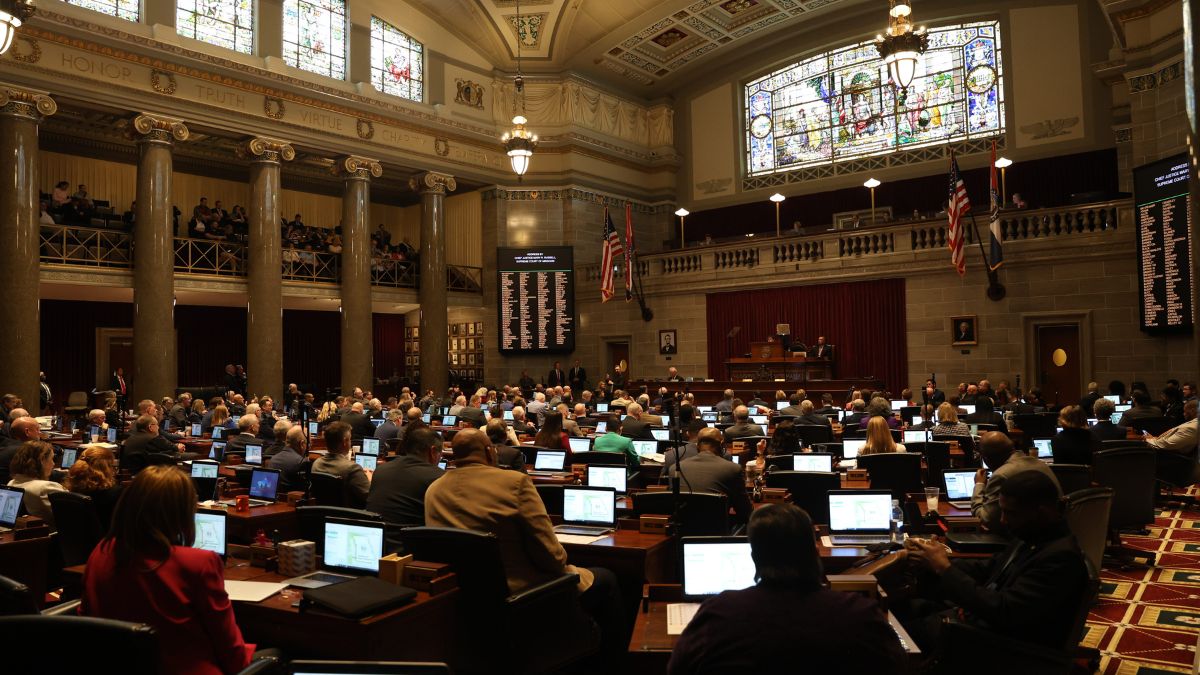
The Kansas City Council approved an official list of 52 priorities for 2026, which the city’s lobbyists will push for in the Missouri General Assembly and state agencies.
But members of Kansas City’s statehouse delegation are not very hopeful about this year’s session.
The 2025 regular and special sessions have soured relationships in Jefferson City — particularly among Kansas City Democrats who fought against the Republican gerrymander of the congressional map in September.
“I actually, genuinely believe this is going to be the hardest one yet,” Missouri House Minority Leader Ashley Aune said. Aune represents parts of Kansas City in Platte County, including Zona Rosa.
“The relationships in the Senate have deteriorated greatly across the aisle,” she said, “and frankly, they deteriorated pretty greatly within (the Republicans’) own caucus.”
Rep. Pattie Mansur, who represents Brookside and Waldo in the Missouri House, expects a lot of “peacocking” from legislators in an election year — particularly Republicans who may feel vulnerable in swing districts.
“Showing off and trying to showcase what your stance is,” Mansur said. “‘Am I more conservative than this person? Am I Missouri first?’ So I think it’s going to be a very difficult year. And I do think some of my Republican colleagues are quietly nervous about this coming year.”
So as Kansas City sends its lawmakers to Jefferson City for the start of the legislative session in January, here’s a list of Kansas City’s priorities, ranked by likelihood.
Likely
Quality child care
What the city is asking for: “Support efforts to increase the accessibility of full-day and full-year quality birth through Pre-K programs for all Missouri students.”
Why it’s asking: Nearly half of Missouri children under 5 live in areas considered “child care deserts.” And even where it’s available, costs have become difficult for many Kansas City families to manage. According to the U.S. Department of Labor, the cost of child care for one infant in Jackson County is the equivalent of nearly one-eighth of the median family’s income.
Why it’s likely: The General Assembly has been trying to expand child care for years, and it came close in 2023, until a Republican filibuster killed the Senate bill. The issue’s champion, St. Joseph Republican Rep. Brenda Shields, is finishing her last term in the Missouri House amid health concerns, which some legislators hope will motivate the General Assembly to get the bill across the finish line this time.
“I really would like to think that Missouri politics is at a place where we’re able to give Brenda Shields her flowers on her way out the door,” Aune said.
World Cup
What the city is asking for: “Support funding and allocation of resources related to planning and hosting of the FIFA World Cup games hosted by Kansas City in 2026.”
Why it’s asking: Kansas City is preparing for the World Cup matches it will host in June 2026, which will bring hundreds of thousands of visitors to the city. The city will need to be ready to house those tourists in hotels, transport them to and from the airport, matches and Fan Fest, and generally maintain a safe and profitable event.
Why it’s likely: The General Assembly has already passed legislation focused on making the World Cup run smoothly, including allowing businesses to serve alcohol for extended hours, as well as a wayfinding program that will help visitors navigate Kansas City’s transit system.
Entrepreneurial support
What the city is asking for: “Support efforts to create an Angel Investment Tax Credit program, as well as increased funding and opportunities for entrepreneurs and early-stage companies.”
Why it’s asking: That program would give tax credits to investors in tech companies.
Why it’s possible: The bill, sponsored by Rep. Sherri Gallick from Cass County and Sen. Kurtis Gregory from Marshall, both Republicans, nearly passed in 2025 before it got sidelined at the end of the legislative session.
Possible
Land Bank authority
What the city is asking for: “Support land bank legislation that expedites acquisition and disposition of vacant and tax-delinquent properties to facilitate affordable housing development.”
Why it’s asking: Kansas City’s Land Bank owns thousands of properties across the city, many of which have remained vacant for years. Neighborhoods including Wendell Phillips and Washington Wheatley have some of the highest rates of vacancy. Katherine Nace, the policy director for Mayor Quinton Lucas, said that reforming land banks in Missouri could unlock development opportunities in Kansas City.
Why it’s possible: “That’s something that (lobbyists) said was having a lot of success last session,” Nace said, “until there was a provision added into it that related to different property tax abatements, and that’s what killed it. So it seems like there’s some potential there.”
Expanded domestic and intimate partner violence resources
What the city is asking for: “Support additional funding to assist organizations and groups that seek to reduce or address harms suffered as a result of domestic or intimate partner violence.”
Why it’s asking: “We had a stark increase in our homicides due to domestic violence this year,” Nace said. City Hall has been meeting with the police department, the prosecutor’s office and service providers, and Nace said support from Jefferson City could make a meaningful difference.
Why it’s possible: Both Nace and Mansur believe that there could be bipartisan support for this issue.
“We have legislators who’ve had personal experiences in those realms, either themselves or a family member,” Mansur said. “There are people on both sides of the aisle who recognize that this is an area of need.”
Medicaid work requirements
What the city is asking for: “Facilitate and ensure simple and efficient processing of expanded Medicaid work and volunteer requirements required as a result of the Federal One Big Beautiful Bill.”
Why it’s asking: The new Medicaid work requirements will go into effect after the 2026 midterm elections. In the past, Missouri has struggled to meet the required timelines to process applications.
Why it’s possible: “I would like to be optimistic that we could see something in that realm happen,” Nace said, “because we know that that’s having a huge impact across our state, with how many people are receiving Medicaid and SNAP benefits.”
Unlikely
Earnings tax
What the city is asking for: “Oppose efforts to undermine or eliminate the Earnings Tax. Support the extension of the Earnings Tax renewal period to strengthen the City’s bond rating.”
Why it’s asking: Kansas City will need to ask voters to renew its earnings tax on the April 2026 ballot. The tax is the city’s largest general revenue source, at $374 million in 2025. Eliminating the tax could gut the city’s budget.
The tax is required to be approved by voters every five years, and Nace said that if the legislature were to allow Kansas City to make the renewal period longer, it would make the city’s revenue more predictable and bring down interest rates it pays for bond financing.
Why it’s not likely: Missouri became the first state in the country to eliminate capital gains tax in 2025, and Gov. Mike Kehoe said eliminating the income tax is his top priority for 2026. That may not necessarily affect the city’s earnings tax, but Mansur said Missouri Republicans have tried in the past to restrict the earnings tax in Kansas City and St. Louis.
“It’s a very anti-tax environment right now,” Mansur said, “and in an election year, anti-tax sentiment among lawmakers runs very high.”
Local decision-making
What the city is asking for: “Support legislative action to return the Kansas City Police Department to local control and provide the city and its residents with equivalent control over budgeting and policy decision (sic) as other Missourians throughout the State.”
Why it’s asking: Kansas City is one of the nation’s few major cities that do not control their own police department. The system of state control was established in St. Louis to assist Confederate forces in 1861, and it was imitated in Kansas City during the Reconstruction. For more than a century, Kansas City officials and civil rights leaders have called for an end to the system, arguing that it limits police accountability and creates financial problems for the city.
In addition, the Kansas City Council is asking the legislature to contribute to funding the department to alleviate budget pressures that result from a state funding mandate.
Why it’s not likely: The Missouri legislature voted to reinstate the system of state control in St. Louis in 2025, and it supported an increase in police funding in Kansas City in 2022. Statehouse Republicans appear to be doubling down on state control and are unlikely to change course.
Health care access
What the city is asking for: “Oppose efforts that restrict access to or further criminalize necessary health care services, including contraception and abortion, or assisted reproductive technology.”
Why it’s asking: Kansas City leaders have opposed abortion restrictions for years. In 2024, 67% of Jackson County voters approved a state constitutional amendment establishing the right to an abortion. Support was also greater than 60% in the Northland.
Why it’s not likely: Missouri became the first state to ban abortion in 2022 after the Supreme Court overturned Roe v. Wade. Although voters overturned that ban in 2024, Missouri Republicans in the legislature believe that voters did not understand what they were voting on and have placed another amendment on the ballot in 2026 to reinstate the ban.
Access to democracy
What the city is asking for: “Support legislative action that extends early voting, allows for same-day voter registration, removes voter ID requirements, and respects the will of voters when issues are put to the ballot for decision by the people of the State of Missouri.”
Why it’s asking: This was one of the most divisive issues in Jefferson City at the end of the 2025 regular session, when the General Assembly both repealed sections of the minimum wage initiative, and placed a new amendment on the ballot that would reinstate a ban on abortion — just six months after both measures had been approved by voters. Then in September, the legislature met at a special session and voted to redraw Kansas City’s 5th Congressional District to water down the city’s voting power in the U.S. House of Representatives.
Why it’s not likely: The Senate and the House were unusually forceful with all three of those votes last year, invoking rare maneuvers to shut down debate. It would be unlikely for the legislature to change course, and the three votes will likely cast a shadow over the 2026 session.
“Mark my words,” said state Sen. Maggie Nurrenbern, a Democrat from Kansas City, at the end of the 2025 session. “Every moment of every session of every day will be miserable for the other party.”
