


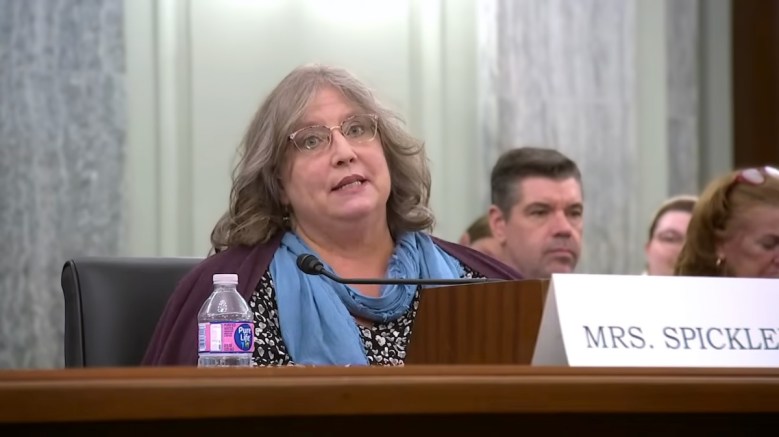
Soon after her testimony before a U.S. Senate subcommittee was posted online last month, Eileen Spickler started to notice the comments.
She had testified about her husband Barry’s unexpected early retirement, his health struggles and the financial headwinds they faced. For the first time in their lives, Spickler and her husband turned to food pantries because the cost of groceries no longer fit in their budget.
Takeaways
- Enhanced tax credits that help people pay for health coverage purchased through the Affordable Care Act Marketplace will expire on Dec. 31.
- That will lead to an increase in the amount people have to pay for monthly premiums and force some people to drop coverage.
- More people without coverage will have negative consequences across the health care ecosystem.
An almost $150-a-month increase in the cost of Barry’s Affordable Care Act health insurance wouldn’t fit either.
But internet commenters didn’t get it.
“They were saying, ‘What’s wrong with them?’ and ‘Why can’t they afford an extra $150 a month?’” Spickler said.
She realized the lack of understanding reflected in those comments was exactly why she needed to show up in Washington to testify.
Since 2021, enhanced premium tax credits have significantly subsidized the cost of health insurance for most of the people enrolled in ACA marketplace plans. But on Dec. 31 those tax credits will expire unless Congress votes to renew them.
Spickler, who lives in Ottawa, Kansas, 50 miles southwest of Kansas City, wanted lawmakers to know how much some people truly need them.
“When you’re poor and you go to food pantries for the first time in your life,” she said, $150 is “a lot of money.”
Subsidy uncertainty
Spickler’s story and others like it have been in the spotlight this fall, as the tax credit expiration date looms. So far, they don’t seem to have made a difference with the Republicans who hold a majority in both houses of Congress.
Lawmakers will most likely leave Washington for the holidays this week without a vote on extending the tax credits, which means people like Spickler’s husband will be left to absorb massive premium increases in the new year.
The health research organization KFF estimates that nationwide, average out-of-pocket annual premium payments will more than double to $1,904 in 2026, from $888 this year. But the increase will be far greater for certain groups.
Premiums vary based on a person’s age, address and income. (You can visit KFF’s calculator to get an idea of what your 2026 rates could be.)
Older people, who tend to have more expensive health problems, and people with higher incomes, who will likely no longer qualify for any type of government subsidy once enhanced subsidies expire, will face the steepest increases next year. But some of the poorest people in the marketplace, who may have had no out-of-pocket costs under the enhanced subsidies, may struggle to cover even a small monthly premium.
Republicans have proposed alternative measures they say will help people afford health care, such as government-funded Health Care Savings accounts, which critics call inadequate. But most Republicans, including those representing Kansas City-area voters, have opposed extending the Biden-era enhanced tax credits, first adopted in 2021 as part of the American Rescue Plan Act and renewed a year later under the Inflation Reduction Act.
Their effect on marketplace participation was nearly immediate.
ACA enrollment doubled to 24 million nationally by 2025, the fourth year enhanced subsidies were available. And some of the biggest enrollment gains occurred in states, including Texas and Florida, that overwhelmingly supported President Donald Trump in last year’s election.
The wide-reaching popularity of the enhanced subsidies may be the reason four House Republicans agreed on Dec. 17 to side with Democrats in forcing a vote on extending the subsidies for three years. But that vote can’t happen until after the new year — not in time to save people from price jumps they’ll experience in January.
‘A significant setback’
Cathy Thomas, a retired executive assistant who lives in Olathe, said her health premium on a high-deductible plan will go from $390 a month to more than $1,000 in January. After a lung cancer diagnosis that requires regular surveillance, she said she has no choice but to keep her ACA plan. At 63, she is still two years away from qualifying for Medicare.
She and her husband will have to forgo trips and find other ways to trim costs to afford the ballooning monthly premium, but she feels lucky to be able to make that choice.
“My heart just goes out to so many people that are just going to have to drop their insurance,” she said. “There are many people that have situations worse than I do.”
In a November survey of marketplace enrollees, KFF found that almost 60% of respondents said they would not be able to afford an extra $300 a year for insurance without “significantly disrupting” their household finances. More than half said they would likely go without health insurance if their premium doubled.

Sara R. Collins, who studies health care access at the Commonwealth Fund, said that without the enhanced subsidies an estimated 7 million people may leave the marketplace next year, and 5 million of those are likely to become uninsured.
“It is a significant setback for the coverage gains that we’ve made over the past 15 years,” Collins said, “and particularly in the last five years.”
Molly Gotobed, executive director of the Community Health Council of Wyandotte County, said she’s already seeing people opt out of insurance after learning how much more plans will cost.
“We are seeing people choose not to get insurance because they can’t afford it and they think it’s not worth it,” she said. “It’s going to be a disaster because these folks are going to end up with huge medical bills. We’re going to have people avoid care.”
Health economists expect ripple effects across the health care market. As hospitals and doctors provide expensive care to people who don’t have insurance coverage, costs will go up, which will lead to more expensive insurance premiums across the market.
Strain on providers and insurers
During November, the first month people could sign up for 2026 ACA plans, the Centers for Medicare and Medicaid Services reported a slight uptick in signups nationally compared to last year. But both Missouri and Kansas saw signups decline.
Experts said it is difficult to draw much meaning from that early snapshot, since it doesn’t show who enrolled or what kinds of plans they chose. The real tell will come, Collins said, after enrollment closes Jan. 15 and there is a clearer picture of which patients chose to remain in the insurance pool.
If younger, healthy people drop coverage but sicker, more expensive patients remain, that will put more strain on health care providers. And it will make it more likely that insurers will decline to offer ACA plans at all.
This year Aetna CVS Health dropped out of the ACA marketplace, leaving patients in Missouri and Kansas with one fewer option for coverage. And some of the plans offered in the Kansas City market are already narrow in terms of the number of hospitals or providers included in the network.
Tim Becks, an insurance broker who owns Becks Benefits Design in Westwood, sees the limited networks covered under some ACA plans as a bigger detriment to people keeping coverage than the increased costs associated with expiring federal subsidies.
For years, experts have warned about “shrinkflation” or “skinny networks” in some ACA markets. The concern is that available ACA plans may have very few options of in-network providers.
Becks said some of his clients are struggling to find ACA plans that include the doctors they need. Next year, only Medica includes Children’s Mercy Hospital and the pediatric practices affiliated with it. And only UnitedHealthcare includes St. Luke’s.
Becks said his clients who want access to Children’s Mercy are forced to choose one of the most expensive ACA plans available in the market.
“They either pay 40% more for Medica, or they change pediatricians,” Becks said. “But guess what? Most of the pediatrician offices around town have aligned themselves with Children’s Mercy.”
A Children’s Mercy spokesperson said that “most insurers have either chosen not to include Children’s Mercy or proposed reimbursement rates so far below market norms that sustainable participation would be impossible.”
A St. Luke’s spokesperson did not say why only one carrier included it in its network. The owner of St. Luke’s, BJC Health, is the largest hospital system in Missouri.
Of course, insurance network participation is a two-way street, said Brian Colby, vice president of public policy with the Missouri Budget Project.
Hospitals may not be willing to accept reimbursement rates insurers offer if they are too low, and bigger hospital systems have more leverage to hold out for more money. On the other hand, insurers want to keep their costs down and may choose not to include larger systems, which typically charge higher rates, in their networks.
“The dynamic is to try to fight back against what is really a hospital pricing problem,” Colby said.
Every loss adds up
Most health policy experts expect the number of people without health insurance to climb in coming years. In addition to expected loss of coverage through ACA plans, Congress passed legislation last summer that will lead to people losing Medicaid coverage.
That will cause more people to end up at hospitals needing more expensive care, but unable to pay.
“Then, for everyone, health care expenses are going to go up,” Gotobed said.
Patrick Sallee, president and CEO of Vibrant Health, a community health clinic in Wyandotte County, said his organization expects to see $250,000 less in revenue from ACA plans next year. That’s despite the fact that commercial insurance — including plans sold through the marketplace — accounts for only a small portion of Vibrant’s payer mix.
Vibrant will see an even bigger hit the following year from lost Medicaid revenue. On top of that, Vibrant, like other community clinics and safety-net hospitals that serve large uninsured populations, expects uncompensated care expenses to go up.
The accumulating losses will take a toll, Sallee said.
“You start chipping away at (revenue),” he said, “you can’t afford the same staff. So then you can’t afford to provide the same access.”
But access to care is what people need, Spickler said. That’s why she testified in Washington last month. She wanted lawmakers to understand the cost on people of not having it.
“I am here fighting for my family and for the millions more who know the struggle of fighting to afford basic needs like health care,” she told the Senate committee. “Health care is a human right. Nobody should go without it.”
