


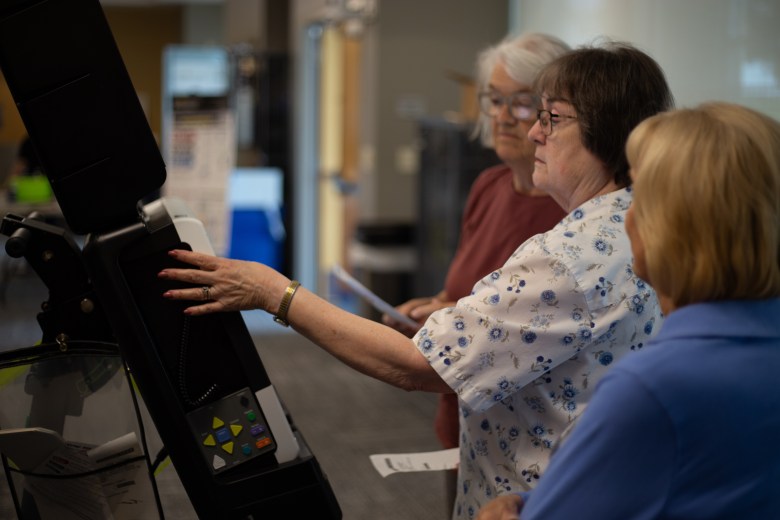
The Trump administration is asking states for additional personal information on voters, and Kansas and Missouri — so far — have rejected those requests.
Takeaways
- The federal government wants to create large databases with voter information. Officials hope that will reduce noncitizen voting.
- Experts say the data isn’t good enough and could flag U.S. citizens. That could mean some people unfairly lose their ability to vote.
- Some states are being sued for not providing this information.
President Donald Trump is trying to weed out noncitizens who vote in elections and clean up voter registration lists, which is why the Department of Justice is making these requests. Some of that data they’re seeking is public and other information is more sensitive.
Notably, the Trump administration wants drivers license numbers and the last four digits of voters’ Social Security numbers. The federal government is also asking some states for access to voting machines.
The federal government hopes more data lets them comb through records and identify noncitizens casting ballots.
“Despite pioneering self government,” an executive order said in March, “the United States now fails to enforce basic and necessary election protections employed by modern, developed nations, as well as those still developing.”
Isabel Linzer, a policy analyst at the Center for Democracy & Technology, is worried about the requests.
For starters, noncitizen voting is a miniscule issue at best.
A 2017 study of 42 jurisdictions with large noncitizen populations found that suspected cases of noncitizen voting happened just 0.0001% of the time. The study looked at the 2016 election and 40 of the 42 jurisdictions said there were no cases of illegal voting.
Compiling the personal data sought by the government can lead to all sorts of problems, Linzer said, even for U.S. citizens who are legally casting ballots.
The information databases aren’t necessarily accurate. Someone might have since become a naturalized citizen and earned the right to vote, and the system may not have been updated to reflect that change. People also have similar names, and the system might incorrectly flag someone. There are also typos in data.
The Texas Tribune reported in July that the system used to check noncitizen voting made mistakes. State officials checked 1,657 records and nearly 300 checks had errors that required state officials to double-check the accuracy of the response.
The system “already draws on data that contains errors,” Linzer said. “When all of those pieces of data are linked together, anyone who would be in this expanded system — that includes citizens by birth — could be flagged through one of those kinds of typos.”
She said U.S. citizens, born in this country and legally registered to vote, could see their registration revoked. The large database also could be hacked and private information could be released. And someone could be incorrectly flagged as a noncitizen and see ICE called on them.
“It just fundamentally erodes trust in our elections and our democracy,” Linzer said. “That is less concrete than ICE showing up at your door, but it’s hugely consequential to everyone living in the country.”
What has Kansas done?
Kansas provided the Department of Justice with publicly available information. The federal government asked for more sensitive information, and the state didn’t provide it.
“We are working with our division of vehicles to assess whether additional information may be used to supplement the existing information found in the Kansas voter registration list,” said Kansas Secretary of State Scott Schwab in a response letter.
Kansans aren’t required to register to vote with a drivers license number, so that information isn’t available for everyone if it was handed over.
Schwab said in his letter that Kansas is regularly checking its voter registration logs. The agency partners with Missouri to remove duplicate registrations, there’s constant checking that deceased voters are removed from the list and the state recently finished a duplication check so county election officials can remove duplicative registrants.
Kansas Attorney General Kris Kobach recently announced the arrest of the mayor of Coldwater, Kansas. Jose Ceballos is a green card holder in the U.S. but a citizen of Mexico. He said voting in multiple elections was an honest mistake.
What has Missouri done?
The Missouri secretary of state’s office didn’t reply to requests for comment. The Brennan Center, which is tracking what information states hand over, said Missouri hasn’t provided any information yet.
The federal government also has asked to see voting equipment from 2020, but county clerks in Missouri said those machines were replaced and the federal government can’t legally look at them.
The federal government has also asked for the same information it asked of Kansas.
