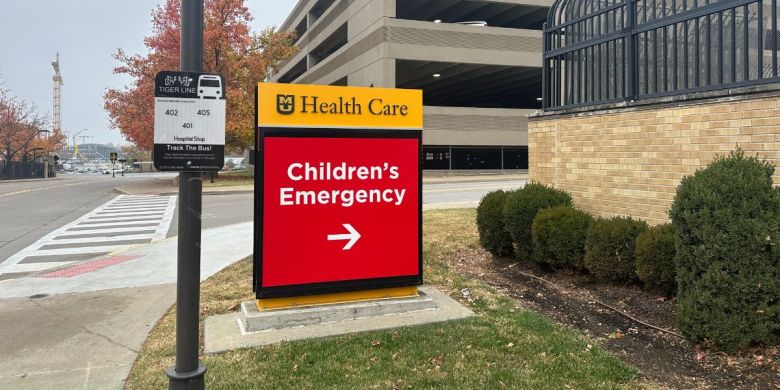
Compared to any doctor’s office, Missouri’s emergency rooms may show the clearest picture of the state’s health.
Takeaways
- A recent study published by the University of Missouri found that 42% of families in the emergency room for their child reported at least one unmet social need.
- The screening program plans to expand to some of MU’s urgent care locations in the future.
- Some Missouri hospitals are working on addressing similar needs through mobile health programs and healthy homes assessments.
That insight inspired a recent study by the University of Missouri School of Medicine, which spent eight weeks piloting a program to screen families visiting the emergency room for unmet social needs. The study examined topics that could be affecting health like food insecurity, difficulty paying utility bills or transportation concerns.
Dr. Mary Bernardin, who led the study from MU’s pediatric emergency department, found many families were checking a box for at least one unmet social need when screened at the emergency room.
When asked, 42% said they had at least one social need, most commonly food insecurity. Afterwards, social workers from the hospital reached out to the families who indicated they wanted more information about resources.
“My thought was, ‘We have such a large rural catchment, we could be helping so many families that need resources, if we could figure out how to do this in the emergency department,’” Bernardin said.
But the study came with an interesting finding — all of the rural families surveyed said they weren’t interested in getting connected with more resources.
“They might have the perception that in order to access resources … that they would have to come back and bring their child back to the city on a different day,” Bernardin said.
“I think that to those particular individuals in rural communities, it just might seem like they’re not accessible,” Bernardin said.
How Missouri hospitals follow up
Although Bernardin’s study showed progress with getting families in touch with resources, there are limits to making those connections while they are waiting in the emergency room.
And with pending changes to which Americans are eligible for Medicaid, emergency rooms across the state are predicted to see higher demand — becoming one of the few places some Missourians can be asked about their access to things like food, transportation or the assistance with bills.
In 2022, 40% of all emergency department visits nationwide were by patients who paid with Medicaid, CHIP or another state-based program, according to the Centers for Disease Control and Prevention, while 29% were patients with private insurance.
Missouri’s hospitals know these statistics all too well, and are developing ways to take their medical care further — especially for patients in rural areas.
Citizens Memorial Hospital in Bolivar noticed many familiar faces returning to its emergency room over the years, and knew that transportation can be a barrier to getting Missourians the care they need.
That led the hospital to develop its mobile integrated health unit, which sends a paramedic to a patient’s home for an appointment to check in on their health.
A 2023 survey by the Johns Hopkins Bloomberg School of Public Health found that In Missouri, 83% said they had at least one preventive visit for their child, while 16.8% said they had none. When asked if they had a regular doctor for sick care, nearly 82% said they did, while 18% said they didn’t.
Citizens Memorial initially launched the program with a theory similar to Bernardin’s: The patients who consistently found themselves in the emergency room may need access to more resources than what they have.
Ryann Allen, coordinator of the hospital’s mobile team, saw slow uptake on sending the mobile team out to patients. She ran reports to find patients who were in the ER three or more times over the last six months to offer them the service.
“When we first started, we really thought it was going to be more of a referral from hospital stays,” Allen said. “Now, over two years in, 75% of the referrals actually come from primary care clinics.”
“I just think that really speaks to the need” for more mobile options when it comes to health care, Allen said.
Allen’s team has completed more than 2,000 visits since the launch. The mobile unit has two full-time paramedics, a full-time obstetrics nurse who is also a lactation consultant, and a part-time psychiatric nurse practitioner.
While there are different types of mobile care solutions, not everybody qualifies for them, said Kim Elliott, the hospital’s director of social services.
“It’s been a huge resource for us for those patients that don’t qualify or wouldn’t have any services otherwise,” Elliott said. “Patients that can’t get to the clinic but don’t necessarily need an ER visit, I think it’s a great way for us to bring health care to them and get them connected.”
In Kansas City, Children’s Mercy takes it one step further with their Healthy Homes program. Doctors from all over the area can refer families to the program, which sends someone out to homes to check for potential environmental or behavioral factors that may impact someone’s health.
Ryan Allenbrand runs the program for the hospital. He said that while it’s sometimes uncomfortable for families to open their home to a stranger, it can make a world of difference in their health.
“We’re often the first people that the families have told this story to, the first time they’re letting anybody into their home to look around and understand what’s going on,” he said.
The Healthy Homes program does simple things like helping families better understand their heating and cooling systems, or the best air filters to buy and when to change them. The program also can help replace water heaters or work with landlords to address concerns like mold.
“As we have found over many, many years, all too often, their environment is playing some form of a role in that child’s health triggers,” Allenbrand said.
The emergency room and patient needs
Most hospitals complete a screening for unmet social needs, but not all do it in the emergency room.
Dr. Rammy Assaf, a pediatric emergency medicine physician at Children’s Hospital of Orange County in California, has been studying the best way to screen families in the emergency room for years.
Although emergency rooms are more likely to become some of the more often-used points of contact for families and the medical system, his thinking on how screening should work has changed.
“We think about the emergency department as the social triage center of the community — as a true safety net,” Assaf said. “In theory, the emergency department would be a fantastic place (for screening).”
When people defer their medical care, they are more likely to end up in the emergency room once their health issue becomes more urgent. And rural residents are more likely to find themselves in that position.
A 2016 study found that rural parents are less likely to report their child had a preventive health care or dentist visit.
In practice, using the emergency room to screen patients is difficult. Families are in crisis, staff are pulled from patient to patient, and the general chaos can make it difficult to slow down and answer a long questionnaire about the resources you have.
So far, Assaf’s research has found that families prefer digital ways of taking a survey that may not come with the potential awkwardness of answering those questions to a nurse or social worker.
He recommends hospitals screen patients in as many departments as possible to truly help the most people, because it isn’t always happening in the emergency room.
“We’re still doing it in the (emergency) department,” Assaf said. “But comparatively, we are active in eight different areas of the hospital, and the emergency department vastly underperforms.”
Assaf and his colleagues wrote recommendations for other hospitals, but noted the difficulty of screening during an emergency.
“The unique logistical nature of the (emergency department) setting — including crowding, relatively short patient stays, unpredictable patient acuity, clinician task interruption, and lack of preestablished patient-clinician relationships and follow-up — hinders sustainable screening and intervention,” Assaf and his colleagues wrote.
Assaf recommends that hospitals looking to screen patients in this way use digital tools and ensure staff buy-in for following up with resources.
At MU, Bernardin’s team found that 40% of the families that screened for at least one unmet social need requested further information about resources available to them. And her team had results in getting them what they needed, with a 75% successful follow-up rate for those families.
The screening program is set to expand to other MU urgent care centers, Bernardin said. She’s hopeful that a non-emergency setting may mean more families will be interested in learning what help may be available for them.
At Citizens Memorial in Bolivar, staff members emphasize that there is a resource for everyone. And having a strong relationship with the community is a key component.
“We are actually living in this community, and I think patients recognize that we want to help,” Allen said. “They see that we’re able to help build that trust. They know they’re not just a number, and we really try to connect them with those resources.”