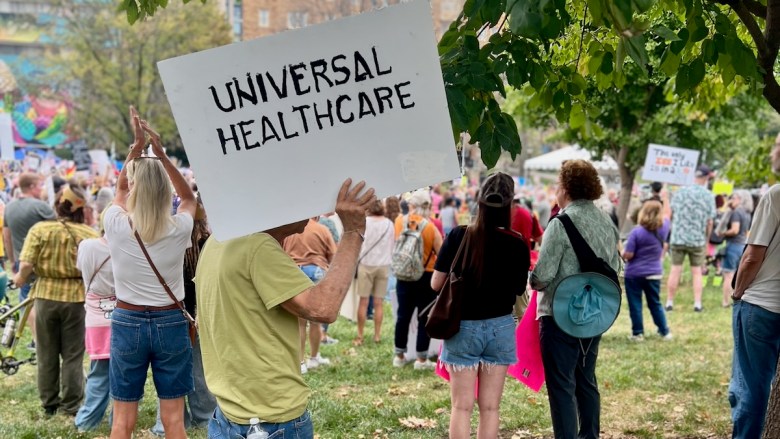
Beginning in January, Rachel Nidin, a 30-year-old sushi chef who lives in Kansas City, Kansas, will have to pay an extra $70 a month for the health insurance she buys through the Affordable Care Act marketplace.
Paula “PJ” Beasley doesn’t know yet how much her ACA plan will cost next year, but she knows she can’t afford more than the $20 a month she’s currently paying. The 64-year-old Midtown resident already relies on a food pantry to make ends meet.
Takeaways
- After an apparent deal that will end the 40-plus-day federal government shutdown, many Kansas Citians can expect to pay substantially more for Affordable Care Act marketplace insurance next year.
- Analysts expect the increased prices will add almost 5 million people to the country’s uninsured population, straining hospitals and economies.
- Insurance experts urged people to look at options for coverage next year well before Jan. 15 when the open enrollment period closes.
Nidin plans to figure out a way to pay the higher rate. She needs sinus surgery and couldn’t afford it without insurance.
Beasley may have to go without coverage until Valentine’s Day, her birthday, when she will qualify for Medicare. But that’s a difficult choice for someone with serious health conditions, including thyroid eye disease, which has stolen much of her vision.
“Sometimes I just sit and cry,” Beasley said, “because it’s so unbelievable.”
Thousands of Kansas Citians getting health insurance through the ACA marketplace, also known as Obamacare, are weighing options for 2026 coverage. As open enrollment gets underway, many are learning they will face substantially higher costs.
The health research firm KFF estimates that nationwide, average out-of-pocket annual premium payments will more than double to $1,904 in 2026, from $888 this year.
Most insurance companies providing coverage are raising premiums, which accounts for part of the cost increase. But for many people, the bulk of the price jump can be traced to the expected expiration of federal tax credits, which for the last four years have heavily subsidized premiums for most of the 24 million Americans enrolled in the ACA marketplace.
Those tax credits expire on Dec. 31. Democrats made extending them their primary demand in a budget fight that shuttered the federal government for more than 40 days this fall. But a Nov. 9 deal to pass a budget resolution does not include promises from Republicans to fund extended tax credits.
That means many people will be left with unaffordable insurance bills, which is likely to increase the uninsured population.
People will have to pay substantially more
ACA health insurance prices vary based on a person’s age, income and address. (You can visit KFF’s calculator to get an idea of what your 2026 rates could be.) But without federal subsidies, many people’s costs will go up next year.
The Center on Budget and Policy Priorities predicts that a family of four making $66,000 a year in Missouri or Kansas will have to pay $4,477 in annual premiums for ACA plans next year, compared to the $1,452 they’d pay if tax credits were extended.
For a family of four making $130,000, annual ACA costs would jump from $11,050 to $25,705 in Missouri and from $11,050 to $23,212 in Kansas. That means that nearly 20% of their income would have to be directed toward paying for health insurance.
According to KFF, of higher income earners (those making 400% of the federal poverty level) enrolled in ACA plans, 51% are 50 to 64 years old and 38% are self-employed. They are among the groups that can expect the biggest premium jumps.
In Kansas, a 60-year-old couple with $85,000 in income would see annual ACA costs jump 373% to $34,148 without enhanced tax credits, compared to $7,226 with them. A similar couple in Missouri would see costs climb 327% to $30,835, compared to $7,225 if the subsidies continue.
But the situation will likely be even more desperate for older adults who have the least income, said Amber Christ, managing director of health advocacy for Justice in Aging, a national advocacy group.
Even a small monthly increase in premium costs could be devastating for someone on a fixed income who is already struggling with the rising costs of food, rent and utilities.
“They have the least amount of resources to weather this, and are more likely to have chronic conditions and health care conditions that warrant health care coverage,” Christ said.
Keep forging ahead
Beasley hasn’t gotten a clear answer about exactly how much her ACA coverage may increase next year. She’s been told it could go up $100 a month. Paying that much, even for a short time, she said, would be impossible.
Beasley lives on Social Security. Her vision loss has made it impossible for her to work for several years, and she barely has enough money to pay the bills she has now.
“I don’t know what I will do in the month of January,” Beasley said, “I really don’t know. I’ve just got to keep forging ahead and be grateful for the people who are helping me.… I never thought I would be in this situation.”
Beasley has lived without insurance before. As an independent contractor, she couldn’t always afford insurance before she found a plan on the ACA marketplace. But she knows the health issues she is dealing with today might not be as bad if she’d had regular, reliable and affordable health care in those days.
When Beasley’s vision started to fail about four years ago, she paid out-of-pocket to see eye doctors.
“I kept saying, ‘You’ve got to get my cataracts out. I can’t see,‘“ she said. “They all gave me new prescriptions, but it didn’t work.”
They didn’t understand what was wrong, Beasley said. If they had, she would have made different choices and gotten care that could have slowed the progression of her disease.
“All the time I was having different symptoms through the years,” she said. “I had no idea that it was related to my thyroid.”
As things stand now, Beasley can’t drive. She needs a magnifying glass to read. She has lost depth perception, so she often falls even when she is just walking around her apartment.
But, thanks to the health insurance she could afford through the ACA after Congress passed enhanced tax credits, Beasley now has reliable care and doctors who understand how to treat her conditions.
Since getting health insurance, she has gone through four surgeries, which have helped her vision a little bit. She also has access to other doctors who are helping her manage her Graves’ disease and an inner ear disturbance that makes her dizzy and nauseous for unpredictable periods.
Beasley is reluctant to give that up, even for six weeks while she waits to turn 65 and enroll in Medicare. But she is one of millions who may have to drop insurance if enhanced tax credits expire.
Millions more uninsured
Enhanced premium tax credits, which Congress first adopted in 2021, have led to enrollment on the ACA marketplace doubling. In just four years, the number of people covered by ACA plans has climbed from 12 million to 24.3 million.
In Missouri, 417,000 people enrolled in the marketplace this year, up from 202,000 in 2020. And in Kansas, more than 200,000 individuals enrolled this year, compared with fewer than 86,000 in 2020.
Experts said that if tax subsidies expire, rising costs will lead to an equally rapid decline in marketplace enrollment. And that will have consequences across the health care ecosystem.
A September study from the Urban Institute and The Commonwealth Fund found that, overall, 4.8 million more people will become uninsured in 2026 if the tax credits expire. More than 7 million people are expected to lose marketplace coverage, but some will find insurance elsewhere.
“This is not something that can stand,” U.S. Rep Sharice Davids, a Roeland Park Democrat, said during a Nov. 4 press conference. She introduced two Kansans who risk losing coverage due to rising rates.
“I just want to make sure everybody recognizes that these aren’t just numbers,” Davids said. “These are devastating numbers. But this is families facing impossible choices between paying for health care and paying for groceries and rent and medicine.“
Even if Congress acts to extend the enhanced premium tax credits, the ACA still will undergo changes that could affect enrollment and costs. President Donald Trump’s budget bill adopted in July along with a new Centers for Medicare and Medicaid Services rule will cause people to pay more and lose coverage even if tax credits are extended, experts said.
Changes include a shorter annual enrollment period, a stricter verification process, an end to automatic reenrollment and restrictions on coverage for legal immigrants. including “Dreamers.” The new CMS rule upends how insurance payments are calculated, which could drive up premiums and force people to pay more for deductibles and copays.
People losing insurance coverage through the ACA marketplace, combined with people who will lose Medicaid thanks to almost $1 trillion in anticipated federal funding cuts to the program, could increase the country’s uninsured ranks by 14 million by 2034, according to the Congressional Budget Office.
That will have negative consequences not only for people’s health, but also for the entire economy, said Brian Colby, vice president of public policy with the Missouri Budget Project. As the uninsured population increases, hospitals and doctors will need to treat more patients who can’t pay their bills. That strains the providers and the wider economy.
The Commonwealth Fund predicts that expiring ACA tax credits could lead to nearly 340,000 jobs lost and a $40.7 billion decline in states’ gross domestic products. That exceeds the $31 billion the federal government would save by not continuing the tax credits.
Missouri could lose 5,100 jobs, $38 million in state and local taxes and see its GDP fall by $614 million. Kansas could lose 3,200 jobs, $25 million in state and local taxes and see its GDP fall by $378 million.
“We’re just going backwards,” Colby said, “and we’ll start to see that number of covered folks decline, making it harder and harder for providers — in rural areas especially.”
Safety net hospitals like University Health in Kansas City will be especially hard hit, he said.
Amid rising costs, know your options
Nidin is one of about 90 people who met with an insurance navigator at Kansas City’s Samuel U. Rodgers Health Center last week during the first days to sign up for 2026 coverage. Open enrollment ends Jan. 15.
She found out pretty quickly what she would be facing — a jump from $13 a month, the rate she’s paid the last two years, to more than $85.
Her job making sushi at a Bonner Springs grocery store doesn’t provide health insurance. She’s already decided she’ll continue ACA coverage, though paying the higher price will mean cutting other things out of her budget.
“I need insurance,” Nidin said. “I always have to see my doctor. … I don’t want to pay out of pocket.”
Sam Rodgers is one of a few remaining places that offer insurance navigation services to help people find and sign up for insurance coverage. Federal budget cuts earlier this year eliminated much of the assistance that has been available in the past.
Jim Torres, the community health center’s program manager for health insurance services, said people are finding that affordable options will be a lot more limited next year.
“They’re kind of stuck with a bad option,” he said. “Will I pay more for insurance that isn’t as good? Or do I just forgo it and take my chances?”
But, he added, it’s important for people to check and not simply assume they will be priced out. Every case is different.
“A consumer really doesn’t know what their options are until they come back and update their income and household information and start shopping for plans,” he said.