


Amanda’s 10-year-old son struggles with social anxiety, making friends and being challenged enough in his Raytown elementary school.
She had encouraged the fifth grader with the promise that middle school would be better.
Takeaways
- Raytown schools are planning for a projected decline in enrollment.
- The district is asking for public feedback on two draft plans.
- One plan would close Raytown Central Middle School and move sixth graders into elementary schools.
He would have access to activities like cross-country, swim team, band and orchestra and would mix with “a wider variety of kids,” including his gifted-program friends from other elementary schools.
So when she learned that the school district was considering a plan to keep sixth graders in elementary schools, Amanda, who asked to be identified by only her first name because she works for the district, started to worry.
“We’ve been making these promises of ‘middle school’s going to be so much better,’” she thought. “And now he’s stuck again.”
Amanda was reassured after attending a recent online forum that the district held to explain two plans it’s considering. She learned that the potential change wouldn’t happen soon enough to affect her son, and she doesn’t anticipate problems for her younger daughter.
But for other families, the changes could be significant.
By the 2027-28 school year, Raytown Central Middle School might no longer exist as a middle school, under plans the school district is considering.
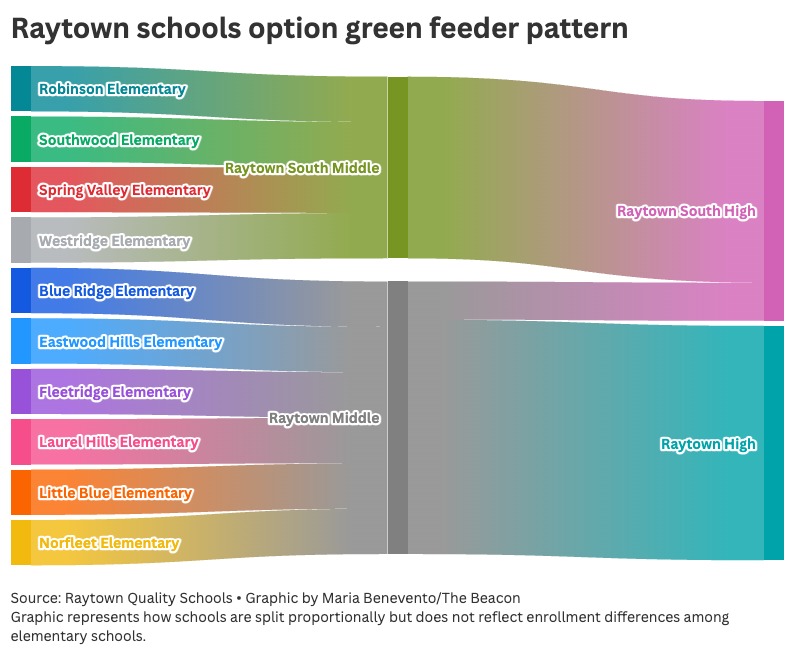
Raytown South Middle School and Raytown Middle School would serve seventh and eighth graders only, while the district’s 10 elementary schools would cover grades K-6 rather than the current K-5. Some neighborhoods would be assigned to different schools.
In all, the district estimates more than 1,100 students would be affected. K-12 enrollment for the whole district was less than 7,500 during the 2024-25 school year, according to preliminary state data, the most recent available.
But that future isn’t set in stone. This idea, known as the “green plan,” is one of two draft ideas the district is circulating, asking for feedback from the public ahead of an Oct. 13 presentation to the school board.
Under the alternative “orange plan,” some school boundaries would still change, but the overall impact on the district would be smaller.
Raytown Central Middle would remain open with a smaller number of students reassigned to make space for about 40 to 60 students from Raytown Success Academy, the district’s alternative school.
The district estimates about 220 total students would be affected under the orange plan.
Both proposals are attempts to address predictions that the district will shrink over the next five to 10 years.
“First and foremost, anytime we put any planning in place to make adjustments, it must be beneficial to children,” Raytown Superintendent Penelope Martin-Knox said. “We also need to keep in mind the financial responsibilities we have as a district.”
Why this is happening
A demographic study the district commissioned predicted enrollment will drop by about 5%, more than 400 students, between the 2024-25 and 2029-30 school years. Over the following five years, it could lose another 1% of its students.
That’s largely because the birth rate in the Raytown school district, which covers nearly all of Raytown and parts of eastern Kansas City and southwestern Independence, is too low to maintain the population, the report says. It predicts families moving into the district won’t be enough to compensate and that the median age of district residents will rise.
So Raytown school leaders have to start thinking about how to use resources most efficiently for a shrinking number of students, as well as adjusting for population shifts among neighborhoods.
In Missouri, public schools receive funding based on how many students attend. So when a district shrinks, so do its financial resources. Costs don’t decline at the same rate unless the district takes steps to become more efficient, such as consolidating into fewer buildings.
Martin-Knox said either plan would save the district a similar amount of money, but that she didn’t have a specific dollar amount to cite. She said savings in either case would come from moving Raytown Success Academy into the Raytown Central Middle building instead of renting space from a church, as the district currently does.
There wouldn’t be any major savings from reducing the number of middle schools since the building would stay in use for the Success Academy and other programs, Martin-Knox said. Instead, the benefit of the more-complex green option would be primarily academic.
There’s no conclusive research that having sixth grade in elementary schools is best, Martin-Knox said. But she said sixth graders’ academic performance tends to dip nationwide as kids adjust to switching classrooms, using lockers and having a bit more freedom.
Keeping kids in elementary schools for an additional year postpones that difficult transition until they’re a little more mature, Martin-Knox said. It also aligns with how some neighboring districts handle things, which could be easier for students who move from district to district.
Martin-Knox said that doesn’t include Kansas City Public Schools, which structures schools in several ways and is planning to open an additional middle school to move sixth graders out of neighborhood elementary schools.
She also emphasized that neither plan is meant to include layoffs.
“There are no plans to eliminate staff,” she said during an online forum. “We believe in investing in our people.”
Green vs. orange
In September, the district unveiled two draft plans, asking for community feedback through a survey and holding in-person and virtual forums on Sept. 18 and Sept. 24, respectively.
Chief communications officer Marissa Cleaver Wamble said about 50 people attended the in-person event and 30 attended online.
Raytown elementary school options
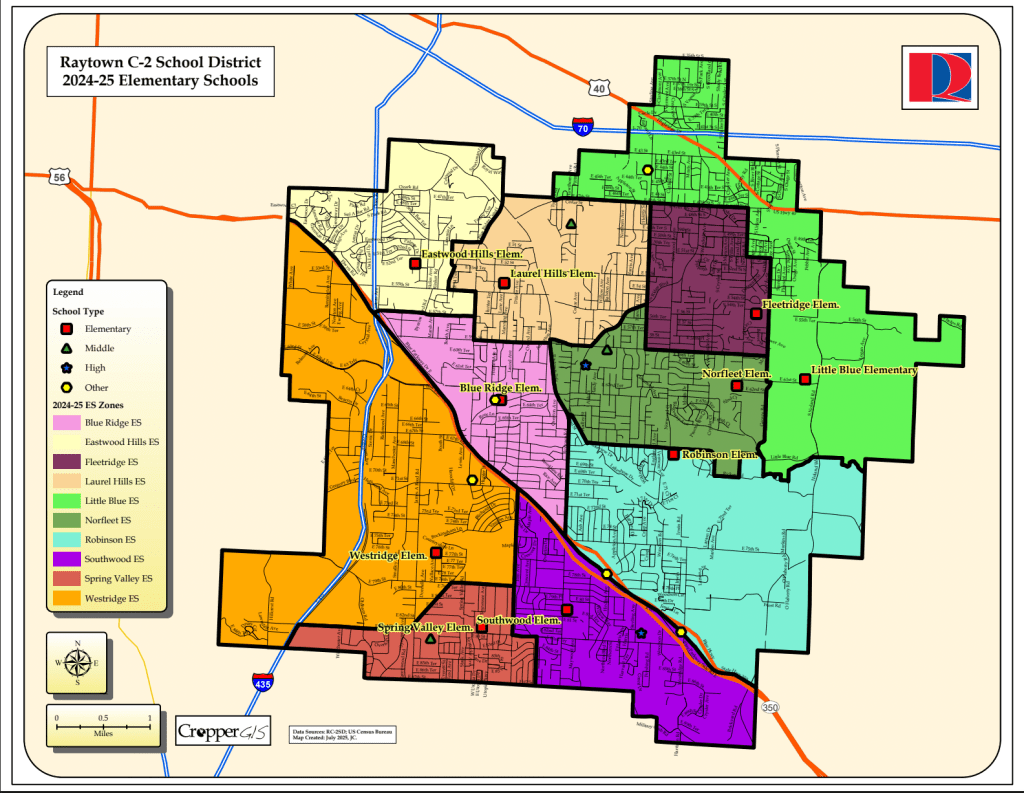
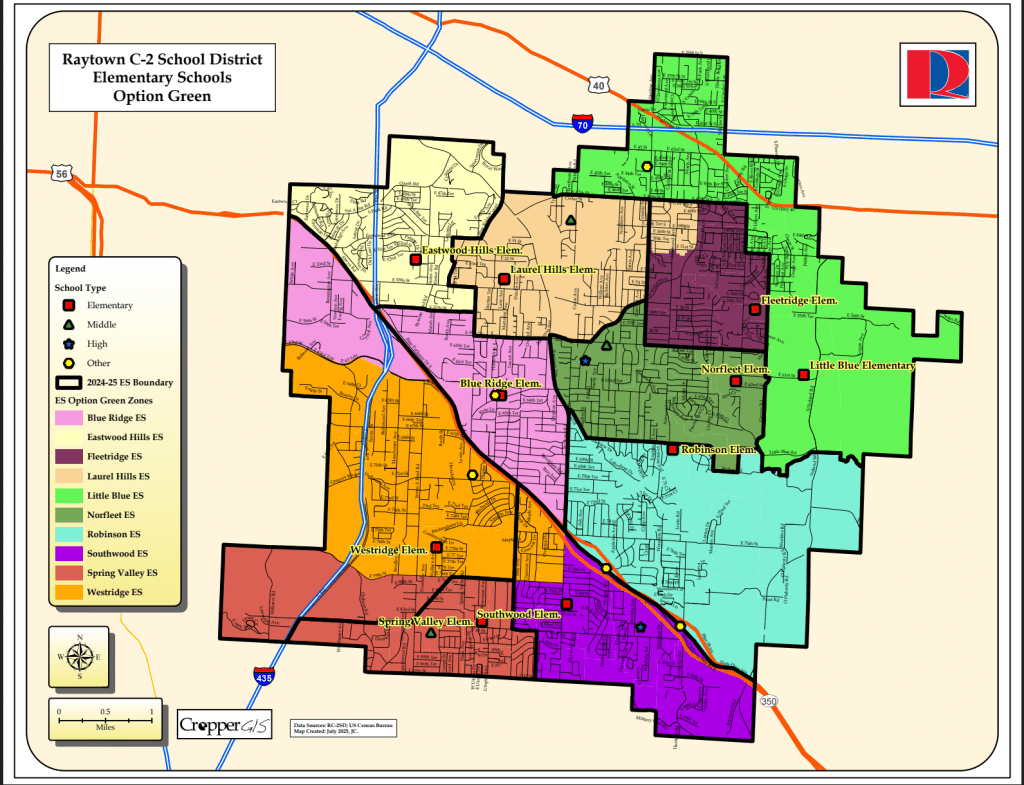
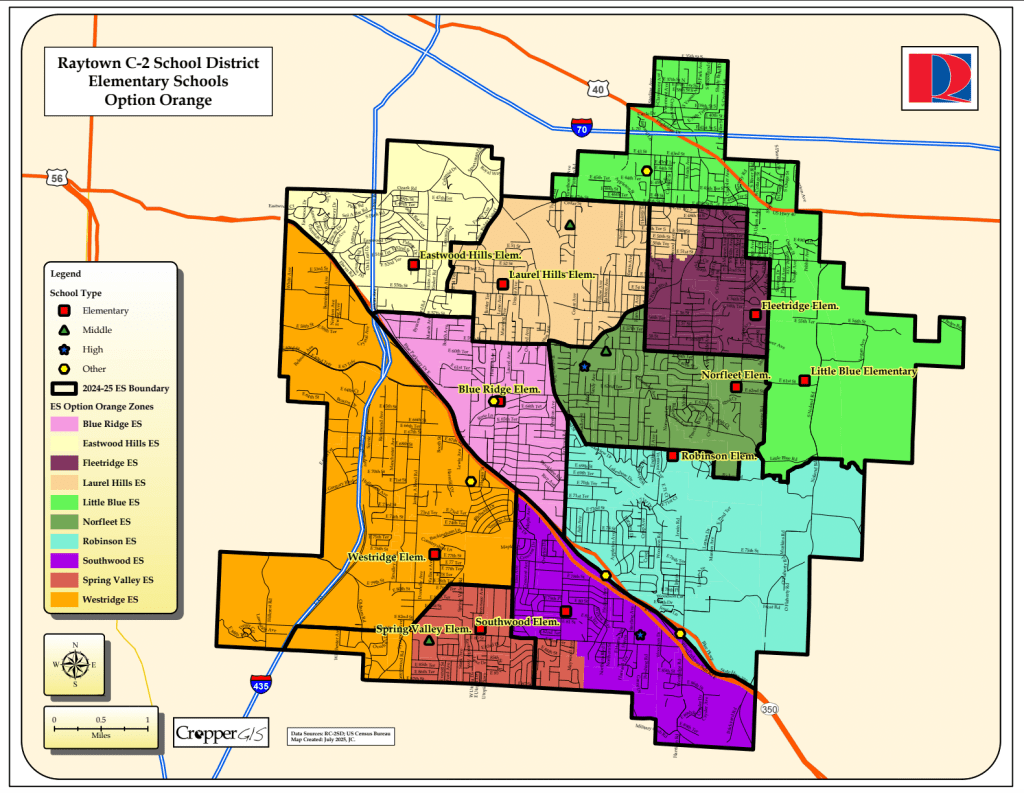
Both plans juggle a number of factors, such as keeping neighborhoods together, minimizing disruption and evenly distributing students.
Ideally, the district aims for all students from each elementary school to move on to the same middle school, then on to the same high school. If not, it aims to divide them evenly when they advance so a small group of students isn’t separated from most of their classmates.
Currently, each elementary school feeds into only one middle school. But students from both Raytown Central Middle and Raytown Middle get split up when they go to high school.
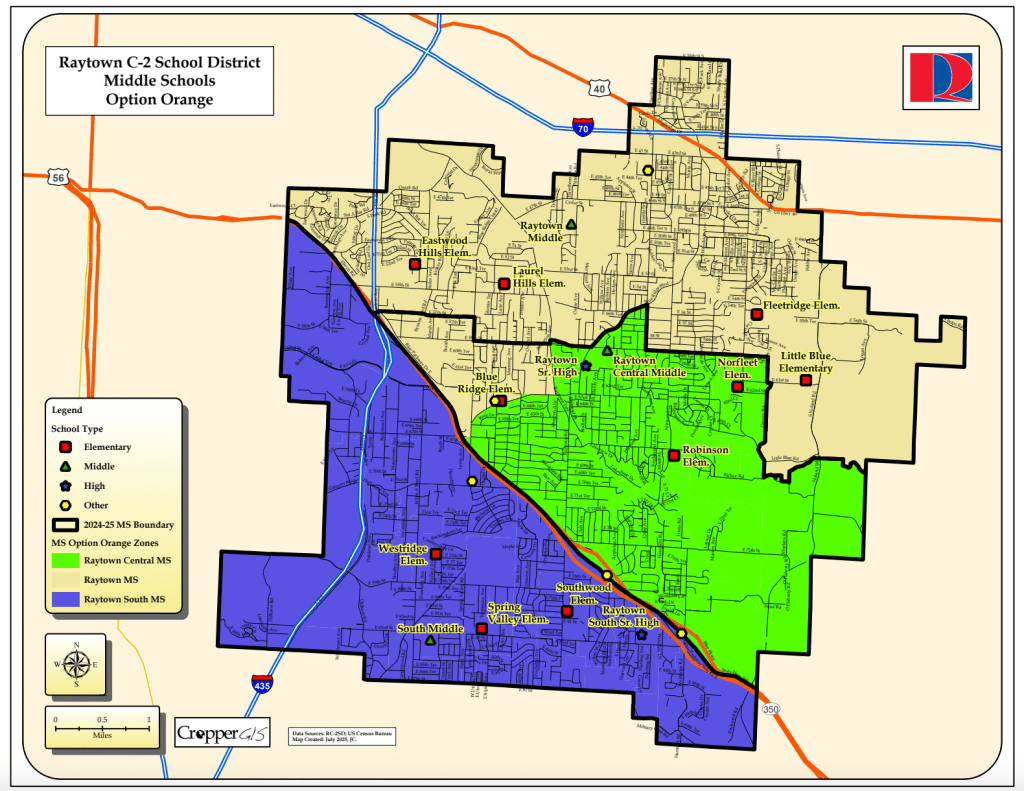
Raytown middle school options

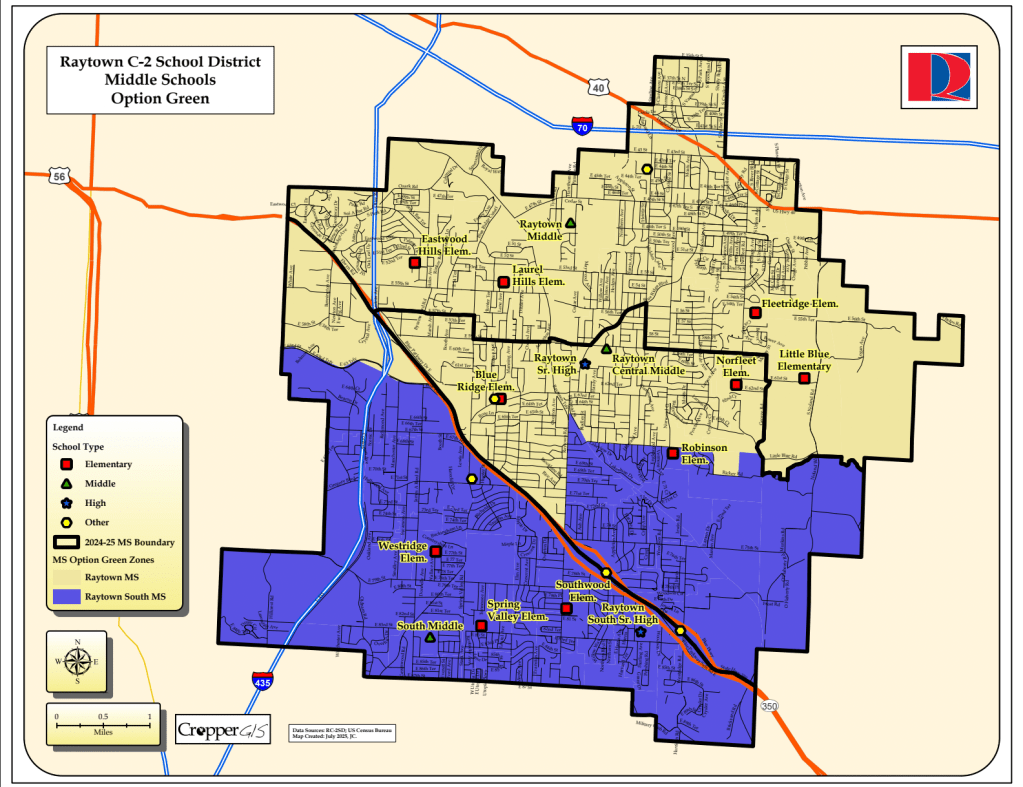
The most uneven split is for Raytown Middle School students. Most attend Raytown High, but 3% move on to Raytown South High.
Either proposal would reduce the total number of “splits,” when students who start out at the same school and don’t change addresses are separated when they advance to middle or high school.
The district tracks whether students who don’t move houses would attend the same middle school as all of their elementary classmates, attend the same high school as all of their middle school classmates or attend the same high school as all of their elementary classmates.
Raytown high school options
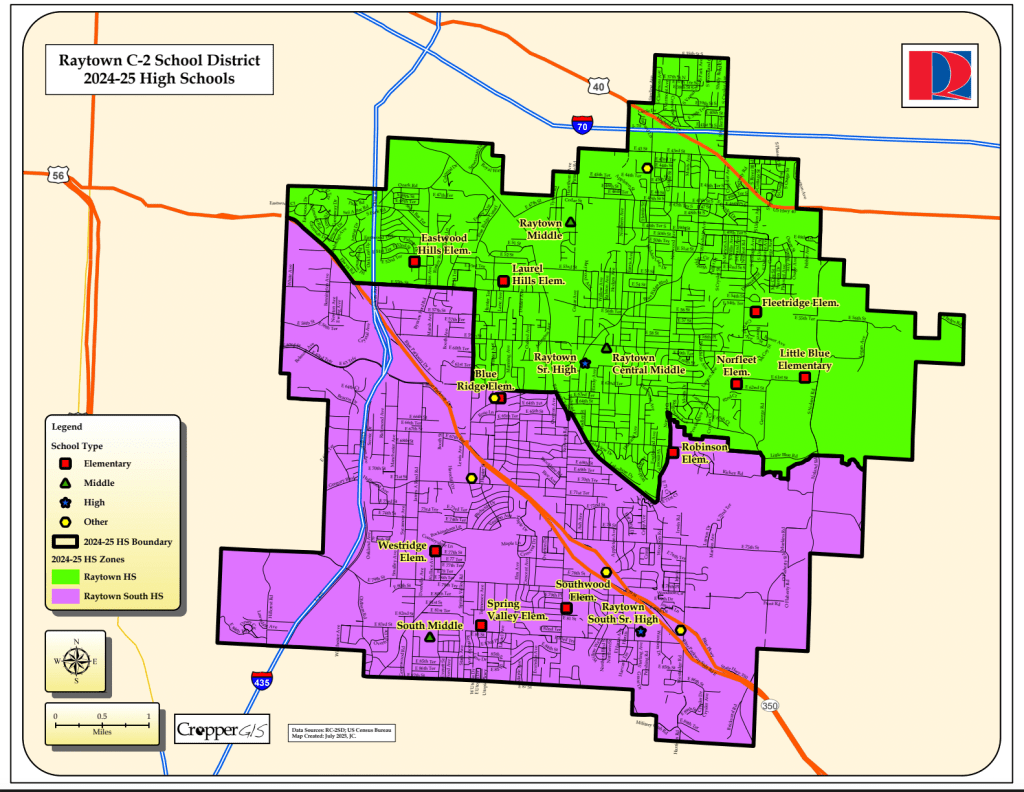
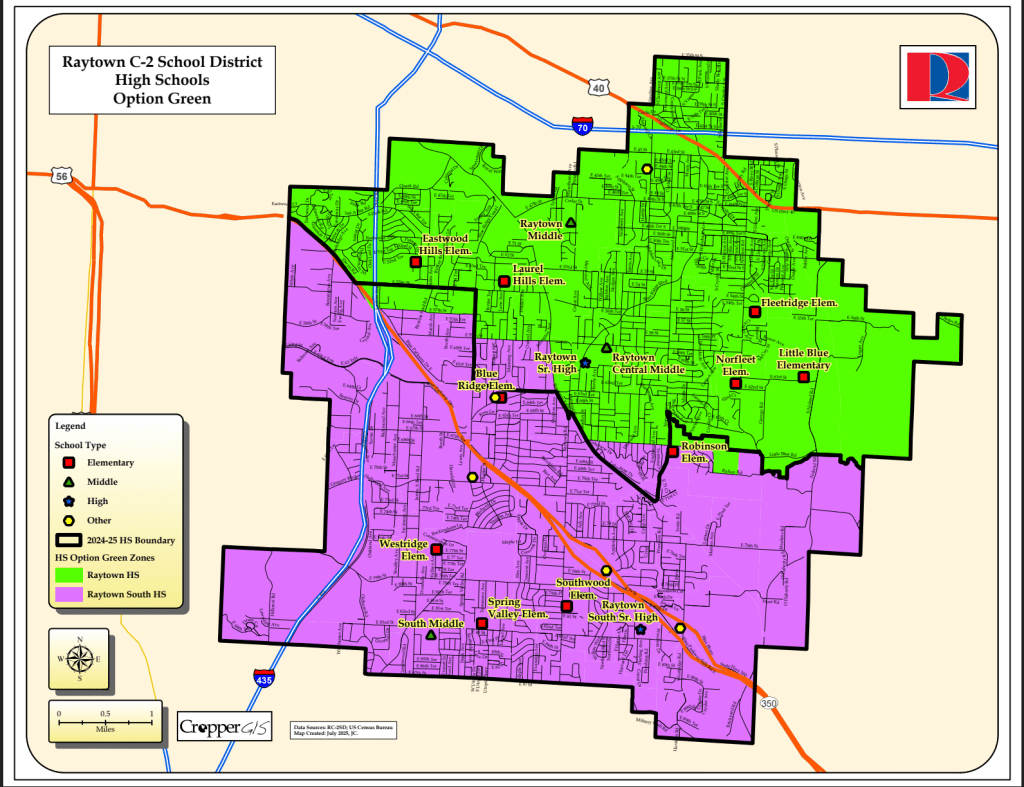
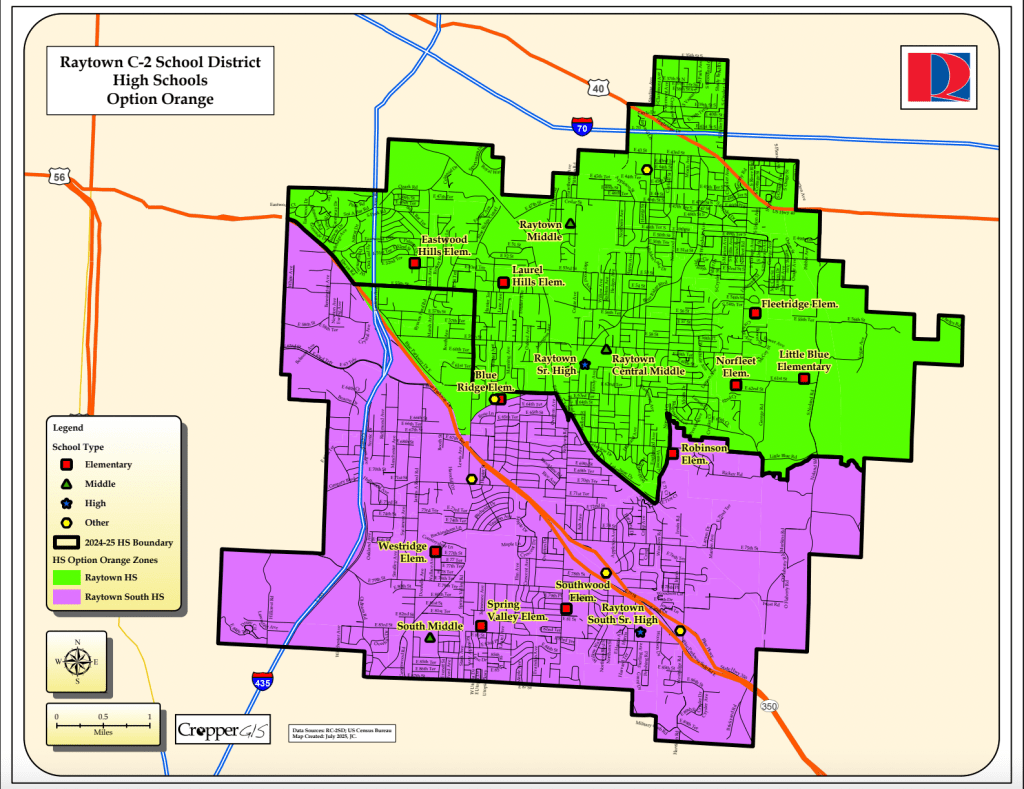
For both plans, numbers are based on 2024-25 enrollment and could be different by the time the plan would actually go into effect.
Under either plan, the district is considering allowing students who would have been in their last year at a school — such as eighth graders or high school seniors — to remain there even if the new boundaries place them in a different school.
Here’s what each plan would entail:
The green plan
Raytown Central Middle School would close as a middle school and be used for other programs such as Raytown Success Academy under the green plan.
The district would find other placements for Raytown Central Middle staff, and sixth graders would be part of elementary schools rather than middle schools.
About 60% of the district’s seventh and eighth graders would attend Raytown Middle School. The rest would attend Raytown South Middle School.
Due to boundary changes, 160 elementary school students from Fleetridge, Southwood and Westridge elementary schools would change schools, moving to Laurel Hills, Westridge and Blue Ridge or Spring Valley, respectively. Five Raytown South Middle students would switch to Raytown Middle. And about 100 high school students would swap to the other high school.
There would be only one “split:” Students living in the Blue Ridge Elementary zone would all attend the same middle and high school. But they’d be separated from their other middle school peers when they advance to high school.
Changes could happen in the 2027-28 school year.
The orange plan
Raytown Central Middle School would remain open as a middle school and sixth graders would stay in middle schools.
Raytown Success Academy, the district’s alternative school for students who struggled to succeed in a traditional classroom, would move into the Raytown Central Middle building. The district currently rents space for the academy from a church.
Due to boundary changes, about 100 elementary students from Fleetridge, Southwood and Spring Valley would switch to Laurel Hills, Spring Valley and Westridge, respectively. About 60 Raytown Central Middle students would switch to Raytown Middle. And 65 Raytown South students would switch to Raytown High School.
When Blue Ridge Elementary students advance to middle school, they’d be split about 60-40 between Raytown Central Middle and Raytown Middle. Raytown Central Middle would be split nearly 50-50 when students advance to the district’s two high schools.

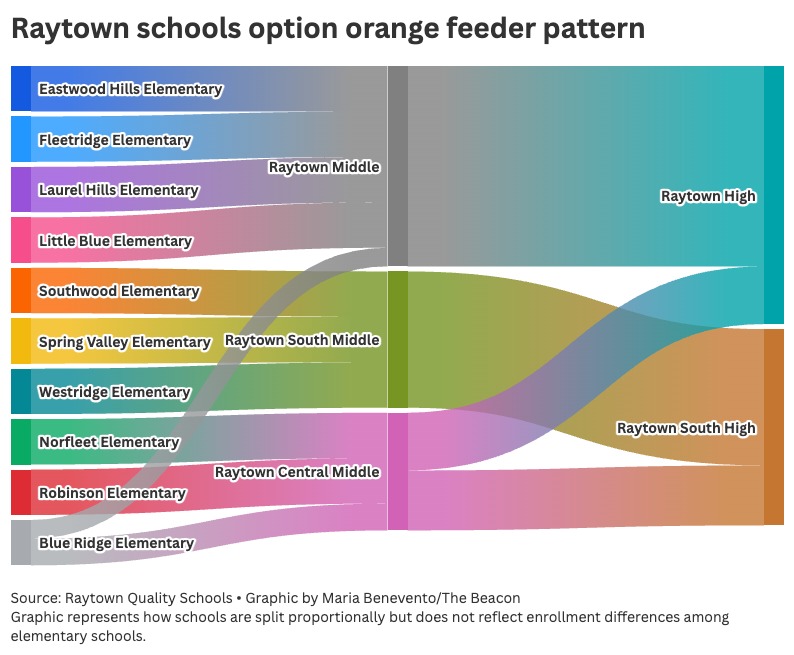
That would lead to students who started at Blue Ridge or Robinson elementary schools not landing in the same high school as all of their elementary school classmates.
Changes could happen as early as the 2026-27 school year.
Questions and next steps
Some parents have expressed confusion about the proposed changes on social media and through private messages to one another.
During the virtual forum in September, many of the questions were about activities that sixth graders normally have access to in middle schools and whether they would still be able to participate in elementary schools.
Martin-Knox said the district will work to make sure sixth graders still have access to things such as arts programs, extracurriculars and gifted programs.
“This is not a change in program. This is just a change in placement,” she said. “This would take a lot of planning on our part, but what we’re not going to do is eliminate opportunities for our children to continue to grow.”
Amanda, the parent of a fifth grader, said she has questions about how the district would manage logistics such as transportation and timing to allow sixth graders in elementary schools to participate in middle school activities.
“But I know that’s all part of the planning process,” she said. “It’s one step at a time.”
Amanda said that even though she’s no longer worried about the impact on her children either way, she favors the less-complex orange plan.
“It disrupts the least amount of students,” she said. “That just makes more sense.”
The district opened a survey to collect feedback on the two specific plans from Sept. 18 through Sept. 30. After the survey closes, people can give feedback through a more general feedback form, and members of the public can always contact school board members, who will ultimately vote on a plan.
Members of the public can visit the Raytown enrollment planning website to view information such as the demographic study, data and maps for both draft plans and an interactive web map.
District administrators plan to settle on a single plan to present to the board during its Oct. 13 meeting, Martin-Knox said. The board could vote on the plan right away, take more time to deliberate or ask for changes.
“We have so many people who are invested, and I appreciate the investment,” she said during the Sept. 24 online forum. “We have to continue to move forward to do what’s best for our school district and for our community.”
