


Six decades ago, Kansas City architects were already grappling with the housing needs of an aging population, at a time when adult children were increasingly unlikely to care for their parents.
In the July 1963 issue of its monthly journal, “Skylines,” the Kansas City chapter of the American Institute of Architects devoted a special section to local senior living projects designed by area firms. The graying of America would continue, the article said.
Takeaways
- Swope Health is developing a $126 million multiuse campus on the grounds of a shuttered nursing home.
- The project is designed to serve the affordable housing and service needs of the rapidly growing number of seniors.
- So far, backers have secured $25 million to start building the first phase of the campus, which could take a decade to complete.
One project of note was the $700,000 expansion of a privately owned facility at 5900 Swope Parkway, where “white jacketed waiters serve dinners for which wine is a nicety of daily living.”
Built in 1957, Swope Ridge nursing home eventually expanded further to a licensed capacity of 240 beds and transitioned to the nonprofit Swope Ridge Geriatric Center.
Through the years, Swope Ridge evolved from a haven for comfortably well-off residents into a financially troubled nursing home serving mostly frail low-income seniors.
Swope Ridge’s closure in 2022 barely made a ripple in the wider community. But it left a hole in the surrounding Town Fork Creek neighborhood.
Now, Swope Health is proposing a $126 million intergenerational development on the former Swope Ridge property — the largest such endeavor in the safety-net provider’s nearly 60-year history.
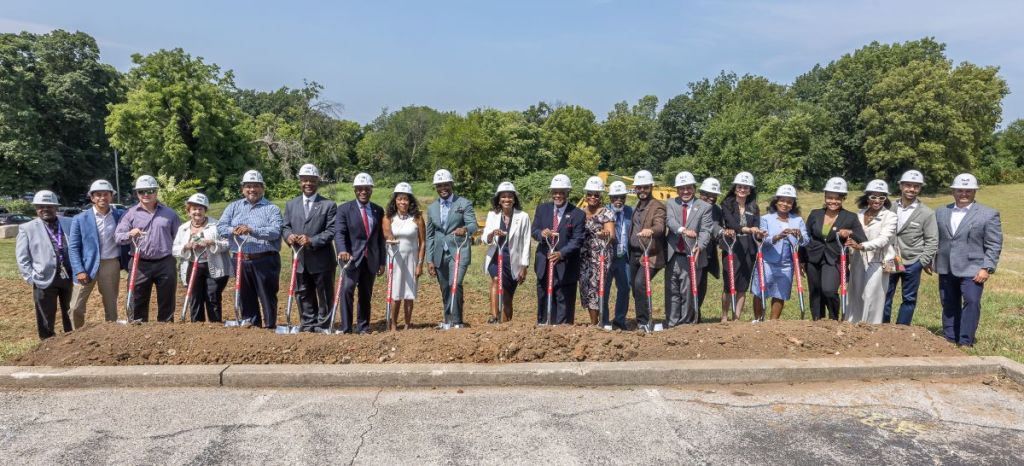
Fundraising is ongoing for the 12-acre development, which could take a decade to complete, but Swope Health has secured about $25 million needed to start the first phase of Swope Health Village. It held a groundbreaking on Aug. 7, which included remarks from Kansas City Mayor Pro Tem Ryana Parks-Shaw.
Swope Health Village is “for the neighbors who said to me when Swope Ridge was closing, ‘Now, councilwoman, what are you going to do about that? We don’t want this blighted. We don’t want this closed building here. What about those people over there? What about those people in that building?’” Parks-Shaw said.
“And I am so grateful for the opportunity to be able to say that we are here and we are delivering on the promises that we made.”
The ‘gray revolution’
The Kansas City architects in 1963 had a clear crystal ball.
In 2020, people aged 65 and older comprised 16.8% of the population, according to the U.S. Census Bureau, compared with 9.2% in 1960. In raw numbers, the population of seniors had risen during that period from 16.6 million to 55.8 million.
Meanwhile, KFF Health News, a national nonprofit newsroom, reports that about 28% of people 65 and older live alone, including nearly 6 million men and more than 10 million women. (Those figures don’t include seniors living in institutions, primarily assisted living and nursing homes.)
And in May, Harvard University’s Joint Center for Housing Studies highlighted the “dual burden” of health care and housing facing U.S. seniors.
The study said that one-third of older households experienced housing cost burdens (meaning they spent more than 30% of their income on housing), and that about three-quarters could not afford a single home-care visit after paying housing and living costs.
As KFF Health News summarized, “This ‘gray revolution’ in Americans’ living arrangements is fueled by longer life spans, rising rates of divorce and childlessness, smaller families, the geographic dispersion of family members, an emphasis on aging in place, and a preference for what Eric Klinenberg, a professor of sociology at New York University, calls ‘intimacy at a distance’ — being close to family, but not too close.”
Consider the “modern residential campus” Swope Health has planned for Swope Health Village — one response to the growing housing needs of an aging nation.
In addition to 200 units of affordable housing for seniors, Swope Health’s plan includes another 90 units for mental health housing and for participants in its Programs of All-inclusive Care for the Elderly (PACE KC). Also planned are 10 beds for substance abuse treatment in collaboration with the Kansas City court system.
Swope Health is pursuing the project as a mixed-use Purpose Built Community that also includes retail space, services from the Kansas City Health Department, plus community gardens and a community center.
“When we talk about holistic care and really care that centers people, we’re defining health care as a broader umbrella,” said Swope Health CEO Jeron Ravin.
For instance, he said, in accordance with the Purpose Built Community pillar of economic vitality, Swope Health envisions space on the campus where community-based organizations offer classes on topics like banking and financial literacy.
Swope Health Village might also be a venue to train aspiring chefs and other entrepreneurs, while also having space to introduce students to health care careers.
Swope Health Village is part of a nationwide trend, said Sonja Bachus, chief experience officer for the National Association of Community Health Centers. She attended the groundbreaking.
She said health centers like Swope Health are embracing the concept of providing care from birth onward and recognizing that circumstances outside the exam room, such as quality affordable housing, impact health.
“When we look at working to keep people as fully functioning in their own space as long as possible, this type of development is how that happens, as opposed to people having to move their loved ones into a full-service nursing home earlier on,” Bachus said. “I think there’s a lot more opportunity for longer autonomy for seniors when they have this kind of infrastructure.”
Ravin credited staff and leadership at Swope Ridge for doing all they could for as long as they could.
But insufficient Medicaid reimbursements and an aging structure meant the facility could no longer provide quality care, even as staff size and available usable space reduced occupancy to around 80 residents when Swope Ridge officials decided to phase out operations as alternative accommodations could be secured.
Swope Health needed to step up, Ravin said.
For Swope Ridge “to no longer exist and not have any type of replacement services” would have been a “significant disservice to the community,” Ravin said.
Initial support for Swope Health Village has included $12.5 million in city and state funding.
Ravin said Swope Health will continue to pursue public funding for future phases, and he hopes the philanthropic community will contribute as well.
Losing an anchor
Not long after the 1963 Skylines article, a five-page McGraw-Hill publication featured Swope Ridge as its nursing home of the month.
The spread highlighted the physical therapy program that owner Albert G. Incani had instituted and noted various resident committees like the one that published the bimonthly Guys and Dolls newspaper, which had a circulation of about 1,000 readers, including residents, their families, physicians and clergy.
As late as 1997, the Kansas City magazine Ingram’s headlined its story about Swope Ridge as the “Miracle in Midtown” for continuing to provide top-notch care even as suburbanization had transitioned its residents to a lower-income population.
That’s the neighborhood anchor remembered by Lisa Ray, 57, president of the Town Fork Creek Neighborhood Association.
She was a candy striper there as a teen, delivering soap, lotion, deodorant and other sundries to the residents as part of central supply. The Swope Ridge she knew then was a nice place where middle-class minorities from nearby areas could stay in familiar surroundings once they were unable to live on their own.
Swope Ridge’s closure not only left a void for seniors in the community, Ray said, but it also eliminated jobs within walking distance for area workers. She now sees some of the workers walking to Prospect Avenue, about a dozen blocks west, to take a bus to their jobs.
As one of the people bending Parks-Shaw’s ear about the fate of the Swope Ridge site, Ray is cautiously optimistic about Swope Health Village. She said residents will be inclined to support Swope Health because of its long service to the community.
That being said, she wants to ensure that, like Swope Ridge, the senior housing serves seniors in and around Town Fork Creek. Given the cost of new construction, Ray also wondered how developers can keep the units within the price range of the intended population.
Parking and traffic are also concerns, given the multipurpose uses envisioned for Swope Health Village.
“I don’t think (residents) are going to be used to so much busyness going on in the area,” Ray said.
But if there is anyone who knows the value of letting seniors stay close to home as they age, it is Ray.

Her 97-year-old grandmother, Elizabeth Ray, was a Swope Ridge resident when it closed.
Elizabeth Ray was a cook in the Kansas City School District for 40 years. She worked primarily at the old Crispus Attucks Elementary School, but was also a trainer in other buildings.
Elizabeth Ray was also a take-no-mercy poker player who didn’t even let up on kids.
“She was a pistol,” Lisa Ray said. “She lived life to the full-est.”
When Swope Ridge closed, Elizabeth Ray moved in with her daughter, who was in her 70s at the time, so it was hard for her to care for an immobile elderly woman.
The family relocated Elizabeth Ray to a nursing home on Southwest Trafficway. She died a couple of years later, and Lisa Ray said the disruption of moving out of Swope Ridge was probably a contributing factor.
“Seniors don’t like change,” she said, “and most of the time when you move seniors, it does something to them. It does.”
