



Dr. Jennifer Mellick, a pediatrician in Olathe, still doesn’t know which of her patients will be getting an updated COVID shot this year.
Takeaways
- The FDA approved the updated COVID vaccine with guidance that it should only be given to people 65 and older or to younger people with health conditions that put them at risk.
- Doctors said most people should still get an updated dose to avoid severe illness and long COVID.
- CDC guidelines, which are expected in mid-September, could determine whether government and private insurers will cover the shot for younger people without health issues.
Like other doctors around the country, she is waiting to see what the Centers for Disease Control and Prevention and its vaccine advisory committee recommend. And how that will influence what government and private insurance plans end up covering.
The Food and Drug Administration licensed the 2025-26 vaccine on Aug. 27, saying its use should be limited to people 65 and older or to younger people with health conditions that put them at risk of more severe illness.
When the CDC gives its final approval, observers said, it is likely that access to the vaccine, which has previously been recommended for virtually everyone on an annual basis, will be restricted. That means insurance plans may stop covering it for people who fall outside the government guidelines.
That’s most of Mellick’s patients — healthy children. Unless their families can afford to pay the $100-plus out-of-pocket cost, she said, they won’t get the shot.
“We’re looking at an issue of the haves and the have-nots,” Mellick said. “You can afford this, but you can’t.”
Doctors disagree
That potential inequity could happen despite the fact that most doctors and public health officials continue to believe most people need a dose of the COVID vaccine every year.
Even if older children and healthy adults aren’t at great risk from the virus, they said, there is always the possibility it can cause severe disease or trigger long COVID, a sometimes debilitating array of symptoms that can last for months or years after an infection.
And doctors said that people should remember getting the vaccine can help protect more vulnerable family and community members.
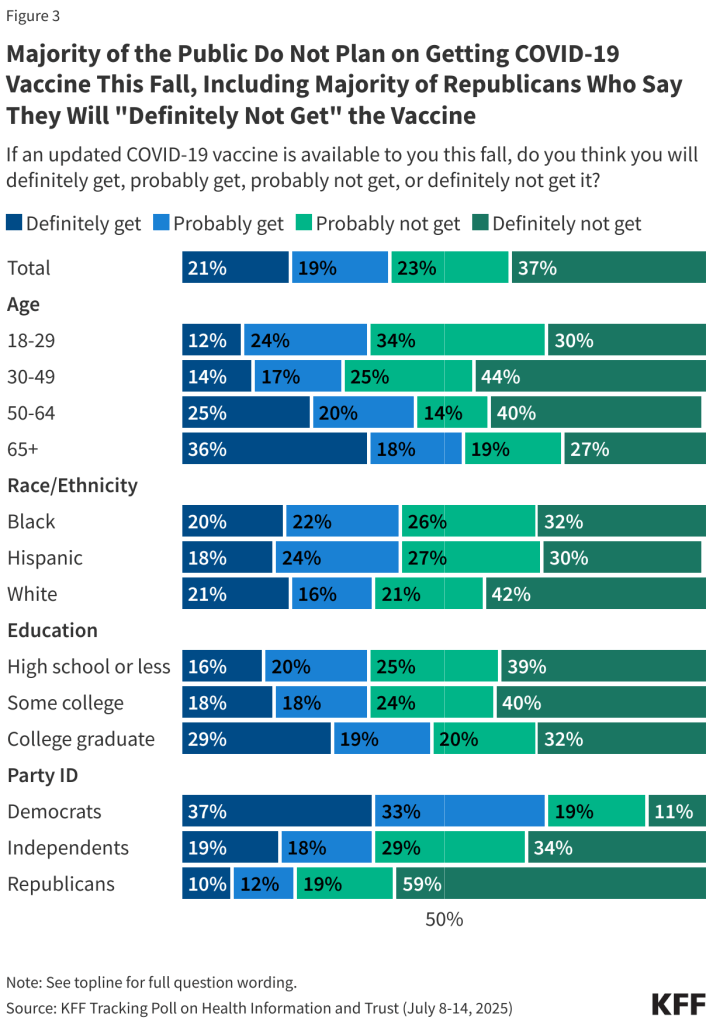
Now experts warn that vaccination rates, already extremely low, would get even worse with new restrictions and added costs. According to a recent KFF poll, the majority of the public didn’t plan to get a vaccine this fall.
That worries Amanda Finley, who has struggled with long COVID since 2020. She facilitates an online support group of more than 16,000 people dealing with the condition who are put at risk when fewer people stay up to date on the shot.
“People just don’t care,” said Finley, who lives in Independence. “They’ve moved on.”
Amber Schmidtke, a microbiologist and assistant dean at Kansas City University, sees the same troubling pattern and agrees that restricting access to the vaccine will not help. She falls in the category of people who may no longer be eligible for an annual COVID shot, but she has vowed to get it anyway.
“This is part of my responsibility as a member of society,” she said, “to look out for those who are more vulnerable.”
COVID has fallen off people’s radar, Schmidtke said.
“I don’t think it’s routine that people have COVID tests in their home,” she said, “and they are less likely to go to the doctor or urgent care to get tested.”
But that can be a deadly choice for people still at high risk from the virus. When people with symptoms don’t test and move about their lives when they unknowingly have it, more COVID will be circulating, which will trigger more related hospitalizations and deaths, Schmidtke said.
Upheaval and eroding trust
Behind the FDA’s new vaccine restrictions is ongoing upheaval at the CDC.
On Sept. 4, Health Secretary Robert F. Kennedy Jr. testified before the Senate Finance Committee about the vaccine debate and other changes he has made since assuming his post, including ousting thousands of employees and, most recently, firing the CDC director.
Kennedy, who has an extensive record speaking out against vaccinations, has eliminated funding for vaccine research. He also dismissed all 17 members of the Advisory Committee on Immunization Practices, the group that advises the CDC about government vaccine schedules and influences which vaccines are covered by insurance. Some of the people Kennedy picked to fill seats on the committee share his anti-vaccine record.
In May, under Kennedy’s direction, the CDC stopped recommending the annual COVID vaccine for children and pregnant women, a change that prompted the American Academy of Pediatrics and the American Academy of Obstetricians and Gynecologists, leading medical organizations, to issue their own opposing guidance.
Now, confusion and mixed messages seem to be spreading across the country.
On Sept. 3, the governors of California, Washington and Oregon said they would form an alliance to make their own vaccine recommendations based on scientific data. Then New York’s governor said she would sign an order allowing pharmacists to give the shot to almost anyone who asks for it.
Meanwhile, Florida Surgeon General Dr. Joseph Ladapo said he would push for his state to end all vaccine mandates, including requirements for children to be vaccinated against measles and other communicable diseases to attend school.
Public health experts and doctors across the Kansas City area worry that the unfolding chaos will erode already-limited trust in public health and vaccines.
“I am concerned that the mere fact that there are these differing recommendations and information coming out is going to sow some additional doubt and make people more reluctant to get vaccinated,” said Charlie Hunt, director of the Johnson County Department of Health and Environment. “I think we’ll have to do a lot of work on messaging to talk about the science and the facts about the vaccine and the disease,”
It’s almost like starting from square one, said Dr. Dana Hawkinson, an infectious disease doctor at the University of Kansas Health System who spent hours during the pandemic educating the public about the virus and the importance and safety of vaccinations.
“In the medical and scientific community, there is huge concern for where we are and where we’re moving — for science and medicine, but also for public health and community health,” he said. “We will continue working to keep our community, our neighbors, our patients — everyone — as safe as they can be.”
Waiting for a COVID vaccine recommendation
Ultimately, it will be up to the Advisory Committee on Immunization Practices to make a recommendation to the CDC about who should get the shot this year. The topic is on the agenda for the group’s next scheduled meeting, Sept. 18-19.
If members follow the FDA’s lead and restrict access to the vaccine, getting a COVID shot will become far more complicated for many people this fall.
Those who fit the FDA guidelines can still log into a chain drugstore’s website for an appointment or stop by a community pharmacy for a shot. Younger people will need to attest to having at least one complicating health condition.
But the parents of healthy children under 18 will need to consult a doctor if they want their children to get this year’s shot. It’s unclear whether Vaccines for Children, a federally funded program that provides free vaccines to low-income children, or Medicaid or commercial insurance plans will cover the cost.
Questions also remain about whether adults younger than 65 without an underlying health condition can get access to the shot. Some pharmacists and doctors said they believe people in that age group could still get the vaccine with a prescription. But whether insurance will pick up the tab remains an unresolved question for this group, too.
Typically, insurance coverage is based on the CDC advisory committee’s recommendations.
In a written statement this week, Tina Stow, a spokesperson for AHIP, the national trade association representing the health insurance industry, said the group was reviewing the FDA’s recommendations and would monitor upcoming meetings and recommendations from the CDC and the advisory committee.
“Individual health plans and plan sponsors will be prepared to make coverage decisions informed by science, the latest medical evidence and data,” Stow’s statement said. “This process will be evidence-based, evaluate multiple sources of data, including but not limited to ACIP (the advisory committee), and will be informed by customer needs.”
If patients don’t have coverage and decide to get the vaccine anyway, they could end up paying out of pocket. According to the CDC’s vaccine price list, the shot could cost more than $140.
Where to get a shot if you don’t qualify
Like most health care providers, Dr. Yvette Guislain, an internal medical doctor with Sunflower Medical Group in Roeland Park, wants patients to have access to the vaccine even if they don’t meet the new FDA guidelines. She pledged to make it available in her office for patients who don’t have other options for getting it.
“I would encourage them to get it if they felt like they’’e in any situation that puts them or others at risk,” Guislain said.
Other physician practices, including those affiliated with KU and St. Luke’s Health System, said they also would offer the COVID vaccine in various clinics and pharmacies. They encouraged patients to discuss risk factors and their need for the shot with their medical providers.
Dr. Angela Myers, a pediatrician at Children’s Mercy, said her hospital will be providing the vaccine to “all children who want it” based on recommendations put out by the American Academy of Pediatrics. The academy recommendations diverge from the CDC, by continuing to recommend the vaccine for infants aged 6 to 23 months and for older children.
“We will try to make sure we have enough on hand to meet demand and will provide it in the clinics and in the hospital as we have in the past,” Myers said in a written statement.
Local public health departments also are expected to offer some shots, although federal funding for vaccines has been reduced, meaning the supply may be limited. And access — including whether or not shots are free for some people — will vary by health department.
Marvia Jones, director of the Kansas City Health Department, said her agency will make some doses available at no cost or on a sliding-fee scale.
A spokesperson for the Clay County Public Health Center said “no one is turned away based on inability to pay,” although vaccine supplies will be limited.
And the Wyandotte County Public Health Department will make the vaccine available through the federal Vaccines for Children program, Kansas Medicaid and some types of private health insurance, but it will charge recipients a $20 administration fee.
Differing local guidance
States and local health departments have latitude to offer their own guidance about who should receive the vaccine. At least one county health department is looking at doing that.
Hunt said the Johnson County Department of Health and Environment is poised to issue its own guidance on this year’s COVID vaccine. And that guidance may differ from the CDC’s, he said.
“We will make the recommendations and decisions based on what we think is best for public health,” he said.
Hunt also acknowledged that the question of money will have to factor into the department’s guidance.
If Medicaid, the Vaccines for Children program or private insurance decline to cover the vaccine for people who fall outside the FDA guidelines and the county can’t find money to provide free doses, advising people to get it anyway might not be the best option, Hunt said.
“We’re trying to figure all this out,” he said. “We want to make sure our recommendations are equitable.”
A spokeswoman said the Kansas City Health Department will follow federal policies and “reevaluate the local situation periodically.”
At the state level, Jill Bronaugh, communications director for the Kansas Department of Health and Environment, said her agency’s current recommendations follow CDC guidance on immunizations. But that could change.
“We are in the process of gathering the most current and accurate information before making any changes or issuing additional guidance or educational materials as it relates to current vaccine schedules and recommendations,” Bronaugh wrote in an email.
The Missouri Department of Health and Senior Services could not be reached for comment about its plans.
