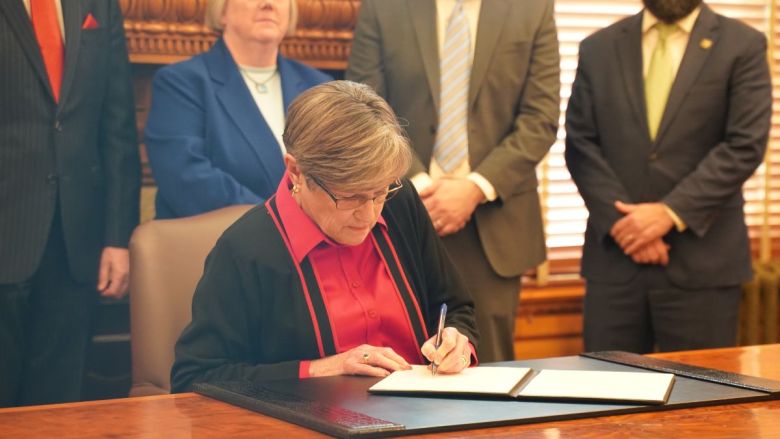
Kansas lawmakers have passed property tax plans, reworked elections and banned gender-affirming care for transgender minors.
The Kansas Legislature’s regular session has ended. All that’s left is the veto session that takes place April 10. Here is a list of the bills the Legislature passed that Gov. Laura Kelly has vetoed so far.
State budget
This bill was signed and it is law. About half of the around 40 line item vetoes have been overridden.
Kelly signed the state budget with more than three dozen line-item vetoes. She vetoed funding for a feasibility study to try and bring a dentistry school to Kansas. Other vetoes include changes to how sports gambling contracts are negotiated and the legislature trying to get more say in online curriculum.
Lawmakers did override the veto on a handful of items, include how sports gambling contracts are negotiated.
Gender-affirming care
This bill was vetoed and the veto was overridden. It is now law.
Republicans banned puberty blockers, hormone treatment and gender-affirming surgeries for anyone under 18.
The law was vetoed by Gov. Laura Kelly, but Republicans overrode the veto in February.
House Speaker Dan Hawkins of Wichita said overriding the veto protects “Kansas kids from the irreversible harms of experimental gender transition surgeries and medicines.”
Democrats said the law targets transgender kids and should never have been passed.
Rep. Mark Schreiber, an Emporia Republican, was one of the few Republicans to oppose the idea.
“We don’t teach kids to have cancer, we don’t teach them to have birth defects and we don’t teach them to have a medical condition called gender dysphoria,” he said.
The ban is tied up in legal challenges that could strike it down or preserve it.
Mail ballot grace period
This bill was vetoed and the veto was overridden. It is now law.
Mail ballots in Kansas used to be eligible even if they arrived after election day. Ballots postmarked on or before election day that arrived three days later could still be counted. Now, ballots must arrive before polls close.
Kansas now has one of the shortest turnarounds from when ballots are mailed to people and when they need to be returned.
Rep. Pat Proctor, a Leavenworth Republican, said voters don’t like to see results change because of late-arriving ballots.
“Voter confidence that the result of our elections reflects their will, that every vote is counted, lies at the very heart of our form of government and our way of life,” Proctor said in a press release.
Kelly vetoed the bill because Kansans who legally cast ballots and made an honest attempt to vote could have their ballots thrown out.
“This bill is an attack on rural Kansans who want to participate in the electoral process guaranteed by our Constitution,” Kelly said in her veto message. “I will not sign legislation that deprives Kansans from having their vote counted.”
Income tax cuts
This bill was vetoed and the veto was overridden. It is now law.
Future income taxes would be tied to increases in revenue and the state’s rainy day fund. The bill requires the state to cut income taxes if it collects more in revenue than in the past year, when adjusted for inflation. The bill also requires the state’s rainy day fund to be “less than 15 percent of the prior fiscal year’s tax revenues.”
The secretary of the Department of Revenue would determine how large the tax cuts are. The income tax rate could be no lower than 4%.
Republicans tried in past sessions to pass a flat tax. This bill doesn’t immediately propose a flat tax, but it could eventually lead to every Kansan paying 4% in income tax. Conservatives support a flat tax because they say it’s the fairest and simplest tax system.
Kelly vetoed the bill because she doesn’t want to force future tax cuts.
“Make no mistake, should this bill become law, it will put the state back on the path toward the failed Brownback tax experiment: the four-day school weeks, the budget cuts, and the crumbling roads and bridges that came with it.”
Fetal personhood
This bill was vetoed and the veto was overridden. It is now law.
Republicans want to mandate that pregnancy-related expenses, like medical visits, should be included in child support payments.
Lawmakers disagree how often this happens now. Rep. Lindsay Vaughn, an Overland Park Democrat, said judges already award pregnancy-related expenses as part of child support. Other lawmakers say this doesn’t happen consistently enough.
Democrats oppose this bill because they say it’s an attempt to give a fetus more rights to chip away at abortion rights. Republicans say this bill is only about clarifying that child support during pregnancies should happen.
Sen. Kellie Warren, a Leawood Republican, said unborn children already have rights in state law. They can be the beneficiary of a trust, there are criminal penalties for killing them, and state law says life starts at conception.
Religious beliefs
This bill was vetoed and the veto was overridden. It is now law.
Republicans passed a bill that would prevent the secretary for the Department for Children and Families from enforcing foster child placement policies that conflict with someone’s sincerely held religious beliefs.
Supporters of the bill worry families may decline to care for LGBTQ foster kids and then not be allowed to foster other children at all. Passing the bill strengthens religious protections and prevents discrimination against foster parents, supporters argue.
Kelly vetoed the bill, saying this opens the state up to lawsuits and doesn’t actually help children. Other opponents of the bill called this proposal “state-sponsored child endangerment.”
Legislative approval of social services waivers
This bill was vetoed and the veto was overridden. It is now law.
Republicans want the legislature to approve or reject any waivers for public welfare programs. Under this bill, the federal government could offer to expand eligibility for programs like the Supplemental Nutrition Assistance Program. Or the state government could send a waiver, or request, to expand eligibility for public assistance programs.
The bill would require that to pass through lawmakers first.
“It helps us maintain some oversight on spending,” said Rep. Francis Awerkamp, a St. Marys Republican.
Kelly vetoed the bill, saying it is legislative overreach and it could cost taxpayers because it’ll take hundreds of hours of work from state staff.
“This bill and the subsequent backlog that it would create threatens food and medical assistance benefits for our most vulnerable Kansans at a time of increased inflation and overall financial uncertainty,” Kelly said.
Fetal development lessons
This bill was vetoed and the veto was overridden. It is now law.
This proposal would require schools with human growth or sexuality classes to show fetal development videos. Those videos need to be at least three minutes long and explain the development of the heart, brain and other vital organs.
The bill is locked in abortion politics. Kelly vetoed the bill, saying it’s convoluted and manipulative.
“As policy makers and parents, we should demand that our children are provided with high-quality, relevant, researched and age-appropriate educational experiences free from ideological prejudice,” Kelly said. “(This bill) falls short of that goal. For these reasons, I cannot and will not support this bill.”
Olathe Public School parent Danielle Good told The Kansas City Star that she supports the bill.
“Watching a video like this is what made me turn pro-life,” Good said. “I think everyone should have a visual of what actually happens during that procedure before making a life-altering decision.”
Removing pandemic protections
This bill was vetoed and the veto was overridden. It is now law.
This bill would prevent public health officers from banning gatherings and requiring quarantine. The proposal is in response to the COVID-19 pandemic and bans on how people can gather. Lawmakers also heard from an anti-vaccine family who had to quarantine their student because of a case of chickenpox.
Kelly said ignoring health professionals could hurt Kansans.
“While this legislation is likely motivated by the politics coming out of the recent pandemic, it would cause actual harm in efforts to mitigate current outbreaks related to measles, tuberculosis and other infectious diseases,” she said.
Welfare program investigation
This bill was vetoed and the veto was overridden. It is now law.
This bill lets the inspector general audit all cash, food and health assistance programs the state runs. The Kansas Department for Children and Families already has a team to investigate fraud. That’s why Kelly said the bill is redundant.
“It is very unclear what problem, if any, this bill is attempting to solve,” she said. “It makes no sense from a legal, policy, or fiscal standpoint to make this change.”
Conservatives backed the idea because they say programs still have waste. DCF does have investigative teams, but some worry about agencies investigating themselves for fraud and waste.
“Expanding the inspector general’s capabilities is not (intended) for removing people rightfully receiving these benefits,” said Sen. Beverly Gossage, a Eudora Republican, “but focusing on making the system work better for everyone.”
Regulatory sandbox
This bill was vetoed and the veto was overridden. It is now law.
HB 2291 creates a “regulatory sandbox” in the attorney general’s office. That means businesses have a chance to operate outside of existing regulations. The idea lets companies try something new without dealing with regulations or being subject to those penalties.
“They can be used to help consumers test new products or concepts previously unavailable,” said Eric Stafford, vice president of government affairs for the Kansas Chamber.
The proposal creates an oversight committee to monitor businesses. But Kelly doesn’t like that the committee could overrule existing law.
“Additionally, this bill blocks any transparency in relation to the applications submitted for review which further exacerbates my concerns regarding the role of special interests,” Kelly said.
Election funding
This bill was vetoed and the veto was overridden. It is now law.
Republicans want to approve how federal funds are used in elections. The bill says any federal funds for elections must be used for their authorized purpose or get legislative approval.
Steve Greene, with conservative think tank Opportunity Solutions Project, said a Biden-era executive order told election offices to develop a plan to increase voter registration.
“Regardless of politics, federal resources and funding should never be funneled into partisan get-out-the-vote efforts,” Greene told lawmakers.
Kelly said this bill micromanages election officials too much.
“Given that the Legislature only convenes for three months each year, how can we expect them to approve funding when they are not available year-round?” Kelly said in her veto statement. “Instead of obstructing our electoral process, lawmakers should concentrate on the real issues impacting Kansans, rather than complicating the management of election funds.”
State Medicaid services
This bill was vetoed and the veto was overridden. It is now law.
Managed-care organizations help deliver medical services, very similar to insurance companies. UnitedHealthcare is one of the managed-care organizations in Kansas.
This bill would require a written set of rules when selecting these organizations. It would require an appeals process, regular reports to the legislature and would prevent agencies from destroying records related to this search process.
In the 2024 round of contract selections, both Republican and Democrat lawmakers were frustrated that the state selected HealthyBlue. HealthyBlue joined forces with Amerigroup, a company that refused to pay millions to service providers when it previously lost a contract.
“I cannot imagine why on earth (Amerigroup) would ever be considered to be brought back in,” then-Rep. Susan Concannon, a Beloit Republican, told the Kansas Reflector last year. “I’m just appalled that we … are reentering into a contract, with the way they behaved when they exited.”
The most recent selection process also led to challenges filed by companies that weren’t selected. This is why lawmakers wanted to get involved in the process.
Kelly said she originally supported the bill. But the bill was amended to include an appeals process. The appeals committee would include elected officials and have more Republicans than Democrats.
Kelly said this is legislative overreach because the Department of Administration runs this process, and the governor appoints the secretary for that agency.
“This bill creates a haphazard procurement process that does nothing to mitigate conflicts of interest among legislators and creates an environment that is rife for exploitation and graft — exactly the opposite of what the existing process,” she said.
Kelly said she is open to collaborating on a proposal next year to amend the process.
Continuous budget
This bill was vetoed and the veto was overridden. It is now law.
This bill allows the state budget to be continuous. Lawmakers return to Topeka every year to pass a new state budget, but this bill would allow the previous year’s budget to be used if a new one wasn’t passed.
Senate President Ty Masterson, an Andover Republican, said the state’s lawmakers could threaten to shut down the government as part of political negotiations. The governor also could use the budget as a political pawn.
“Governors could threaten to veto an entire budget to get their way on a particular issue, holding the entire state budget hostage,” Masterson said.
Kelly vetoed the bill, saying this is the legislative body trying to grab away power from the executive branch.
“If this legislature cannot do what every previous legislature has been able to do since our founding — through periods of war, famine, pandemic, recession, the Dust Bowl and even the Great Depression — then they will have to do it over my veto because I will not sanction it, nor will the people of Kansas,” Kelly said.
At-risk students
This bill was vetoed and the veto was overridden. It is now law.
Kansas has funds for at-risk students in every school district. The money could pay for contracted services and staff that work with this population. The bill allows nonprofit programs accredited by the International Multisensory Structured Language Education Council to be added to the list.
Kelly vetoed the bill because the state board of education already has this authority. In February, the state board did expand the number of at-risk programs that qualify for this funding.
Private school funding
This bill was vetoed and no motion to override was considered. The bill is dead.
The Kansas Promise Scholarship helps students get a two-year degree or go to technical college. Lawmakers expanded what colleges were eligible for this program, which would include private colleges.
Kelly said these are public funds and they should go to public schools.
“I have serious concerns about the precedent that would be set by providing state funding to for-profit educational institutions that are not accountable to the state or taxpayers,” she said.
Hawkins said whether the school is private or public, this money helped train new workers in much needed fields.
Limiting out-of-state hunters
This bill was vetoed and an override was not attempted. The bill is dead.
Rep. Tom Kessler, a Wichita Republican, said in-state hunters are being squeezed out by out-of-state hunters. So the legislature passed a bill to restrict nonresident hunters.
A nonresident is anyone who isn’t a “bona fide” resident of Kansas for the past 60 days. Nonresidents could still hunt migratory waterfowl, but only on Sunday, Monday and Tuesday. Kessler said the Department of Wildlife and Parks will do an economic study to see if the bill hurts businesses and towns.
“If something alarming shows up in there, we can actually address this issue next year, right away,” he said.
The bill also mandates discounted hunting and fishing licenses to residents over 65 and changes the cost of lifetime licenses fees for youth.
Kelly vetoed the bill because of the nonresident clause.
“This prohibition could have a detrimental impact on the prosperity of our communities and businesses by denying the many positive outcomes from the economic activity generated by nonresidents coming into our state for hunting purposes,” she said.
This bill does not have veto-proof support.
Specialty license plate
This bill is vetoed and an override was not attempted. The bill is dead, but another bill that addresses Kelly’s concerns was passed.
This bill creates the Hunter Nation specialty license plate. Specialty license plates are used to raise funds for groups, and the Hunter Nation is a nonprofit. But it is a politically active nonprofit, Kelly said.
“Official government-issued license plates should not be used by organizations to generate revenue that can be redirected by organizations for political purposes,” Kelly said.
Kris Kobach, the state attorney general, is a member of the Hunter Nation board of directors. He supports the bill.
“Hunter Nation has had a tremendous impact across the country in promoting and protecting hunting, conservation and access to habitat at the state and federal level,” he said in testimony.
This bill currently has enough votes to survive a veto.
Candy and soda ban
This bill was vetoed and the House did not attempt an override. The bill is dead.
Republicans don’t want food stamps to be used to buy candy or soda, but state lawmakers can’t amend the program to prohibit those purchases.
The bill requires the Department for Children and Families to ask the federal government if the state’s food stamps program could ban candy or soda purchases. Kansans could still buy candy or soda with their own money, but not use supplemental nutrition assistance programs money.
Conservatives say SNAP is about supplementing diets — that includes healthy food and not candy or soda.
Kelly said this bill would harm Kansas businesses and fail to achieve its goal. It’s hard to define candy in state law. So items with flour wouldn’t count. That means Twix, Twizzlers and Twinkies wouldn’t count as candy.
The bill is well short of veto-proof majority.
Government contracts for legal services
This bill was vetoed and an override was not attempted. The bill is dead.
This bill would require the state attorney general to approve contracts for attorneys for political subdivisions. Municipalities wanting to enter into contracts must hold open sessions to discuss the contract and report on why the contract is necessary.
Kelly said the bill has retroactive language that would require approval of existing contracts. She also said this undermines local control.
A previous version of this article said the legal services review bill was overridden when the legislature had not yet attempted an override. This article also mentioned a gun detection program that was vetoed when it was not.