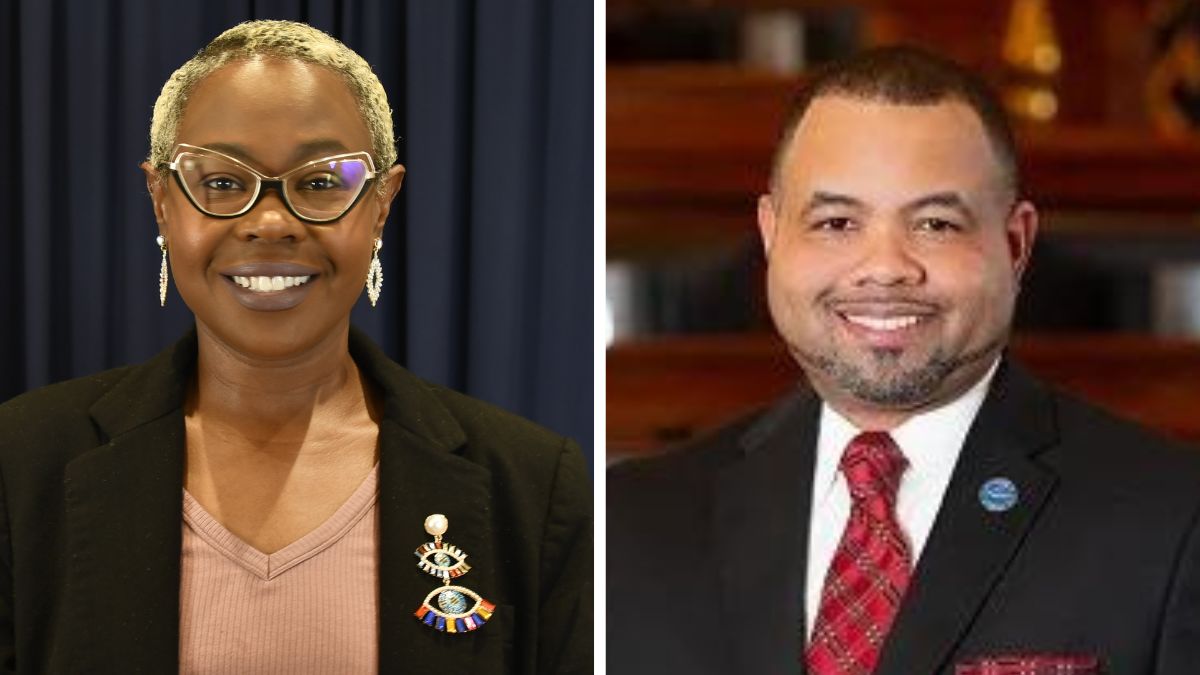
Rep. Patrick Penn, a Wichita Republican, is running against a Safe Streets Wichita staffer in a November race.
Republicans have won this district the last five elections. Penn has won his last two elections by over 15 percentage points.
Election Day is Nov. 5. Oct. 15 is the last day to register to vote. Early voting starts Oct. 16. You can find your polling place and the races you vote in here.
Who are the candidates in Kansas House District 85?
Democrat Aonya Kendrick Barnett
Barnett is a prevention specialist with Safe Streets Wichita and is vice chair of the Governor’s Behavioral Health Prevention Subcommittee, according to her LinkedIn profile. She studied communications and women’s studies at Wichita State University.
“I’ve worked across community sectors to combat the overdose crisis, advocate for public health and promote educational justice,” she said. “Together, we will build a future where every voice is heard, every community is uplifted and everyone has a fair shot at success.”
She is endorsed by the Kansas branch of the AFL-CIO, the Kansas National Education Association and Game On for Kansas Schools.
Her campaign website is here.
Republican Patrick Penn (Incumbent)
Penn first took office in 2021. The Army veteran served in Operation Iraqi Freedom, Operation Enduring Freedom and Operation Inherent Resolve.
He was awarded the Meritorious Service Medal and the Combat Action Badge. Penn retired in 2017 with the rank of captain.
The former foster child has a criminology degree from Colorado State University and a master’s in applied information technology from George Mason University Volgenau School of Engineering.
He and his wife have four children.
“Growing up, Patrick learned the importance of faith, family, and hard work,” his campaign website said.
Penn is endorsed by the Kansas Chamber of Commerce, NFIB-Kansas, the Kansas Farm Bureau, Kansas Livestock Association, Kansas Family Voice, Kansans for Life and the Kansas Rifle Association.
His campaign website is here.
Both candidates were asked the same questions about their priorities for office and how they would vote on certain issues. Penn didn’t respond to the election guide. His answers are from his voting history, campaign website and Facebook page.
If elected, which of these politicians would you most closely resemble?
Options include: Joe Biden, Sharice Davids, Bob Dole, Nancy Kassebaum, Laura Kelly, Roger Marshall, Jerry Moran, Donald Trump or someone else.
Barnett: If elected, I would most closely resemble Shirley Chisholm. Like her, I am committed to fighting for justice, equity, and the rights of all people. Inspired by her vision in “Unbought and Unbossed,” I believe in a government that genuinely listens to its people, especially those historically marginalized. My leadership will be bold, unapologetic and focused on challenging the status quo to create a more inclusive and fair society where every voice is heard and valued. I will work tirelessly to ensure the government serves all its people, not just the privileged few.
Penn: Penn didn’t respond to the questionnaire.
If you could pass any bill, what would it be and why?
Barnett: It would be a comprehensive public health bill that ensures every Kansan has access to affordable, quality health care. This bill would address health disparities, expand mental health services and strengthen preventive care. Health is foundational to opportunity, and this legislation would make Kansas a healthier, more equitable state for all.
Penn: Penn sponsored the Born Alive Infants Protection Act. This law requires doctors to give medical care to babies delivered alive after an abortion. Supporters pushed for this law because they believe medical providers leave children to die if they survive an abortion. It is a felony for doctors to not provide care to these infants.
Penn also proposed toll exemptions for current military members in Kansas.
How would you have voted on the following items? You can vote yes, no or pass.
The Aug. 2, 2022, constitutional amendment on abortion
Voting no meant the state constitution would continue to protect the right to abortion. Voting yes would have meant it can be regulated or banned.
Barnett: No. I believe in protecting a person’s right to choose and maintaining access to reproductive health care.
Penn: Yes. “In 2019, the Kansas Supreme Court ruled that the Kansas Constitution protects a nearly unlimited right to abortion. This ruling is not only incorrect, but it is completely out of line with the thinking of most of the state and the country. A majority of Americans believe the most vulnerable in our society should be protected and support pro-life policies…. We need to protect the unborn, trust women in Kansas, respect the people of Kansas, and give a voice back to the voters by passing the Value Them Both Amendment on August 2,” Penn wrote in a Breitbart op-ed.
Flat tax on income
A flat tax on income was packaged with property tax cuts and eliminating Social Security income tax. Democrats and Republicans agreed on other parts of the plan, but were at odds over a flat tax. A single rate on income didn’t pass this year.
Barnett: No. A flat tax disproportionately impacts low- and middle-income families. We need a tax system that is fair and progressive.
Penn: Yes. (A proposed flat tax plan) was primarily geared towards those who are living paycheck-to-paycheck. It was also designed to encourage economic growth so we can reverse the troubling trend of people leaving Kansas for more prosperous pastures.
Banning transgender women from women’s sports
Voting yes would mean athletes have to play the sport based on their gender assigned at birth. This bill was vetoed but the veto was overridden in 2022.
Barnett: No. Everyone should have the right to participate in sports consistent with their gender identity. This bill unfairly targets transgender youth and young adults, promoting discrimination rather than inclusion. All athletes deserve the opportunity to compete in a supportive and equitable environment.
Penn: Yes. “Should LSU’s female champion Angel Reese give up her spot, her recognition and her victory — a Black woman — because a man decided to suit up with the females and go dominate the court? … You want to say that you want to help Black people, I encourage you to vote yes on this,” Penn said on the House floor.
Banning gender-affirming care for trans youth
Voting yes means children under 18 can’t get puberty blockers, hormone treatment, and in rare cases, gender-reassignment surgery. This bill narrowly failed this year and is expected to come up again in 2025.
Barnett: No. Gender-affirming care is medically necessary for the mental and physical well-being of trans youth. This bill would strip away their access to critical, life-saving health care, putting their lives at risk and denying them the dignity and respect they deserve. Everyone, regardless of their gender identity, has the right to receive the care they need to live healthy, authentic lives.
Penn: Yes. SB 233 enacts important protections in recognition of the fact that children’s brains aren’t fully developed before the age of 18, meaning their ability to fully weigh the risks and consider the long-term ramifications of these genital mutilation procedures and body-altering drugs is limited.
After all, it’s for this same reason that we don’t allow kids to smoke or buy alcohol, get tattoos, or gamble among other things that can have negative and lasting effects.
Chiefs and Royals stadium-financing bill
This bill didn’t spend any taxpayer money to attract the teams, but it did set aside future sales tax dollars from future stadium districts to pay off bonds. This law passed by a comfortable margin, and voting yes opens the door to the Chiefs and Royals in Kansas.
Barnett: Pass. While I support economic development, I need more information on how this bill impacts taxpayers before I decide.
Penn: Yes. Penn didn’t respond to the voting guide, but legislators who supported the law said bringing a professional sports team to Kansas is a major economic development project that would pay for itself.
APEX (Attracting Powerful Economic Expansion)
This bill had billions in tax incentives to bring a Panasonic battery plant to De Soto, Kansas. As it was being passed, lawmakers were not told which company would be coming, but were told the bill is necessary to attract large businesses. Voting yes approved a massive tax incentive plan for companies.
Barnett: No. While I support bringing businesses to Kansas, this bill needed more transparency and accountability in decision-making.
Penn: Yes. The tax giveaways to attract APEX projects should help all Kansas companies — not just one — with a measured corporate tax reduction … I support bringing jobs and investment to our state.
Mail ballot grace period
Currently, any mail ballot in Kansas can arrive three days after Election Day and still be counted if it was postmarked on or before Election Day. Voting yes would eliminate that grace period.
Barnett: No. Eliminating the grace period would disenfranchise voters, especially those in rural areas or who face barriers to voting.
Penn: Yes. It’s important that Kansans have faith in our elections … (Passing this bill lets) voters know with confidence that every vote is ready to be counted when the polls close.
A bill loosening child care regulations
It would expand allowed child-to-staff ratios and allow teenagers to work at these facilities. Voting yes approves the loosened restrictions. Learn more about this bill here.
Barnett: No. While expanding access to child care is essential, loosening regulations could compromise the quality and safety of care for our children.
Penn: Yes. Penn didn’t respond to the voting guide, but lawmakers who supported the bill said stripping away burdensome regulations will let businesses grow.
The Parents’ Bill of Rights
This bill lets parents pull their kids out of classes if they are being taught objectionable material. Republicans say it is up to parents to determine what their children should be learning. Democrats say this bill addresses a problem that doesn’t exist.
Barnett: No. This bill creates unnecessary divisions and undermines public education by allowing personal beliefs to dictate curriculum. We already have foundational rights protecting parental involvement in education; this proposal is redundant and risks disrupting the educational environment by imposing subjective views on all students. Public schools should focus on providing a balanced, comprehensive education that serves all students equitably.
Penn: Yes. (These bills are) key because it allows parents to review what is being taught to their children and puts a spotlight on the race Marxist ideology that the teacher unions and Democrats want to use to indoctrinate our children.