


Correction: A previous version of this story inaccurately stated that no KCPD officers were charged or indicted in the killings of Ryan Stokes, Dantae Franklin, Cameron Lamb and Malcom Johnson. This story has been corrected to say that the officer who shot Lamb was charged in Jackson County court with involuntary manslaughter and armed criminal action.
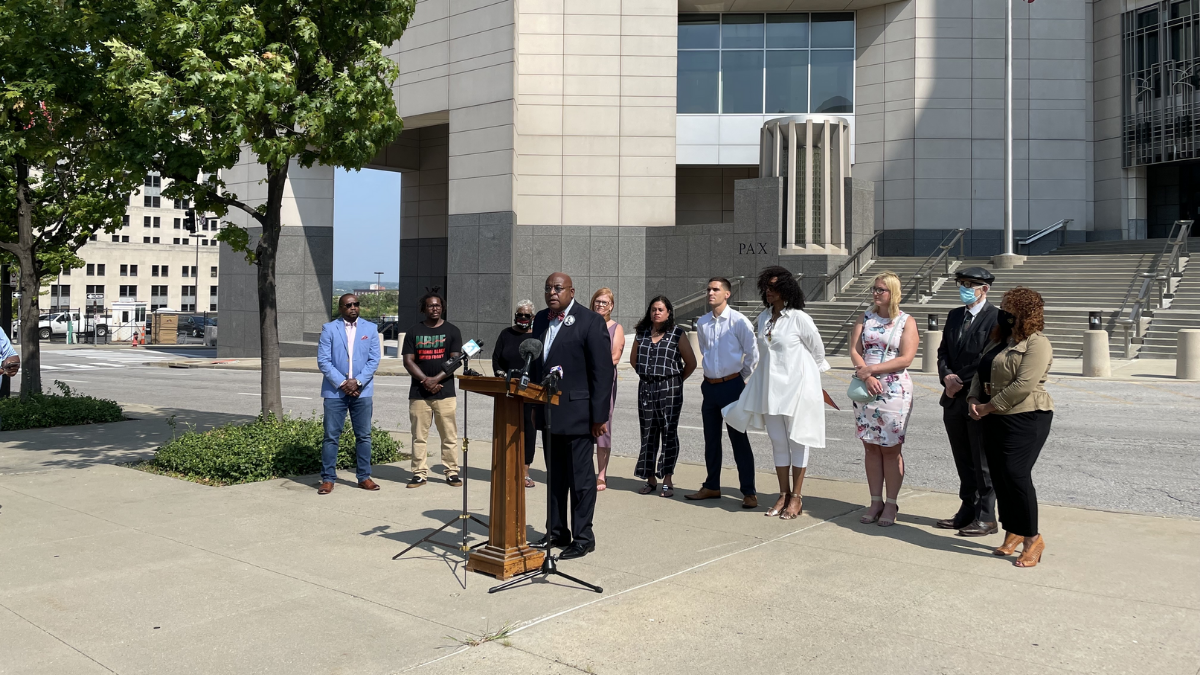
A coalition of civil rights groups in Kansas City recently asked the U.S. Department of Justice to launch an investigation into the Kansas City, Missouri, Police Department. The partners allege a long pattern of racial bias and inappropriate use of force by officers.
Groups that signed the letter include the Urban League of Greater Kansas City, the Kansas City branch of the NAACP, the Southern Christian Leadership Conference of Greater Kansas City, National Black United Front-Kansas City and the Urban Summit. Jackson County Prosecutor Jean Peters Baker also expressed support for an investigation.
The coalition sent the letter to the DOJ July 23. It is still unclear whether the agency will officially launch an investigation into the KCPD. As Kansas City waits for a formal decision, The Kansas City Beacon breaks down what it means when the federal agency chooses to investigate a law enforcement agency.
2. What authority does the DOJ have? Has this happened before?
3. What is a “pattern-or-practice” DOJ investigation?
4. What happens after a DOJ investigation?
5. Does the police union have any control over the terms of the agreement?
6. Can the DOJ investigation give Kansas City local control of its Police Department?
Why do civil rights groups want a DOJ investigation?
In a 15-page letter sent to U.S. Attorney General Merrick B. Garland, the local coalition cites three reasons for a possible investigation: excessive and deadly force incidents against Black and Latinx Kansas Citians, lack of accountability from the department and “compelling evidence” of constitutional violations and discriminatory practices.
The letter describes several cases of deadly police violence against Black and brown residents, including the killings of Ryan Stokes in 2013, Dantae Franklin in 2017, Cameron Lamb in 2019 and Malcolm Johnson this year.
The officers involved in the killings of Stokes, Franklin and Johnson have not been charged or indicted. Eric DeValkenaere, the KCPD officer who shot Lamb, was indicted by a grand jury in 2020 and charged with involuntary manslaughter and armed criminal action.
“We are left with no other recourse,” said Vernon Howard, the president of the Southern Christian Leadership Conference, during a July news conference announcing the request.
What authority does the DOJ have? Has this happened before?
It’s not uncommon for the Department of Justice to investigate a law enforcement agency. The practice began in 1994, when Congress gave the U.S. attorney general the authority to investigate cases of police “patterns or practices” that violate constitutional or federal rights.
During President Barack Obama’s administration, the department opened 25 investigations. Among them was an investigation into Ferguson, Missouri’s Police Department.
Investigations ground to a halt under President Donald Trump’s administration. The Justice Department only investigated one department during his presidency, in Springfield, Massachusetts.
Ken Novak, a professor of criminal justice and criminology at the University of Missouri-Kansas City, said investigations will likely pick up speed under the Biden administration.
“It’s not so much that the Biden administration has a taste for consent decrees,” he said. “It’s more like the Trump administration had an aversion to it. That’s politics. The former administration, being a law and order platform, ran on a platform of making sure cops were happy, and one way that cops could be unhappy is to come in and make them do something pursuant to a consent decree.”
Earlier this month, the department announced it was opening an investigation into the Phoenix Police Department. It’s the third investigation opened under the Biden administration. The other two investigations are taking place in cities where citizens died as a result of police actions — Breonna Taylor in Louisville, Kentucky, and George Floyd in Minneapolis.
John Smith, a former DOJ investigator, said the small size of the federal department’s Civil Rights Division is the main limiting factor on the number of investigations it will open.
What is a ‘pattern-or-practice’ DOJ investigation?
A DOJ “pattern-or-practice” investigation is concerned with whether there are serious, repetitive instances of excessive force, biased policing and other unconstitutional practices in a law enforcement agency.
Investigators gather information from multiple sources, including community members, police officers, local officials, documents and data. They may go on ride-alongs with officers to observe practices.
“In a technical review of the department, they’ll look at hundreds of thousands of pages of documents, everything from use-of-force reports, stop-and-search reports, civilian complaints and other documents that might be kept,” Smith said.
The process can take six to nine months to complete, he added, depending on the investigation’s scope. Some are narrow in focus, while others take a more general approach.
The DOJ also hires subject matter experts for each investigation.
“They’re people who came out of the law enforcement community,” Smith said. “Former chiefs of police, for example, or people who were responsible for the area being investigated in their own department.”
What happens after a DOJ investigation?
The DOJ can take two routes postinvestigation. In all cases, it will release a public report on its findings.
If the investigation finds no systemic violations of federal or constitutional rights, the department will say so in its report and close the investigation. Just because federal violations weren’t found doesn’t mean there’s no need for change.
“In many cases, we found areas of concern or issues that were raised but didn’t rise to the level of a pattern violation of the Constitution,” Smith said. “We release the report publicly, and it’s designed to provide everybody throughout that community with a baseline for thinking about what reform and change would look like inside that department. So it has to be a touchstone for going forward in terms of a remedy.”
If the investigation does uncover systemic rights violations, the DOJ will try to reach an agreement with the police department on a consent decree. A consent decree is an agreement between the federal government and the department being investigated, which stipulates specific changes that must be implemented.
“It could be completely transformative,” Novak said. He described a consent decree as an agreement between the local government and the federal government designed to avoid further legal action. “Very often, police departments will see these consent decrees as good because it comes with avoiding other litigation,” Novak added.
The consent orders must be reported to a third party monitor, who updates the court on the department’s progress. The consent decree can last for years — however long it takes the department to make the reforms it agreed to.
Does the police union have any control over the terms of the agreement?
Consent decrees cannot violate the terms of an existing bargaining agreement. In Kansas City, police officers are represented by the Fraternal Order of Police.
While police unions are not usually at the table during negotiations, their contract and the power they hold both within the department and city government can have an effect on what’s agreed to in the consent decree.
Sharon Brett, legal director of the American Civil Liberties Union of Kansas and a previous DOJ investigator, said union contracts often have protections embedded in them that get in the way of improved transparency and accountability.
“Most often, this comes up around internal investigations of police officer misconduct,” she said. “The collective bargaining agreements often have very strict provisions. … Those provisions can very specifically detail when an officer can be interviewed, what the officer has the right to do before being interviewed, how that information can be used, things of that nature.”
Eliminating the potential for bias and conflicts of interest can mean butting up against those provisions.
Can the DOJ investigation give Kansas City local control of its Police Department?
“That is a political question,” Smith said. “The DOJ would not make that kind of change.”
Kansas City does not have local control over the KCPD. The agency is overseen by a Board of Police Commissioners. Four commissioners are chosen by the Missouri governor, and the fifth member is the elected mayor of Kansas City.
Although the DOJ lacks the authority to change the department’s governing structure, Smith said investigators often find that a lack of accountability is at the core of a police department’s problems. It will recommend fixing accountability systems, even if those aren’t included in a consent decree.
“It’s possible you might get a recommendation that the creation of more local control will create more accountability,” Smith said. “I’d be surprised if they could make the argument that in order to fix any constitutional problems, you’d have to change the structure from state to local.”
