
Two of the Kansas City area’s largest public health departments are seeing a significant drop in demand for vaccinations.
The Kansas City Health Department said vaccine traffic has fallen as much as 30% from a year ago, while the Johnson County Department of Health and Environment reports a 20% decline.
Takeaways
- After a steady decline in vaccination rates, two of the area’s largest public health departments said fewer people are coming in for shots this year.
- Public health officials fear that confusion resulting from new federal immunization policies is leading more parents to skip routine vaccinations.
- As measles continues to spread around the country, they warn that people who are unvaccinated are at risk.
The numbers are consistent with recent trends in vaccination rates, which have been especially evident among children.
Nearly 6% of Missouri kindergartners received a religious exemption for the 2025-26 school year, allowing them to avoid childhood vaccinations required to attend. And in Kansas, the religious exemption rate was 3.3% in the 2024-25 school year, the most recent data available.
Wyandotte County, the county in the Kansas City area lagging the most, reported that only 72% of kindergartners received their required shots in the 2024-25 school year.
“I think we should all be worried,” said Charlie Hunt, Johnson County’s health director. “Quite frankly, we are still in the midst of a resurgence of measles in this country. … Measles is a serious disease, so it is something that we’re concerned about.”
False claims fuel skepticism
While school officials and local public health leaders said they have been working to improve vaccination rates, they are struggling against powerful forces.
False claims about the safety of vaccinations have taken hold online and in social media over the last two decades, and have picked up steam since the COVID pandemic, helping fuel skepticism and a steady decline in vaccination rates since 2020.
Increasingly, parents may not know where to turn for information and what to believe.
Now, that skepticism has found a platform in the White House.
Since President Donald Trump returned to office in 2025 and picked Robert F. Kennedy Jr., a high-profile vaccine skeptic, as health secretary, vaccinations have been a consistent target. Now federal vaccine guidance differs from guidance given by the majority of the medical establishment, sowing even more confusion and doubt.
Breanna Schukar, an Overland Park mom whose third- and fifth-grade daughters are fully vaccinated, worries that parents of kids who share her daughters’ school won’t get accurate information and choose to skip shots. That, she said, will lead to future outbreaks that are avoidable.
“People are trying to get too much information from websites that are invalid and untrustworthy,” she said, “and it’s going to cause problems for our children in the long run.”
New executive order
The Trump administration’s latest volley against vaccine norms came in the form of an Aug. 11 executive order, calling for changes to the long-established childhood vaccine schedule.
Among other things, it proposes:
- Reducing the number of recommended shots for most children to seven from 13.
- Splitting the combined measles, mumps and rubella (MMR) vaccine into single shots, which are not available in the United States.
- And spreading the vaccines out over a longer stretch of time.
While signing the order, Trump inaccurately called the MMR vaccine “quite lethal” in its combined form, and he brought up disproven claims about a link between vaccines and autism. The MMR vaccine has been used for five decades and is considered extremely safe by health providers and scientists. Scientists have found no link between vaccines and autism.
Trump also exaggerated the volume of currently recommended vaccine doses, falsely describing them as “the size of a bottle of soda poured into a little child’s body.” Doses can better be measured in teaspoons than soda bottles.
Across the board, medical organizations, doctors and public health leaders rejected the proposed changes in the new executive order and called Trump’s claims about the safety of existing recommendations false.
Major medical groups, including the American Academy of Pediatrics, the American Academy of Family Physicians and the American College of Obstetricians and Gynecologists, continue to recommend that patients follow the long-standing childhood vaccine schedule.
State health departments in Kansas and Missouri said state vaccine requirements will not change based on the new executive order. Shots on the existing vaccine schedule will continue to be available and covered by insurance and government programs, they said.
“The executive order does not directly alter our school immunization requirements, and Missouri has made no changes to state vaccination requirements,” Lisa Cox, a spokesperson for the Missouri Department of Health and Senior Services, said in a written statement. “There is no new scientific evidence that changes current guidance.”
Jill Bronaugh, communications director for the Kansas Department of Health and Environment, also said that the state’s guidance had not changed.
“Vaccines remain one of the most effective tools for preventing serious infectious diseases, and decades of rigorous studies have shown they are safe and effective,” Bronaugh said in a written statement. “We remain committed to supporting clinical guidance and recommendations that provide the most accurate, credible and transparent information available for health professionals and Kansas families.”
‘It breaks my heart’
Health officials warn that extending the vaccine schedule, as the new executive order suggests, would force parents to return for multiple appointments to get every necessary shot. That would lead to more children missing vaccine protection.
At a press conference called last week to urge local parents to get their children vaccinated, Kansas City Health Director Marvia Jones said she understands why parents are confused given the conflicting information and false claims being peppered into official announcements.

She urged parents to ask questions and talk to their children’s doctors before deciding to pass on getting the shots.
“It breaks my heart,” Jones said, “to know that people are having to make these types of difficult decisions when it should really be so simple.”
The bottom line, she said, is that getting children recommended vaccines isn’t dangerous. But avoiding them is.
“We’re here today to reiterate that there has been no new data to support any changes to the vaccination schedule — the schedule that the CDC has recommended for decades,” Jones said at the Aug. 14 press conference. “We highly recommend that families continue to adhere to that. We ask providers to continue to adhere to that as well.”
Measles is dangerous
Currently, the United States is experiencing the largest measles outbreak it has seen in decades. According to the Centers for Disease Control and Prevention, so far this year 2,550 measles cases have been reported by 47 jurisdictions, and there have been 38 new outbreaks.
That follows 2025, when 2,289 cases were confirmed, along with 48 outbreaks, including one in southwest Kansas, which came dangerously close to the Kansas City area.
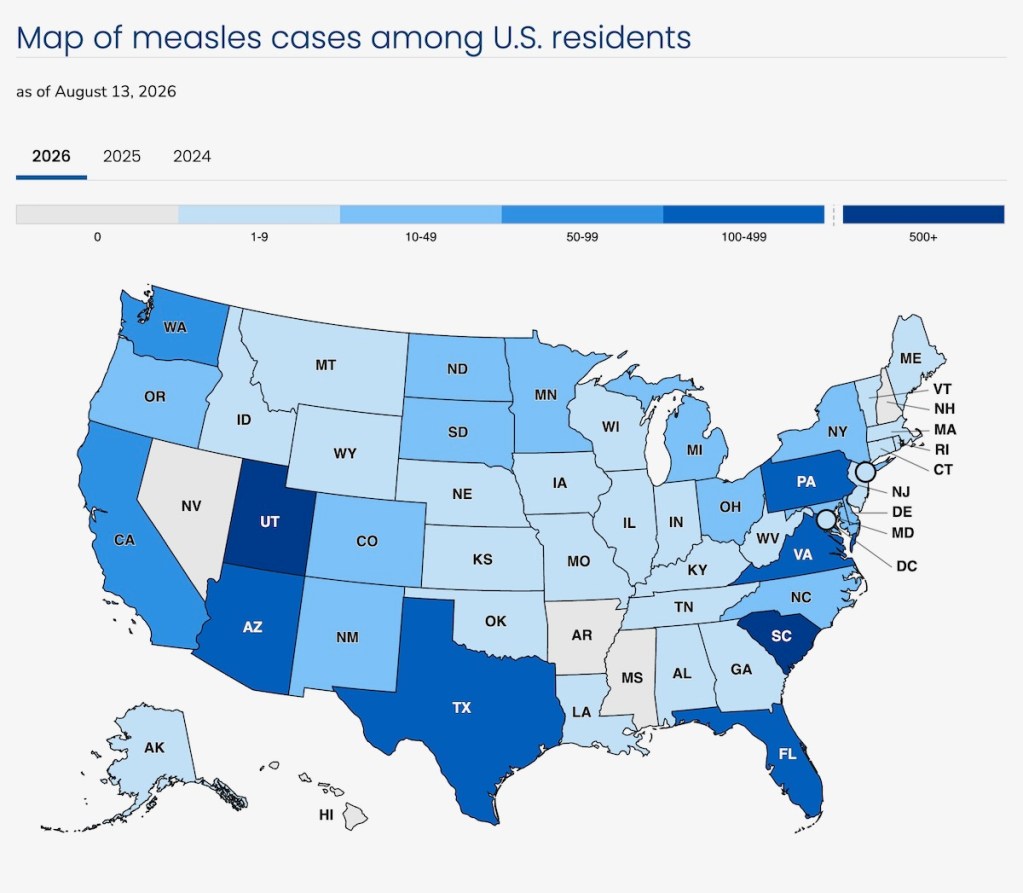
The highly contagious virus will quickly infect anyone who is not vaccinated, and can spread like wildfire when vaccination rates in a community are low. Herd immunity for the virus — when it is unlikely to spread — requires a vaccination rate of 95%, a target that local jurisdictions and schools are increasingly missing.
Measles, which had been virtually eliminated in the United States until immunization rates began to slide in recent years, is not only highly infectious, it’s also dangerous. One child out of 1,000 who gets it will die, said Dr. Maria Deza Leon, an infectious diseases doctor at Children’s Mercy.
“There’s a misconception that measles is only a rash,” she said. “However, measles can have a lot of complications.”
In addition to death, the virus can lead to pneumonia and encephalitis, she said. It can essentially erase a person’s immune memory, leaving them vulnerable to illnesses their body had known how to fight off. And, in rare cases, the virus can remain dormant in the body and show up as a fatal disease years after an infection.
But beyond the potential health consequences, there can be practical consequences of a measles outbreak, too. When someone who is not vaccinated is exposed, they will have to miss school or work for 21 days.
“I know for many of us, having to find childcare for two days or three days is a problem,” Jones said at the press conference. “So, what does it mean when there’s an outbreak in a classroom and children have to be home for 21 days?”
Added confusion
Lauren Grimes, director of nursing services with the Kansas City Public Schools, said she is hearing from lots of parents wondering what all of the recent news about childhood vaccines means for them.
“Most of our calls are confusion, (parents asking), ‘Does that change what we need for immunizations?’” Grimes said. “We just remind them that, no, it does not change the requirements.”
By the time classes begin Aug. 24, she said, children need to have the required shots, be in the process of getting them or file for an exemption with the state.
Health officials worry more parents across the area will opt for an exemption if the rules become too complicated and confusing. And they fear that reduced vaccine demand at area health departments could be a sign that is happening.
“There are some people that are going to get vaccinated no matter what,” Hunt said. “But some people have concerns. And when they hear people talking about vaccines being unsafe at the national level, it’s going to have an impact potentially.”
Where to go for walk-in vaccine clinics
Kansas City Health Department, 2400 Troost Ave., Kansas City
8 a.m. – 5 p.m. Monday, Tuesday, Thursday and Friday
8 a.m. – 7 p.m. Wednesday
8 a.m. – noon Saturday (Children’s Immunization Clinic)
Johnson County Department of Health and Environment, 11875 S. Sunset Drive, Suite 300, Olathe
8 a.m. – 4 p.m. Monday-Thursday
8 a.m. – 2 p.m. Friday
Wyandotte County Public Health Department, 619 Ann Ave. Kansas City, Kan.
8:30 a.m. – 4 p.m. Monday, Tuesday, Thursday and Friday
8:30 a.m. – 6 p.m. Wednesday