


Update (April 17, 2026): This story has been updated to reflect that the City Council approved the ordinance.
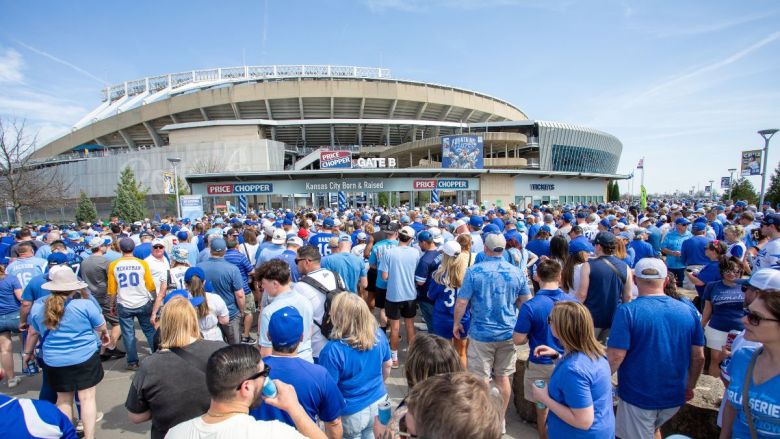
Kansas City leaders are bidding to retain the Royals at a new downtown stadium two years after Jackson County voters overwhelmingly rejected a sales-tax-funded ballpark in the Crossroads.
Takeaways
- A Kansas City Council ordinance starts negotiations for a $600 million tax-increment financing deal to help finance a $1.9 billion downtown ballpark for the Royals.
- The deal will not be finalized for weeks — if not months — because the city needs to order a third-party financial analysis before finalizing details.
- The city would issue $600 million in bonds that would be paid back using new tax revenue from the stadium and surrounding district. But if the city is not careful, it could end up being forced to use general revenue to cover the debt.
Not surprisingly, a familiar fight about taxpayer-subsidized stadiums has roared back to life.
Kansas City’s Finance Department presented the plan on Tuesday to the Finance, Governance and Public Safety Committee, which unanimously advanced an ordinance to the full Kansas City Council.
The Kansas City Council voted to approve the ordinance kick-starting negotiations with the Royals by a vote of 11-1. Nathan Willett, who represents the 1st District, voted no, and Crispin Rea, who represents the 4th District at large, abstained.
That ordinance directs City Manager Mario Vasquez to submit an application for a tax-increment financing deal that would leverage new sales and earnings tax revenue in a still-undefined stadium district to pay off a $600 million city-backed bond to help finance the project. All told, the ballpark is expected to cost $1.9 billion, with the balance financed by the Royals and the state of Missouri.
“We think we have a great project that will ultimately come to pass,” Brooks Sherman, the Royals president of real estate and development, told reporters on Tuesday. “We are very appreciative of this process and we will maintain our work in it.”
Even so, it faces fierce opposition from KC Tenants, the citywide tenants union, and advocacy groups like the Missouri Workers Center and Stand Up KC. Those groups also campaigned against the Jackson County ballot measure in 2024.
Some opponents, including City Councilmember Johnathan Duncan, have suggested they may even gather petition signatures to force a citywide referendum.
Importantly, the City Council has not made any final decisions on the stadium subsidy.
They still need to nail down several key details before a plan can come before the Tax Increment Financing Commission. Even then, that commission is required by law to provide 45 days of notice before anything can be approved.
“What this ordinance does,” Vasquez told the committee on Tuesday, is “it lays out the necessary steps for the city to begin negotiation, discussion for the construction of the major league baseball stadium in the area of Crown Center and Washington Square Park. This is the first step. We’ve had a lot of conversations with the team, and I think this is a step that we need to take forward in order to proceed.”
How the deal would work
The biggest difference from the 2024 Jackson County sales tax is that Kansas City is proposing a tax-increment financing plan — also known as a TIF — rather than a direct subsidy.
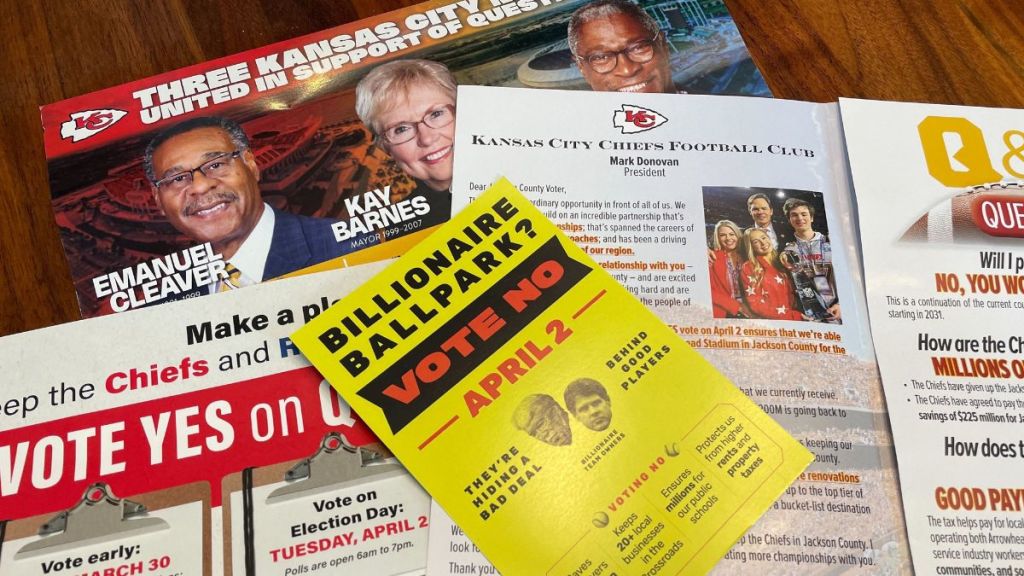
Anyone who shops in Jackson County currently pays a 3/8-cent sales tax that’s split between the Chiefs and the Royals. It was approved in 2006 and is set to expire in 2031.
If it had been renewed in 2024, it would have generated about $2.2 billion by 2056 — $1.1 billion for each team.
That Jackson County tax is, in many ways, a blank check.
It’s money that’s collected from taxpayers and given to the Jackson County Sports Complex Authority, which reimburses the teams for anything that could fall under the wide umbrella of “repair, maintenance, management or operations.”
The Kansas City proposal, on the other hand, is a $600 million bond supported by TIF.
Basically, the city will designate a certain area of the city as a TIF district. That district will include the stadium and nearby businesses that are expected to benefit from increased traffic generated by the stadium.
That district has not been drawn yet, but it will likely include Washington Square Park, proposed as the new stadium location, as well as Crown Center and much of the Crossroads neighborhood.
The city will then calculate a baseline level of sales tax and earnings tax revenue within that district.
Then, to build the stadium, Kansas City will borrow $600 million to help finance the estimated $1.9 billion stadium project. The city’s contribution would be paid off using specific tax revenue from the TIF district.
Once the stadium opens and nearby businesses start to generate more tax revenue, some of the increased tax revenue above the baseline will be used to pay off the $600 million loan. In theory, that incremental revenue could otherwise be used to pay for city services.
Say, for example, that a nearby restaurant is currently generating $4,000 per year in sales taxes. Then, once the stadium opens, the restaurant gets more customers and generates $6,000 per year in sales taxes.
A portion of that $2,000 increase — half of it, under a traditional TIF deal — will go toward paying off the city’s debt on the stadium, rather than police salaries or trash collection.
The rationale goes that any of the increase in tax revenue at the stadium will be entirely new money that would not be there if not for the stadium.
Some observers, on the other hand, say that some of the economic impact is more likely to be displaced from other areas of the city. For example, Kansas Citians might go to a bar in the Crossroads instead of a bar in Waldo, or spend money on a baseball ticket instead of going to Worlds of Fun.
Lots of unanswered questions
But here’s where the deal could go wrong.
Unlike most other TIF deals, Kansas City will be on the hook for its portion of the debt used to build the stadium, instead of the Royals.
The city plans to guarantee repayment of its bond, meaning that if the stadium and the surrounding district don’t generate enough money to pay for the debt payments, City Hall will need to dig into its own pockets to cover the shortfall.
In a worst-case scenario, that could be tens of millions of dollars every year — money that could otherwise be spent on public safety, transit or other city services.
(For reference, Kansas City is spending $84 million total on public transit in the next fiscal year.)
If that sounds familiar, that’s because the city also backed the loan for the Power & Light District in 2006 — and has paid to backfill financial shortfalls on that project over the past two decades.
As of 2023, Kansas City had paid a total of $167 million over 16 years to cover the shortfall at the Power & Light District — an average of $10.4 million per year.
There are a lot of theories as to why that happened at the Power & Light District.
Some people blame the Great Recession that began in 2007 and forced the developer to scale back more ambitious plans — and muffled any boom in entertainment spending. Others say that the boundary of the Power & Light TIF district was too small, so some of the increases in economic activity in surrounding areas were never captured. Still others believe that the financial projections didn’t build in enough margin for error.
The city has since refinanced the Power & Light debt to bring down those payments.
In any case, members of the City Council want to make sure that doesn’t happen again.
That’s why the stadium ordinance includes a $250,000 allocation to, in part, pay for an independent study to determine whether it’s a safe investment and how the city can shield itself from crushing debt payments.
That analysis, City Councilmember Andrea Bough said, would be completed by a third party — not the Royals or the city. Bough represents the 6th District at large.
“Especially as the finance chair,” Bough said, “I want to make sure that we’re not doing anything to jeopardize the basic services of the city.”
Essentially, what the city needs to prevent is a gap between what the stadium and district are generating, versus the amount the city needs to pay on the debt.
The problem right now is that those exact numbers are unknown. Hence, the financial analysis.
A traditional TIF deal can last a maximum of 23 years. And if we make a simple assumption of a 4.5% interest rate, that comes out to about $42 million in payments each year.
In reality, that payment will depend on a variety of factors, such as the interest rate when the city issues the bond and whether the city takes out all $600 million at once or in phases.
As far as the TIF revenue goes, Bough said that the city’s finance department has drawn up some estimates, which she believes are conservative. Even so, she wants someone to check that math to make sure neither the Royals nor the city are setting unrealistic expectations.
That’s because, again, the city is backing the debt. The city will need to pull money from other city services if the TIF district doesn’t generate enough money to make the debt payment.
And with all of the financial analysis, there will always remain the uncertainty of future economic conditions. Even with the most preparation, a recession or a pandemic or a war could scramble the city’s numbers.
Duncan is very concerned about a scenario where those estimates are wrong and taxpayers suffer.
“My concern stems from,” he said, “we are bearing the burden of feasibility studies that were wrong for Power & Light, for instance. … It’s $600 million of public dollars that we could be on the hook for, coming out of our general fund when we know we’re already struggling with revenues.”
Next steps
The ordinance will kick-start the city’s earnest negotiations with the Royals.
Aside from the $250,000 for financial advice, legal services and architectural services, nothing in the ordinance will be, from a legal or financial perspective, a final deal.
But Melissa Patterson Hazley, a councilmember representing the 3rd District at large, is more concerned about the political pressure.
“I just want the language (of the ordinance) to be softened,” Patterson Hazley said during the committee meeting, “such that nobody has the impression that we are making commitments and taking responsibility, and then the council is politically — politically, not financially, politically — in a position where we can’t pull back.”
Once Vasquez, the city manager, submits an application to the TIF Commission for the city’s $600 million portion of the Royals deal, the commission will be required by law to provide taxing jurisdictions a 45-day notice.
(Those taxing jurisdictions include any school districts, libraries or counties whose funding will be affected by the deal.)
From there, the TIF Commission will give their recommendation, and the City Council will take a full vote to draw the TIF district, authorize the tax redirection and take out the $600 million loan.
By that time, the City Council hopes to have a community benefits agreement in place. Negotiations for a similar agreement fell apart leading up to the Jackson County vote, resulting in groups like Stand Up KC, which represents low-wage workers, campaigning against the sales tax.
Most council members are asking for a community benefits agreement for the city deal, including benefits for residents outside of downtown.
That includes Darrell Curls, who represents the 5th District at large, as well as Lindsay French, who represents the 2nd District at large.
That community benefits agreement, French said, should include affordable housing, labor and apprenticeship benefits, child care, streetscaping and small-business benefits.
“If this is going to be a transformative project for Kansas City,” she said during the committee meeting, “I want to have a transformative community benefits agreement as well.”

