


Budget Hearing #2 Kansas City, Missouri (March 2, 2026)
By Sarah Bleha, Kansas City Documenter
These notes were produced through Kansas City Documenters, which trains and pays community members to take fact-checked notes at public meetings, strengthening transparency and accountability in local government.
Summary
- Kansas City hosted its second of three community hearings on the Kansas City budget for the 2026-2027 fiscal year at Guadalupe Centers in the Westside neighborhood.
- Staff presented an overview of the budget through a slideshow presentation, followed by public comment from more than 30 speakers.
- Many speakers discussed public transportation, while others raised concerns about public safety, homelessness and nonprofit funding cuts in the proposed $2.5 billion budget. Several also questioned the city’s allocation of resources toward World Cup preparations while issues affecting residents require attention.
Notes
Meeting Attendance
- Brenton Siverly, deputy finance director
- Andrea Bough, 6th District at large
- Mario Vasquez, city manager
- Kevin O’Neill, 1st District
- Ryana Parks-Shaw, 5th District and mayor pro tem
- Johnathan Duncan, 6th District
- Melissa Patterson Hazley, 3rd District at large
- Eric Bunch, 4th District
- Crispin Rea, 4th District at large
- Lindsay French, 2nd District at large
- Staff (included a mix of staff from the city and Guadalupe Centers)
Introductions
- All speakers introduced themselves and thanked everyone who attended.
- Council member Bough led the meeting.
- Deputy Finance Director Brenton Siverly led the PowerPoint presentation about the proposed 2026-2027 fiscal year budget.
Public Comment
Public comment was limited to two minutes per person, and members of the public were called up in groups of three. There was no open dialogue among the council members in attendance, and only minimal comments were made. The only people who responded were Bough, who helped facilitate the meeting, and a city staff member.
Toward the end of the meeting, a staff member instructed the public to not yell, as it interfered with audio recording. A resident responded, “Since we ain’t screaming enough,” which drew some cheers.
Public Transportation
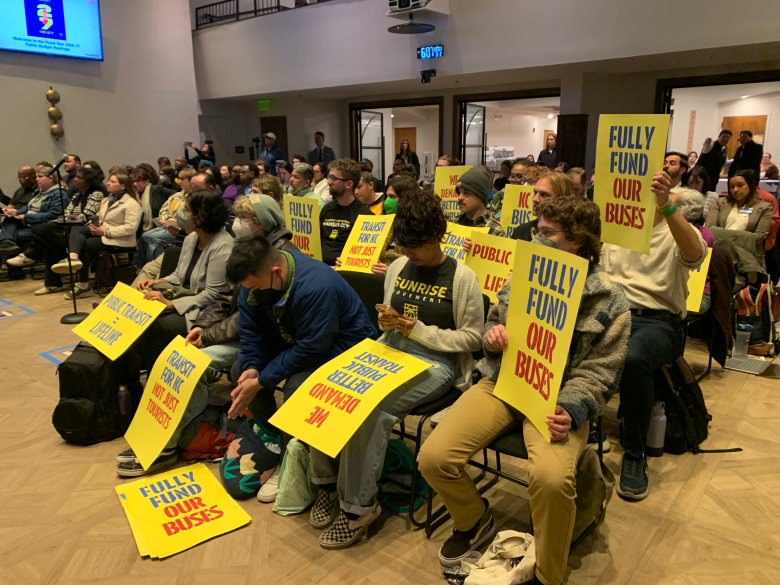
- Sunrise Movement Kansas City and the Kansas City Bus Riders Union had a noticeable turnout, and were vocal about the funding for public transportation. They held signs that read, “Fully Fund Our Buses.”
- Several speakers with with Sunrise Movement Kansas City raised the following concerns:
- Bus service has become less reliable and some routes have been reduced.
- The city should increase funding to support a fully functioning bus system.
- The proposed budget does not provide enough funding for public transit and could lead to additional service cuts.
- Transit investments appear focused on transportation needs for the upcoming World Cup rather than everyday service for Kansas City residents.
- A reliable bus system is necessary if Kansas City wants to be a desirable place to live and a “world-class city.”
- Several speakers criticized the proposed use of public mass transportation sales tax funds for road and streetlight projects.
- Some referenced past spending on defective “purple” streetlights as an example of transit funds being used for nontransit purposes.
- Several speakers with with Sunrise Movement Kansas City raised the following concerns:
World Cup
- Several speakers directly raised concerns about World Cup spending or referenced the World Cup in relation to other city priorities.
- Some said the city has been able to identify funding for World Cup-related transportation and infrastructure projects, while public transit operations, housing support and neighborhood infrastructure continue to face funding challenges.
- A speaker from the Kansas side of the metro area asked how Kansas communities providing services during the World Cup can access federal funding. She said hotels and local services on the Kansas side will support the event, but they have not received clear information about how to apply for or receive funding for security planning and community licensing.
Health
- Terri English-Yancy, CEO of Essential Families, spoke during public comment to request funding for a program called Essential Telehealth.
- She requested $1.8 million in city funding to expand the Essential Telehealth program, which she said has more than 2,000 families on a waitlist.
- The program provides 24/7 primary and mental health access for seniors and single-parent households.
- The program has reduced operating costs by about 70% through technology and AI tools, allowing it to scale more efficiently.
Neighborhood-Based Violence Prevention and Policing
- Nikki Stevens, director of operations for Empire Dreams, said programs such as KC Blueprint and KC 360 are now being threatened due to potential funding cuts. She emphasized the need to continue investing in neighborhood-based efforts aimed at reducing crime.
- One resident referenced a case involving Blayne Newton, a Kansas City police officer who killed three people but got a payout instead of incarceration. The speaker questioned the city’s response to the incident.
- Another resident said incarceration alone does not address underlying issues such as mental health and addiction, stating that punishment is often prioritized over providing support services.
- Edward Bell, vice principal at East High School and president of the Blue Hills Neighborhood Association, said “neighborhoods are the lifeblood of the city” while discussing the importance of investing in community-based programs.
Nonprofit Funding
- Lydia Moreno, representing City in Motion Dance Theatre, said arts programming supports children and strengthens community connections, adding that funding helps keep programs accessible across Kansas City.
- Speakers representing or referencing nonprofit organizations and community programs discussed the potential impact of proposed budget changes, including:
Observations & Follow-Up Questions
- The Office of Language Access was present and provided interpretation services for this event (Spanish, Vietnamese and Somali), as well as American Sign Language interpretation on site.
Read more about this meeting and see all Kansas City Documenters notes here.
