


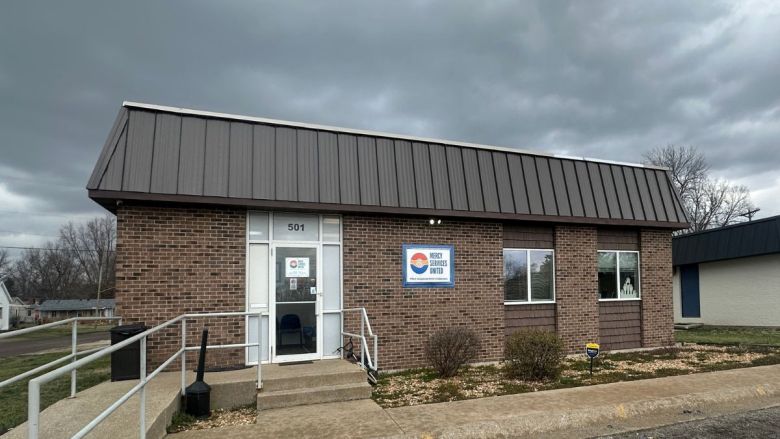
At Mercy Services United in Sedalia, Missouri, scores of people come through the doors every week for a shower, to do laundry, to pick up mail or use a computer.
Takeaways
- Missouri tapped a federal waiver to give rural hospitals funds to address environmental or lifestyle factors that could be affecting someone’s health.
- Six hospitals are piloting a program to use technology and a closed-loop referral system to allow providers to ensure that patients get in touch with the social care they need, like home repairs or utility assistance.
- While the participating hospitals are seeing promising results, staffing shortages and looming Medicaid cuts leave the future for rural hospitals uncertain.
But the building offers so much more.
As leaders in Sedalia reimagine what it means to care for the community, seven organizations have converged under one roof at Mercy Services United to bring a coordinated response to helping those in need.
The city’s newest effort to help its most vulnerable people appears to be a win: a building with the area’s most crucial social service providers all under one roof, available throughout the week on a walk-in basis.
Since it opened last April, volunteers and social workers have helped more than 3,000 Sedalians get connected with more than just showers or laundry. They also help to determine what services are available and fast-track the efforts to get people connected to them. Things like a referral to a behavioral health provider or an application for utility assistance can all happen under one roof.
It’s becoming a one-stop shop for rural communities where services are increasingly scattered. Rachelle Simon, the executive director, thinks it can be a blueprint for how the state thinks about showing up in rural areas.
Even assistance with a broken heating system or pest problems can be addressed at Mercy, thanks in part to a state Medicaid program that is experimenting with social drivers of health in rural parts of the state.
The program, dubbed Transformation of Rural Community Health (ToRCH), is aimed at improving the health of Missourians enrolled in Medicaid, or MO HealthNet. It does so by tackling lifestyle factors that could be impacting someone’s health, like outdated HVAC, trouble paying utility bills or food insecurity.
The program is based on a platform that allows hospitals or organizations lIke Mercy Services United to refer patients to other community organizations to help address those needs.
Before, there could be dozens of service providers around town that hospital social workers would refer patients to. But for the most part, patients had to reach out to those organizations themselves, and there was no way of following to make sure the problems were resolved.
Now, hospitals and affiliated organizations can make the referrals, see who picked them up and track them all within one platform, called Unite Us. They can follow a case online to see things like when the patient was contacted, if they responded to the outreach and the status of the help they were aiming to get.
And just a couple of years into the process, the hospitals enrolled in the program are beginning to point to changes.
“Before (using) Unite Us, we had 30 community-based organizations here in Pettis County that knew who each other were, but didn’t really work together or even know what each other did,” said Marvin Smoot, the vice president of clinic operations at Bothwell Regional Health Center in Sedalia.
“There wasn’t a lot of standardization in the process, because it just took a lot of work,” Smoot said. “Now, much like you would see a DoorDash order go out, and a driver can go, ‘Hey, I want that.’ All of the sudden, you had these community-based organizations in a coordinated effort saying, ‘I want to help this person.’”
Missouri’s request to the federal government
The ToRCH program is the brainchild of Kirk Mathews, the chief transformation officer within MO HealthNet, and Abigail Barker, a health economist at Washington University in St. Louis.
The main goal was to improve the health of Missourians on Medicaid, which would ideally help the finances of the hospitals taking on the cost of caring for those Medicaid patients.
Missouri’s objective was to use federal waivers through the Centers for Medicare and Medicaid Services to find alternative ways to pay for the program. Mathews and Barker worked on the plan for about 18 months before they were ready to present it to the federal government with the request to make changes to Missouri’s already-in-place 1915(b) waiver.
The state pitched the program to 52 of Missouri’s rural hospitals that were the sole hospital in the county to help them better track data. All in all, six hospitals ended up in the pilot program to serve as ToRCH hubs.
“It’s a program that really addresses population health by providing the resources to allow a local rural hospital to make investments by reaching upstream into the causes of poor health that are largely nonclinical causes,” Mathews said. “Things like poor nutrition, or lack of transportation to health care appointments, or perhaps an environmental hazard in their living situation that’s helping lead to poor health.”
Reinventing how Missouri’s rural hospitals can serve their community
Initially, the pilot sounded too good to be true.
Hospital leaders are used to nickel-and-diming with the groups who help reimburse them for care, Smoot said, like the state Medicaid office or the federal government. An infusion of cash and some autonomy about how to spend it were welcome changes.
“We are used to fighting our payers. We’re used to fighting about so many things, and we haven’t had to fight here,” Smoot said. “It really created a unique partnership between these hubs and the state on how we can drive effective care differently.”
In July 2023, with an infusion of state dollars and a new use of the federal waiver, the hospitals began establishing themselves as official area hubs to distribute funding, manage referrals and track data.
At the heart of the system is a technology platform that allows providers to get referred to patients, track those referrals and to follow a patient to ensure they get the care they need. Hospitals also launched a more robust social needs survey program to make sure they had a strong grasp on community needs.
So far, the results are promising.
The program enabled nearly 3,000 referrals across its six hospitals through November of last year, a case study authored by Unite Us found. Providers have seen a nearly 20% improvement in controlled blood pressure rates and an 18% increase in behavioral health follow-ups after emergency room visits.
They’ve also been able to better track social needs through their surveys – like how many patients could be food insecure, or struggle paying their utilities or housing costs.
For Dawn Williams, the mental health coordinator at the Pettis County Health Center, seeing the changes in her patients and the community is a new level of gratification.
“I just connect them to resources and make sure there’s no barriers in their way to get them there, and usually that’s all,” Williams said. “Then they’re gone, and I don’t know unless I run into them, like: ‘Did it work? Did they go through with it? Are they getting help?’”
“This is just a nice way of seeing that the work you do, it’s paying off,” Williams said. “You can see that they are or they’re not engaged. And if they come back in two months, we can say, ‘What caused you not to make it?’ And we work on trying to fix that problem.”
The sustainability conundrum for rural hospitals
Part of the difficulty rural hospitals face is having enough patient volume to keep their services running smoothly. If someone has a complex health profile, they’re more likely to travel to urban areas to see specialists or get those needs met. But it can eventually lead to a consistent stream of patients avoiding rural areas for their health care altogether.
“The volume needed to sustain rural health care as we have known it historically, both in patient volume and dollars associated with those patients, have left rural Missouri a long time ago,” Mathews said.
Mathews estimates that the ToRCH program will have provided some form of care to 10,000 Missourians with unmet social needs by June.
Despite the inroads, major gaps remain.
In Bolivar, Missouri, there are fewer community organizations to pick up the referrals, and often there’s not enough help to cover the needs in the community.
“One of the struggles we have with ToRCH is there is funding available, and not enough bandwidth in the community to stand up programs to address the needs that exist,” said Michael Calhoun, the CEO of Citizens Memorial Hospital in Bolivar.
“Even if you funded it, do you have the people, the facilities, the structure, the infrastructure to be able to address those needs?” Calhoun said. “And a lot of times, rural communities lack that, even if there is funding.”
Calhoun is hopeful for what the future can bring, especially as Missouri prepares to roll out its plan under the Rural Health Transformation Fund.
The state will mimic the idea of the ToRCH pilot by propping up community and regional hubs across Missouri to create a closed-loop referral process for each hospital and community services provider.
And despite the possibility of hundreds of millions of dollars flowing into Missouri over the next five years, rural hospitals still have their livelihoods on the line as a result of federal cuts to Medicaid, which will start materializing over the next few years.
Missouri could lose $23 billion in funding over the next decade, some estimates show.
“Medicaid cuts that come later than this program … they’re more substantial than the amount of funds that are coming through the ToRCH (and transformation) programs,” Calhoun said. “I think the hope that I have is that we learn a lot of things through this ToRCH program that we can continue funding for that drive the outcomes that we’re trying to achieve.”
Ultimately, rural health care providers are used to finding unique ways to make ends meet, Smoot said.
“What has yet to fail, though, is the people who are there regardless of whether or not they’re overworked or challenged,” Smoot said. “Their dedication shines through in so many ways.”
