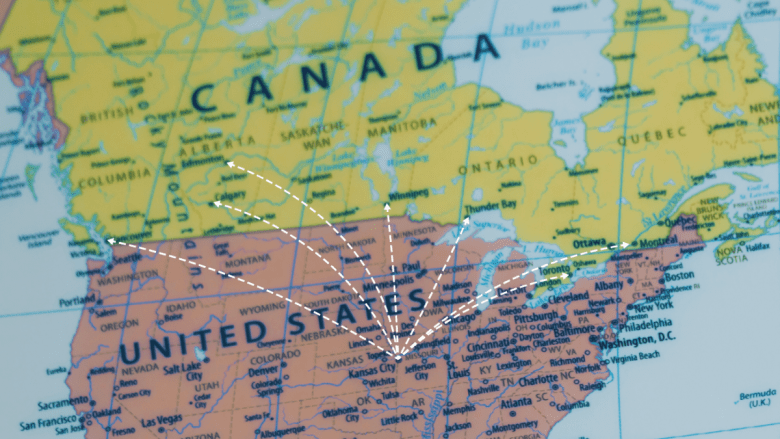
She began seeing the pleas on YouTube last summer.
“If you’re a U.S. health care worker looking for safety for your family,” went one social media video, “there are dozens of communities across Canada that will drop everything to help you get here.”
Takeaways
- Canada is actively recruiting U.S. doctors and nurses to move north and take jobs in its understaffed hospitals and clinics.
- The United States also faces a health provider shortage. But its immigration policies are keeping international doctors out, not welcoming them in.
- Meanwhile, some Kansas City-area health workers are responding to grassroots recruitment efforts on social media and considering moving to Canada.
“We’ve been watching the news,” went another. “We know it’s getting worse down there and we want to help.”
That sounded good to Jill, an occupational therapist from Johnson County. In November, not long after seeing those videos, she spent two-and-a-half weeks on Vancouver Island in British Columbia, meeting locals and visiting area hospitals.
She didn’t love the province’s rainy climate, but she returned to Kansas convinced that she and her husband, who have three children, should start the immigration process. At the very least, it could be an escape hatch they hope they won’t need.
“The Chicken Little side of me … is like, by the time it is too bad, it might be too late,” said Jill, whom The Beacon agreed to identify by a partial name to protect her family’s privacy.
She is not alone.
Among health providers in Missouri who responded to an annual survey by the Transgender Health Collaborative at St. Louis University, about half said they wanted to leave the state or country after President Donald Trump was elected for a second time. That compared to about one-third who gave that response in the organization’s 2024 survey.
“People were afraid,” said Katie Heiden-Rootes, one of the survey’s authors. “At a very basic level, they were afraid, and they knew what was coming.”
While there is no definitive data about how many health providers are leaving for Canada, evidence of growing interest is clear. Since the Trump administration returned to office, the Medical Council of Canada has noted a fourfold increase in U.S. medical graduates setting up accounts on its licensure website.
That was still only 1,225 accounts in 2025, compared to 298 the previous year. But Canada seems determined to turn the United States’ tumultuous political climate to its advantage. The country hasn’t just put out a welcome mat for U.S. health workers, it has thrown the doors wide open.
Here are just a few examples:
- In December, the Canadian government announced plans for an express entry program to make it easier for international doctors already working in the country to gain permanent residency.
- Individual provinces are actively marketing their hospitals to physicians across the border and adjusting licensing pathways to ease the credentialing process for international doctors.
- And communities throughout the country have started volunteer movements under the banner of Canada’s Healthcare Infusions, to provide information, answer questions and be a welcoming committee for their U.S. neighbors.
That’s where those social media videos come in.
Tod Maffin, who with his wife Jocelyn founded the Healthcare Infusions movement last year in Nanaimo, a city of about 100,000 on Vancouver Island, already has more than 1 million followers for the videos he posts regularly on social media.
In addition to some cutting jabs about the Trump administration, its tariffs on Canadian goods and the United States’ high-priced health care system — Canada has a universal, taxpayer-funded health system — the videos urge U.S. doctors to come north.
Less than a year into the recruitment campaign, Maffin estimates that 30 U.S. health workers have settled on Vancouver Island and are working in its hospitals and clinics.
Others, like Jill, have come to visit. And hundreds are active on the Healthcare Infusions Discord servers, run by volunteers in individual communities.
For Maffin, a former radio host, the effort has a singular purpose.
“I just want more nurses in our hospitals,” he said. “I just want more doctors so that we don’t have people on waiting lists. That’s all I want.”
Canada’s critical shortage
As in the United States, Canada faces a critical shortage of doctors and nurses.
A December report from the Canadian Institute for Health Information found that 17% of Canadian adults — 5.7 million people — didn’t have a regular health care provider in 2024. To meet demand, the report said, the country needs to increase the number of family physicians working in the country by 49%.
In Canada’s system, primary care doctors are the starting point for any specialized care, so the shortage of primary providers has led to backups and waiting lists and forced more patients to turn to emergency departments.
Karen Fleury, who coordinates Healthcare Infusions in Edmonton, Alberta, said she was moved to take on the volunteer job after hearing that someone in a local hospital had died after waiting eight hours to be seen in the emergency room.
“That really motivated me to find a way to help,” Fleury said. “I didn’t just want to complain on social media, I wanted to find a way to get involved.”
Canada’s health worker shortage can be traced in part to provincial policies in the 1990s that reduced enrollment in medical schools and capped the number of residency slots available in the country.
But the country’s predicament is far from unique. Many countries — the United States included — are experiencing a shortage of doctors, nurses and other health providers.
The Health Resources and Services Administration estimates that the United States will see a 113,000-physician shortage by 2028 — growing to more than 141,000 by 2038. According to the agency’s projections, Missouri will only be able to meet 91% of its physician needs by 2038, while Kansas will only be able to fill about 84% of its needs.
Some reasons for the imbalance are the same in Canada and the United States. The biggest one comes down to demographics. Both countries’ populations are growing older and need more medical care, but younger age groups are smaller in number and can’t fill all the health care jobs required.
In both countries, the situation was exacerbated during the COVID pandemic, which drove many people to leave health care jobs. Those departures, in turn, compounded the burnout caused by the increased demands placed on remaining providers.
But while the two North American countries’ health workforce challenges may be similar, the ways they are dealing with them are not.
While Canada is looking abroad for help meeting its worker needs, the United States is implementing policies that will prevent many foreign doctors and nurses from getting jobs here. The U.S. also is enacting other policies that will effectively shrink access to health care education opportunities.
The combination has many health researchers in the United States worried that the country’s health care workforce shortages will only get worse.
What is the United States doing?
While some state licensing boards have sought to make it easier for international providers to practice here, immigration restrictions at the federal level are standing in the way.
At the top of the list of concerns for those trying to close the U.S. health worker gap is a $100,000 fee that the Trump administration plans to slap on new H-1B visas in the coming year. While the industry relied on the temporary visa program to fill approximately 19,000 positions last year, most hospitals and clinics won’t be able to afford the new fee.
The industry is hoping to win an exception from the fee for health jobs before the H-1B lottery in April. But if that doesn’t happen, jobs that international doctors and nurses would have filled could likely remain vacant. That will be felt most severely in rural communities and underserved areas where international health workers often step into positions Americans don’t want.
“It’s a drastic shortage that we’re experiencing in the U.S.,” said Ann-Rose Johnson-Lewis, an attorney with WorldWide HealthStaff Solutions, which recruits international nurses to the United States. “We have something like 300,000 openings across the country for nurses, and currently there is not a pool to draw from domestically to fill those openings.”
“It’s a drastic shortage that we’re experiencing in the U.S. We have something like 300,000 openings across the country for nurses, and currently there is not a pool to draw from domestically to fill those openings.”
Ann-Rose Johnson-Lewis of WorldWide HealthStaff Solutions
Eli Greenspan, a policy advisor for the Association for Advancing Physician and Provider Recruitment, said the hospitals that organization represents can spend years recruiting international candidates and selling them on their communities. Those efforts may be wasted if the H-1B fee remains in place.
Ultimately, he said, more hospitals will close or practice areas will disappear because staffing is inadequate.
“As much as we’re concerned about the recruitment pipeline and the pool of talent,” Greenspan said, “it all comes down to patient access.”
Even if the visa situation is rectified, other barriers to immigration stand in the way of recruiting health workers from abroad. Chief among them are travel bans the Trump administration has placed on certain countries.
Johnson-Lewis said the bans are causing job candidates who have successfully made it through every immigration hurdle to be blocked from jobs they are qualified for and ready to fill.
“This whole thing is just so sad and frustrating for a lot of these nurses,” she said, “because a lot of them have been in process now for over two-and-a-half-years. They get to the end of the line, and now they’re told, ‘I’m sorry, you have to wait again to see what happens with all these travel bans or visa pauses that have been implemented by the administration.’”
On top of immigration policies preventing international doctors and nurses from coming into the United States, new limits included in the budget bill Congress passed and President Trump signed last summer will restrict how much money students can borrow through federal loan programs. That is expected to reduce the pipeline of future health providers being trained in the country.
Beginning in July, medical students can only borrow $50,000 a year and $200,000 over a lifetime. That’s far below annual tuition at most medical schools and will likely prevent some students from enrolling.
For nursing students who have been classified under the new rules as nonprofessional, the loan limits will be even more constraining. Nursing students will be limited to $20,500 per year in federal loans and a lifetime limit of $100,000.
“My fear is that we’re going to have disruptions in our immigration policy without really recommitting ourselves to the domestic physician workforce and worsen existing care disparities,” said Dr. Tarun Ramesh, a research fellow at the Harvard Pilgrim Health Care Institute.
Some of it comes down to politics
Meanwhile, changes to U.S. health policy, like the recent overhaul of childhood vaccination recommendations and laws that limit medical care options like abortion restrictions and transgender care bans, are making providers more likely to answer Canada’s recruitment calls.
On the Nanaimo Discord server, doctors, nurses and other health professionals give their reasons for exploring immigrating to Canada.
“My daughter is 6 and I don’t feel safe here anymore,” wrote someone who identified as a nurse from Kansas City. “I’ll do whatever I need to do for her to thrive.”
“I’m very weary and scared staying in the U.S.,” wrote a registered nurse from Lawrence, Kansas. “Though the act of leaving here may be years from now, it could be sooner.”
And a nurse practitioner from Kansas City wrote, “I have four kids under 10 and (I am) looking for safety and stability.”
As for Jill, the occupational therapist from Johnson County, her motivation for leaving the United States is both personal and professional.
She is white and her husband is Black, so she worries about his and their children’s safety as federal immigration efforts seem to increasingly rely on racial profiling.
Professionally, she is reluctant to practice as an occupational therapist in a country where politics seem to be prioritized over patients’ needs.
“The social determinants of health — all these things that create barriers for people to be able to do the things that they need to be able to do,” she said, “are suddenly being looked upon as irrelevant.”
Mostly, Jill believes all of that could be different in Canada. Though she would rather stay in the place she’s spent almost her entire life, where she has raised her family and has friends and a home, some days she thinks she may not have that choice.
“We’re trying to think of it like car insurance,” she said. “We’re going to get everything in line and hope we never have to use it.”
Correction: An earlier version of this story gave the incorrect title of Eli Greenspan. He is a policy advisor with the Association for Advancing Physician and Provider Recruitment.