


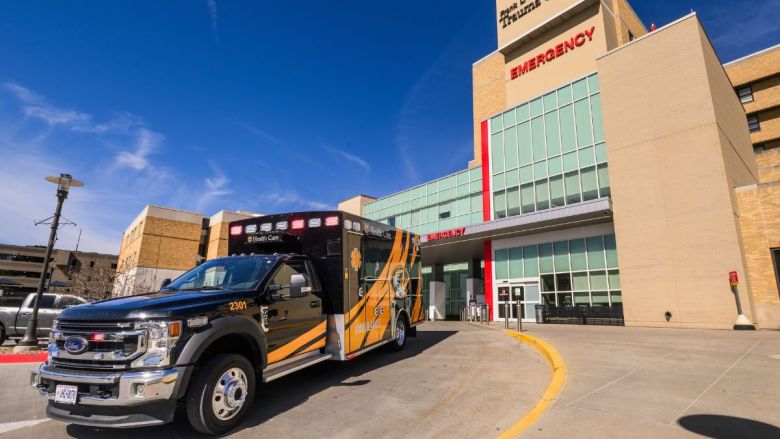
In the case of a severe car injury, every second counts.
Severe bleeding is the top cause of preventable death in trauma patients on and off the road, but most emergency responders don’t have the resources to give a blood transfusion at the scene of a crash or severe injury.
Under a federal grant awarded to the University of Missouri School of Medicine, researchers are hoping to bring those capabilities to Columbia in the hope of saving more lives.
The university’s Department of Emergency Medicine received a $4.6 million grant to give its first responders the training and resources to launch a mobile blood transfusion program in Columbia. The grant is expected to help inform the city’s safety action plan and its Vision Zero efforts, a national initiative aimed at eliminating traffic deaths.
Researchers will spend years piloting the program alongside other initiatives, such as bringing on advanced airway management to help trauma victims breathe more effectively after a severe injury and administering antibiotics and other medications to help improve patient outcomes.
For every minute of delay in getting a victim that needs blood a transfusion, their chance of death goes up by 11%, said Dia Gainor, the executive director of the National Association of State EMS Officials.
“The clock is the severely injured victim’s biggest enemy,” Gainor said. “Time is everything.”
About 40% of people who die from a car crash were still alive when first responders arrived at the scene. Julie Stilley, the assistant research professor leading the pilot at MU’S Department of Emergency Medicine, hopes quick interventions like ones set to be tested in the program will prevent some of those deaths.
Rural patients, who may be far from a Level 1 trauma center, may benefit most from early interventions like the one MU is piloting.
“In central Missouri, it’s often too close to our Level 1 trauma center to deploy an air ambulance helicopter,” Stilley said. “That critical response and that advanced response is often lost.”
From 2013 to 2022, the number of traffic crashes nationwide in which someone died increased by 30%.
In Missouri, traffic fatality rates increased by 11% from 2014 to 2024. Trauma patients who received blood on the scene were more likely to survive and required 60% less blood overall, data from the National Highway Traffic Safety Administration show.
“Those minutes after when you are in hemorrhagic shock are very precious,” Stilley said. “We need to eventually get you to definitive trauma care. But in the first few moments that we get to you, can we keep you as healthy as possible so that not only do you survive, but you have fewer complications as a result.”
Every second counts after a severe injury, especially in rural Missouri
In Missouri, only a handful of EMS agencies outside of MU currently have a pre-hospital blood transfusion program in place, and only 2% of EMS agencies nationwide have the technology.
“Pre-hospital blood administration is pretty new in the state of Missouri,” Stilley said. “There’s very few agencies that do that because it is very complex.”
Rural roadways make up a higher share of fatal crash locations compared to urban ones, data from the U.S. Department of Transportation show. In 2023, rural roadways accounted for 41% of traffic deaths.
First responders in Cole County, which is just south of MU, have had a mobile blood transfusion program in place for years. They use it for car crash victims from time to time, but often respond to more calls from off the roadway, like internal bleeding or gunshot wounds.
Because they’re near the Level 1 trauma centers in Columbia, it doesn’t make sense to transport a patient there by air ambulance, making their geography a great fit as an early adopter in Missouri.
“We are still close enough to Columbia where the cost-benefit of getting a helicopter to respond, getting them on-scene and getting them to the university outweighs the time that we can just drive them there,” Cole County EMS Chief Eric Hoy said.
“One of the issues we ran into is that we didn’t really have a lot of the interventions that are required to stabilize those types of patients,” Hoy said. “And that’s really where this pre-hospital blood product program came from.”
Part of the difficulty in starting up the program is the cost and logistics of sourcing blood that can be used in emergency situations. It’s predictably expensive and has to constantly be kept cool, then warmed with more equipment before it can be administered.
“One of the biggest hurdles we faced in all of this was actually finding a supplier,” Hoy said. “Blood products in the hospital setting are very highly regulated, highly monitored, so they weren’t necessarily interested in working in the dynamic environment of the pre-hospital environment. Obtaining these products from the hospital wasn’t really an option.”
Cole County EMS purchases its blood from a supplier in Davenport, Iowa, which also supplies blood and plasma to St. Charles County and the Mehlville Fire Protection District. It lasts for about a month before it has to be discarded, so they have to make careful choices about how much they carry and administer.
“Where maybe it would be beneficial to carry two units of packed red blood cells, we only carry one,” Hoy said.
Sustainability can also be difficult. Hoy’s agency is supported by a sales tax in Cole County, but for more rural agencies, maintaining a program can be difficult.
Stilley hopes that eventually, all of Missouri’s EMS agencies will have what they need to provide these types of care. As part of her grant, she’ll be working with MU Health Care providers to track outcomes like survival rates, the length of time they’re in the hospital, or whether they had to spend time in the intensive care unit.
“I think every Missourian deserves to have access to pre-hospital blood in the event of a crash or traumatic injury,” Stilley said. “I’d love to work with our regional partners in central Missouri to see just how we can do that.”
