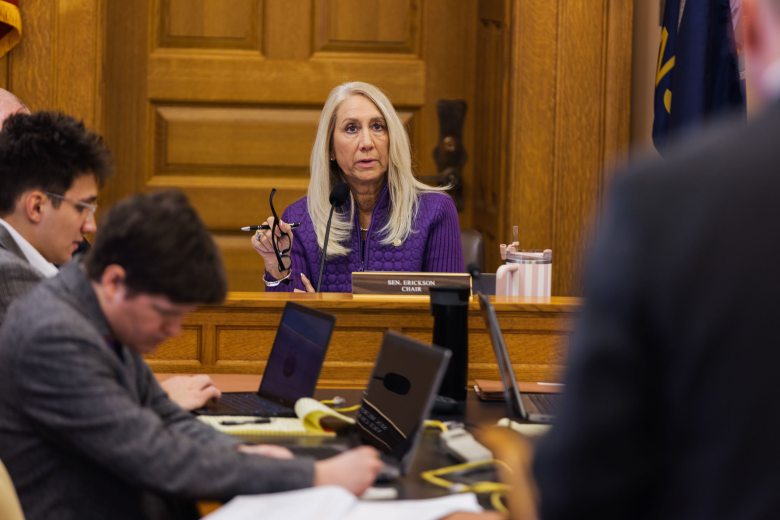
Kansas Republicans want to cut waste in social services programs, but a proposal to save the state money could cost more, increase error rates in the programs and take away benefits from eligible families, opponents said.
Takeaways
- Republicans have a proposal to increase eligibility checks for social services recipients. They say this will ensure only the people who need the programs are on it. The proposal is similar to the One Big Beautiful Bill Act passed at the federal level.
- Democrats say this bill will kick off eligible families because of paperwork errors and increase mistakes in these programs.
- An overwhelming majority of people who testified on the bill opposed the proposal.
A proposed bill codifies parts of the One Big Beautiful Bill Act passed by the federal government by adding a number of additional requirements to get food and medical assistance programs.
The Kansas bill does a lot of things, but simply put it requires more regular eligibility checks, prevents people from self-identifying certain information on applications and adds 256 state employees dedicated to checking applications.
It will cost the state $18.5 million in 2027 and $17 million in 2028 to implement, but the math is simple for Republicans. They say more eligibility checks and more staff snuffing out wasteful spending saves Kansas in the long run.
“The fiscal note (for this bill) is, I guess we could say, hogwash,” said Sen. Douglas Shane, a Republican representing parts of Johnson and Miami counties. “It only addresses the cost factors of potential new (employees) but does nothing to address the savings.”
But for opponents of the bill, more checks, more oversight, more paperwork and more staff only mean more mistakes and more wasted money.
“We have 40 opponents of this bill who are subject matter experts based in Kansas, and one proponent with an organization based out of Florida,” said Sen. Cindy Holscher, a Johnson County Democrat.
FGA Action, a conservative think tank, is the only group that has come out in favor of the bill.
The bill does the following:
- Requires quarterly eligibility checks for medical assistance.
- Bans self-reporting for things like income, household size, age and address for food assistance programs, Temporary Assistance for Needy Families support, medical assistance and child care subsidies. Workers would need to verify that information before offering benefits.
- Requires 20 hours of work, volunteering or school each week to get food assistance. Adults with children older than 13, adults aged 55-64 without dependents, kids aging out of foster care, veterans and homeless Kansans are subject to these requirements.
- Cuts retroactive Medicaid benefits from three months of coverage to two months of coverage.
- Requires legislative approval for certain waivers and exemptions to social service programs.
- Requires monthly, semimonthly and quarterly data sharing programs between state agencies and the federal government to confirm recipients are still eligible for the programs.
Some of these requirements already exist. Both the Kansas Department for Children and Families and the Kansas Department of Health and Environment already require proof of income for benefits.
Some of these requirements don’t do anything. Carla Whiteside-Hicks, the director of economic and employment services for DCF, said businesses report employment information quarterly to the Kansas Department of Labor. The bill requires semimonthly checks, which just wastes staff’s time because the information won’t always be updated.
Some of these requirements can’t legally adjust anything. Pregnant women and children who get Medicaid coverage based on income get the coverage for one year, guaranteed. Quarterly checks could mean the staff spends time confirming information, and even if the family is no longer currently eligible, their benefits couldn’t be taken away because of federal law.
Karla Hagemeister, executive director of the Flint Hills Breadbasket, said she helped a Kansan finish the more than 30-page, 200-question food assistance application. He’s had the same job for the past 14 years, but he needs help because he ended the month with only $9 in his account.
Hagemeister worries recipients will struggle to comply with quarterly checks. The resident has no email and doesn’t answer phone calls during the day because he is working.
“I don’t know that this bill, Senate Bill 363, will achieve anything that we’re talking about really wanting to achieve,” she said.
A parade of people opposed the bill. Kansas has already lowered its SNAP error rates from 12% to 5% in a recent month, and agency officials said nothing in the Senate bill would help those rates drop further.
Some SNAP errors are human errors. Whiteside-Hicks said it takes one year to fully train staff to process SNAP applications. More applications thrown on already overworked staff would mean more chances for mistakes.
Others noted that these social services programs already have regular checks and safeguards in place to prevent ineligible people from getting state money. There are also state staff already dedicated to finding waste, fraud and errors in applications.
Heather Braum, senior policy adviser with Kansas Action for Children, told lawmakers that an interim committee should dive deep into the experiences of people on these programs. That committee could then make recommendations on how to address waste in the programs.
One opponent of the bill said they knew a mother who didn’t have health care for her daughter with Down syndrome. They were eligible for help, but paperwork errors prevented them from getting coverage.
It wasn’t until the child was in the hospital for pneumonia that the mother was helped and they were able to get the child reenrolled.
“This bill will result in families losing Medicaid and (the Supplemental Nutrition Assistance Program),” Braum said. “Families will be unable to afford their child’s medical care, and kids will have less food to eat in their homes.”
But lawmakers want to find a solution now.
Sen. Mike Thompson, a Johnson County Republican, said error rates are costing Kansas tens of millions of dollars now.
“If we spun up an interim (committee),” Thompson said, “we’re talking about an additional year, and we’re sitting here in the same situation a year from now, with less money.”