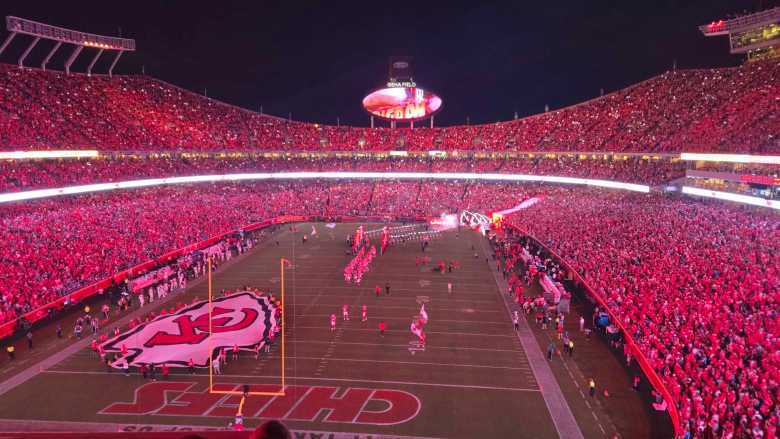
Kansas lawmakers have approved $1.8 billion in public funding to build a new Kansas City Chiefs stadium in Wyandotte County.
The Chiefs have proposed a multibillion-dollar plan to build a new stadium, training facilities and nearby mixed-used developments in Wyandotte County and in Johnson County. State funding would finance 60% of the stadium’s cost.
The Sports Business Journal reported the stadium will end up near the Kansas Speedway. All told, the plan would entail about $4.4 billion in economic impact for the stadium, training facilities and other related projects.
The stadium itself will cost $3 billion and have a dome, the governor’s office said in a press release.
“This agreement to bring the Chiefs to Kansas takes our state to the next level,” Gov. Laura Kelly said. “This is a game-changer for Kansas, and it’s a signal to America and the world that our state’s future is very bright.”
Kelly said the stadium will bring an estimated $1 billion in economic impact annually to the state and create tens of thousands of jobs. The Hunt family is expected to spend an extra $1 billion for additional development.
“This project represents another step in our legacy of innovation and our fan-first mentality, which started with my father, Lamar Hunt,” said Chiefs Chairman and CEO Clark Hunt. The stadium, practice facility and surrounding development will benefit the entire region, and further elevate Kansas City in the eyes of the country and the world.”
Economists generally are skeptical about public subsidies for stadiums. They argue that moving the team from Missouri to Kansas wouldn’t create new economic activity so much as shift existing spending around the metropolitan area. The people spending money at a Chiefs game would otherwise be spending money elsewhere.
And the Kansas plan relies heavily on creating new economic activity.
It would use sales tax and revenue bonds, known as STAR bonds, which work by taking out debt and repaying it with state and local tax revenue generated within a development district. In this case, a stadium district would be drawn up and tax money would be used to pay down stadium debt. Elected officials say using sales tax funds mean they won’t need to raise taxes or pull from general fund dollars.
STAR bonds usually covered 50% of a project’s cost, but Kansas lawmakers increased the limit as they pursued stadium deals with the Chiefs and Royals.
“You are not going to generate enough net revenue to cover one of the facilities, let alone two,” Geoffrey Propheter, an associate professor of public finance at the University of Colorado Denver, previously told The Beacon.
STAR bonds have been used before to mixed success.
A majority of projects are expected to be paid off on time, but other projects will take over 100 years to pay off.
Children’s Mercy Park paid off its bonds early, but that was a $150 million bond for a smaller capacity stadium. STAR bonds have never been used to pay off the amount of debt for the new Chiefs stadium.
The Wichita Riverwalk could also bring more people to its district than a full season of Chiefs football would draw. The riverwalk brought in around 3 million visitors in 2018 and 2019. It got a $55.3 million bond.
In 2025, the Chiefs are averaging over 73,000 fans per game. Assuming the stadium is the same size — which some reports say it won’t be — a maximum of nine home games, and three playoff games — that’s about 876,000 people in the stadium. More fans will join for tailgating or spending money at nearby bars, but it isn’t clear how large the STAR bonds district will be.
The Chiefs’ current lease at Truman Sports Complex, where the team has played since 1972, expires in 2031.
Kansas City Mayor Quinton Lucas, appearing Monday morning on KCUR’s “Up to Date,” defended state and local efforts to retain the Chiefs in Missouri.
“I don’t like to negotiate in the public, but I think it is worthy of public recognition that the state of Missouri, Kansas City and our partners have put up about an offer north of $1.5 billion for the team to remain in Kansas City at Arrowhead Stadium. That is a robust commitment, potential commitment, of taxpayer resources. It speaks to the value of the team,” Lucas said.
Kansas lawmakers adjourned on Monday without discussing a Royals funding plan, which makes it much more likely that baseball stays in Missouri. The Royals have been considering a site near 119th Street and Roe Avenue in Overland Park for a possible ballpark development.
House Speaker Dan Hawkins, a Wichita Republican, gave both teams a Dec. 31 deadline to strike a deal with Kansas, and he said he won’t take up any proposals in 2026.