


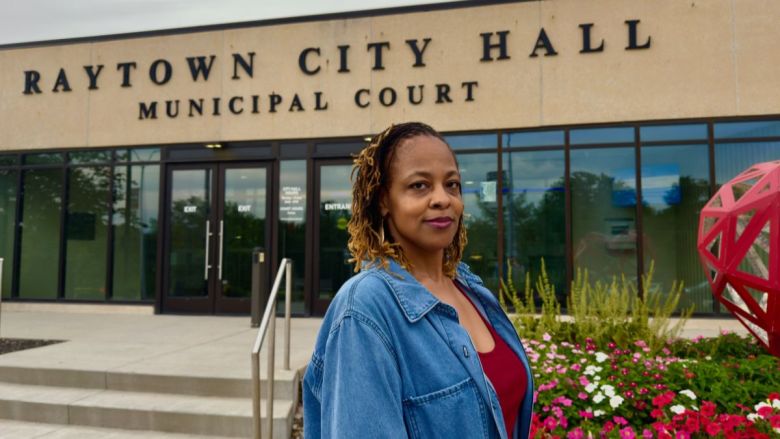
A former alderman in Raytown believes that she was improperly removed from office in June during a private meeting with Mayor Mike McDonough.
Latrice Thomas had been elected on April 8 to represent the northernmost neighborhoods in Raytown on the Board of Aldermen — Raytown’s equivalent to a city council.
She works as a medical assistant at KU Medical Center and founded a nonprofit that provides sexual health education for young people.
Thomas won her election narrowly — by just five votes — and unseated incumbent Ryan Myers, who had held that position for eight years.
“I was asleep, and my daughter must have literally kicked the door in and said, ‘Mama, you won!’” she said. “I’m telling you, the text messages were coming in, coming in, coming in — ‘Congratulations, you did it, girl!’”
Thomas was sworn in on April 22 and began attending and voting at biweekly meetings. She traveled to a training conference for elected officials in mid-June, where she networked with other leaders from across the state.
But her victory came crashing down just two weeks after she got home.
She got a call from McDonough on June 26 asking her to meet with him in his office.
McDonough showed her a letter from the Missouri Department of Revenue stating that she did not meet statutory requirements to be a candidate after an investigation found that she had been delinquent on her taxes at the time of her election.
The mayor then showed her another letter, signed by himself and the city clerk, saying that effective immediately, she was not qualified to serve as an alderman in Raytown.
Since then, Raytown has removed her name from the city’s list of elected officials on its website but has not acknowledged her removal in any press releases or on the city’s Facebook page.
Raytown Alderman Greg Walters said he does not remember Thomas’ removal ever being addressed at a public meeting of the Board of Aldermen.
In response to an interview request from The Beacon, City Clerk Teresa Henry shared the letter from the Department of Revenue that said Thomas did not meet requirements for candidacy and the Raytown letter addressed to Thomas that said she would be removed from office. The city declined to comment further.
Thomas believes she should never have been removed. She says that she’s not delinquent on her taxes and that she was removed without due process.
“I want to return to my seat that I rightfully won,” she said. “It was a unilateral misuse of power. It was wrongful, it was incorrect, it was out of order.”
Why was Latrice Thomas removed from office?
When someone files paperwork in Missouri to become a candidate for office, one of the documents they’re required to submit is an affidavit which says that, to the candidate’s knowledge, they are not delinquent on any taxes.
If the Department of Revenue learns that a candidate is tax delinquent, it sends a letter to the candidate notifying them that they have 30 days to resolve the issues. If they don’t, the department notifies the city or election board to say the candidate doesn’t meet the tax requirements.
From that point, the city or election board disqualifies the candidate and bars them from refiling for an entire election cycle.
That’s almost what happened to Thomas. Except in her case, the Department of Revenue received the complaint on April 23 — the day after she was sworn in as an alderman.
According to a letter the city of Raytown shared with The Beacon, the department sent her a letter at that time, but she didn’t resolve her tax delinquency.
Thomas said she didn’t get the letter. But as soon as she learned of the issue during her meeting with the mayor, she called the Department of Revenue.
The department ran her Social Security number and didn’t see any outstanding taxes, she said. But when they ran her husband’s information, they found that he had some state income taxes that were in dispute.
A dispute is when the taxpayer and the tax collector disagree on how much money is actually owed. Disputed taxes are not considered a tax delinquency when filing for candidacy.
JoDonn Chaney, a spokesman for the Missouri Department of Revenue, confirmed that the department found in its investigation that Thomas was not compliant with the requirements under the Missouri statute.
Due to the private nature of tax records, he could not share any other information about why the department determined Thomas to be delinquent or whether her husband’s taxes were in dispute, but he said in an email that the department was not responsible for any decision to remove her from office.
“The department regularly receives compliance complaints regarding candidacy,” he wrote. “The department reviews these complaints, but we are not an election authority, and therefore cannot make determination regarding eligibility. In this specific case, that would be a matter to be determined by the city, according to state statute.”
Chaney also could not say who submitted the initial complaint to the department.
Thomas believes she was removed improperly
It’s not uncommon for someone’s candidacy to be challenged because of an alleged tax delinquency. But in this case, the Department of Revenue did not receive the complaint until after the winner was sworn in to office.
Brad Constance, a lawyer who represents the Jackson County Election Board, did not comment on this specific case. But he said that in the past, a candidate being disqualified from an election has resulted in their removal from office.
In 2011, a man named Herschel Young was elected to be Cass County presiding commissioner. It was later discovered after he was sworn in that he had pleaded guilty to a felony nearly 20 years prior — which would have disqualified him as a candidate.
The Missouri Supreme Court, in its opinion, said that “one of the requisites to being qualified to hold office is that the person seeking office be a valid candidate and comply with statutory provisions regarding candidacy.”
In that case, Young was removed when the prosecuting attorney filed a petition to oust him.
But there is not any court filing associated with Thomas’ removal. The mayor sent her a letter declaring her unqualified, and Thomas has been absent from the dais since then.
Thomas believes that the mayor can’t remove her unilaterally. She is no longer a candidate, she said, and she thinks it’s wrong for the mayor to remove her from office without hearing out the facts of her case.
“I’m serving in my capacity,” she said. “Sworn in, signed, sealed and delivered … At this point, I’m a representative, liaison, all of that for Ward III constituents. So I want to be treated as such. I want that due process of doing it the correct way.”
If Thomas isn’t eligible to hold office, it’s unclear whether McDonough removed her in a valid way or whether it should have happened through an impeachment process, a petition filed by the Jackson County prosecuting attorney or another means.
The process of potentially replacing Thomas is outlined in another Missouri statute. If a position on the Board of Aldermen becomes vacant, the mayor nominates a replacement at a special meeting, who then must be confirmed by a majority vote of the board. This has not happened yet.
The Beacon asked Henry, the Raytown city clerk, whether that law would guarantee Thomas an impeachment hearing, whether the Board of Aldermen intended to replace her and whether the city knows who submitted the initial complaint to the Department of Revenue.
“At this time, the matter has been referred to the Attorney General’s Office,” she wrote in response. “We have no further comment.”
The attorney general’s office did not respond to a list of questions by email.
Raytown appears not to have addressed the removal of an elected official in any press release or statement to the public over the past two months. Henry also declined to say whether that was true.
Thomas said her removal has a negative impact not only on her, but also the people who voted for her.
“It’s hard enough for people to get out and vote,” Thomas said. “We’re already out begging people to vote … It’s a huge letdown, a huge disappointment. And I hated for that to be confirmation for why they don’t vote.”

