


Just one sentence in a bill making its way through the Missouri General Assembly has pitted the Port Authority of Kansas City against labor unions, Kansas City Public Schools, the city’s Economic Development Corp. and even some members of Port KC’s own board.
Most of the bill is noncontroversial. It includes straightforward changes that Port KC says would make it easier to work with the state’s development department and simplify the process for creating port districts.
But it also includes a line that opponents say would undermine Kansas City’s ability to set standards for construction projects happening within city limits.
That one provision, they argue, would give some developers the chance to bypass Kansas City Council ordinances that limit tax breaks, require affordable housing and make sure construction workers are paid a livable wage.
“Our voters have elected several City Council members who have specifically run campaigns on some of the very incentive policies that are undermined in this bill,” Tracey Lewis, president of the EDC, said in an email to the Missouri Senate.
An amendment to that bill may soon prevent Kansas City and St. Louis port authorities from taking advantage of the line that sparked criticism. Both the bill’s supporters and its critics say they are on board with that amendment.
But an underlying issue remains. Some advocates are concerned about Port KC’s ability to issue tax breaks to developers without following the rules that the City Council has set for all other economic development agencies.
Port authority bill would update 50-year-old law
The port authority bill was proposed by Rep. Mike Steinmeyer, a Republican from Sugar Creek, to little fanfare about two months ago.
At its first hearing, Port KC CEO Jon Stephens testified in favor of the bill, as did the agency’s general counsel and a handful of lobbyists from J.E. Dunn, the Missouri Chamber of Commerce and the Missouri Port Authority Association.
It’s a lengthy bill that includes provisions that allow port authorities to lease land in neighboring cities, hire security guards for port districts like the Berkley Riverfront and create a process for removing board members.
The bill would bring what Stephens said are much-needed updates to the laws that govern Missouri’s 19 port authorities — including Port KC and agencies in St. Louis, New Madrid, St. Joseph, Hannibal and other cities lining the Mississippi and Missouri rivers.
“To remain competitive, we need government efficiency and modernization of the Port Authorities Act,” Stephens said at the hearing. “It has remained relatively unchanged since 1974 and it has served us well. But like many things in Missouri, there are efficiencies that we need to look at to move forward and to lead as a state.”
The bill passed easily in the Missouri House by a vote of 137-13.
But when the bill went to the Senate, the EDC in Kansas City learned about a line that they say would give developers the ability to bypass city regulations on what kinds of projects are allowed to get tax breaks.
One pesky provision
The line in question would give port authorities across the state the ability to issue tax incentives under chapters 99, 100 and 353 of Missouri statute. In Kansas City, those incentives — issued by the Land Clearance for Redevelopment Authority, the Planned Industrial Expansion Authority or the Chapter 353 program — are required to go through the EDC.
That raised alarms for the EDC, which has been concerned that Port KC may be taking on projects that would otherwise have to go through Kansas City’s development process.
While the EDC is required to follow Kansas City ordinances regulating development, Port KC is a state agency that is largely exempt from those same rules.
That means that if Port KC were given the power to issue those tax incentives, it would create a loophole for developers who might prefer not to follow the city’s rules.
Those rules include the city’s requirement that developers set aside a certain number of apartments for affordable housing and work with contractors that pay their employees the prevailing wage.
Dan Moye, the vice president of land development at the EDC, also noted that Port KC would be able to ignore the incentive caps in city law if the bill passes in its current form.
Under the LCRA, which was established in the 1950s, the state law allowed economic development agencies to give developers a property tax break for up to 100% of their tax bill for 10 years.
But since then, the City Council has passed an ordinance that limits that tax break to a maximum of 75% of property taxes.
If this bill were to pass, Port KC could have the authority to issue LCRA tax incentives, in addition to the EDC. Moye is concerned that in that case, developers would stop applying at the EDC because they could theoretically get a bigger tax break from Port KC.
Testimony against the bill
Word about this one-sentence provision quickly spread. And when it came time for the bill’s Senate hearing, the EDC, Kansas City Public Schools, the Greater Kansas City Building & Construction Trades Council and AFL-CIO descended on Jefferson City.
Lewis, from the EDC, wrote an email to the senators on the committee expressing “significant concerns” with the bill.
“This undermines local control of our economic development policy,” he said in the email. “Cities would not have any ability to control a port’s use of these powers outside of explicit language in plans.”
“I stand in opposition to this,” testified Ralph Oropeza, executive officer and business manager of the construction trades council.
He said Port KC regularly passes over local construction unions when hiring contractors for its projects, instead hiring out-of-state workers and paying them less than prevailing wages.
“We cannot continue to have a robust workforce in our communities,” he said, “if we are having contractors come in from out of state that are not vetted and do not pay into our local economy.”
The drama subsequently spilled over into Port KC’s board meeting on April 29, when Kansas City Councilman Kevin O’Neill, who also serves on the Port KC Board of Commissioners, scolded Stephens for testifying at the statehouse that Port KC supported a bill that O’Neill thinks could undermine the city.
“I was kind of blindsided by it,” O’Neill said at the meeting. “When Port KC supports a project, it means the commissioners are supporting the project, and I didn’t know we were supporting a project that went against a lot of the things at the city.”
Stephens responded that the information circulating about negative impacts to Kansas City’s development agencies was unwarranted — to which O’Neill said, “That’s debatable.”
Morgan Said, another commissioner on the Port KC board, echoed those frustrations in a phone call with The Beacon.
“The city gets so few bites at the apple in Jefferson City every legislative session,” she said. “I would hope that we’re all moving cohesively throughout the state Capitol so that we are maximizing opportunity for Kansas Citians and bringing back as much as we can to Kansas City from Jefferson City.”
In a statement to The Beacon, a spokesperson for Mayor Quinton Lucas said the bill was presented in Jefferson City without any consultation with the mayor, City Council or any board or administrative leadership.
An amendment may be coming soon
For his part, Stephens told The Beacon that the provision was never intended to do what the EDC and other groups feared.
“The concept around this is primarily to offer port authorities (in cities) that don’t have those tools the ability to utilize those tools without having to create separate organizations,” he said.
For example, cities in more rural areas of Missouri may not already have a LCRA or PIEA board to handle that kind of proposal. Opening up that power to port authorities would give smaller cities the ability to consider proposals that they couldn’t before.
“Kansas City has a housing crisis,” Stephens said. “But really, some of the areas in the more rural communities have it, frankly, as bad or worse, because they don’t even have the programs to address affordable housing or anything like that.”
He said that he never intended for Port KC to use those tax incentive powers that LCRA, PIEA or the Chapter 353 program use through the EDC.
That’s why he supports an upcoming amendment to the bill that would carve out Kansas City and St. Louis from that specific provision — meaning it would only apply to the more rural port authorities in Missouri.
But even if the bill passes with that amendment, Port KC is continuing to issue tax incentives outside Kansas City’s process, unbound to the rules that City Council has passed to regulate development.
Stephens said Port KC voluntarily includes affordable housing in development proposals and uses its own “but-for” financial analysis for incentives, audited by a third party. He said it’s bound to the same requirements as Kansas City developments when it comes to contracting with minority- and women-owned businesses.
But workers on Port KC projects don’t always get paid as well as at the EDC, which has to follow Kansas City’s prevailing wage requirements.
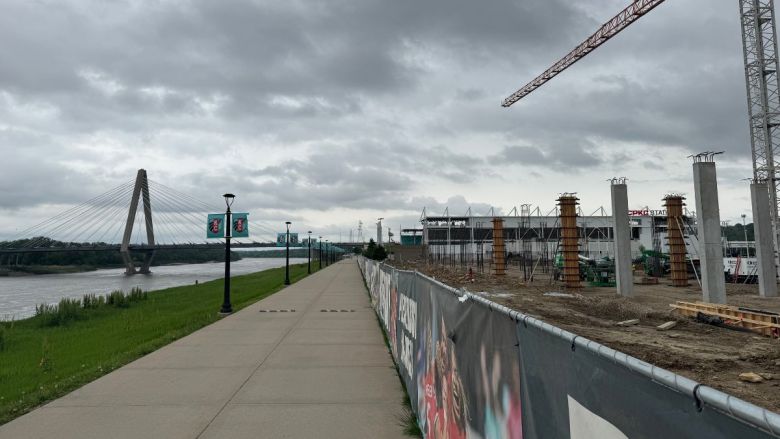
“There’s a $1 billion project in the riverfront that’s underway,” Oropeza said at the hearing. “A $200 million portion of it was just released. The building trades got absolutely none of that. So that is greatly affecting us. It’s an out-of-state contractor with an out-of-state workforce, and that’s greatly affecting our local economy.”

