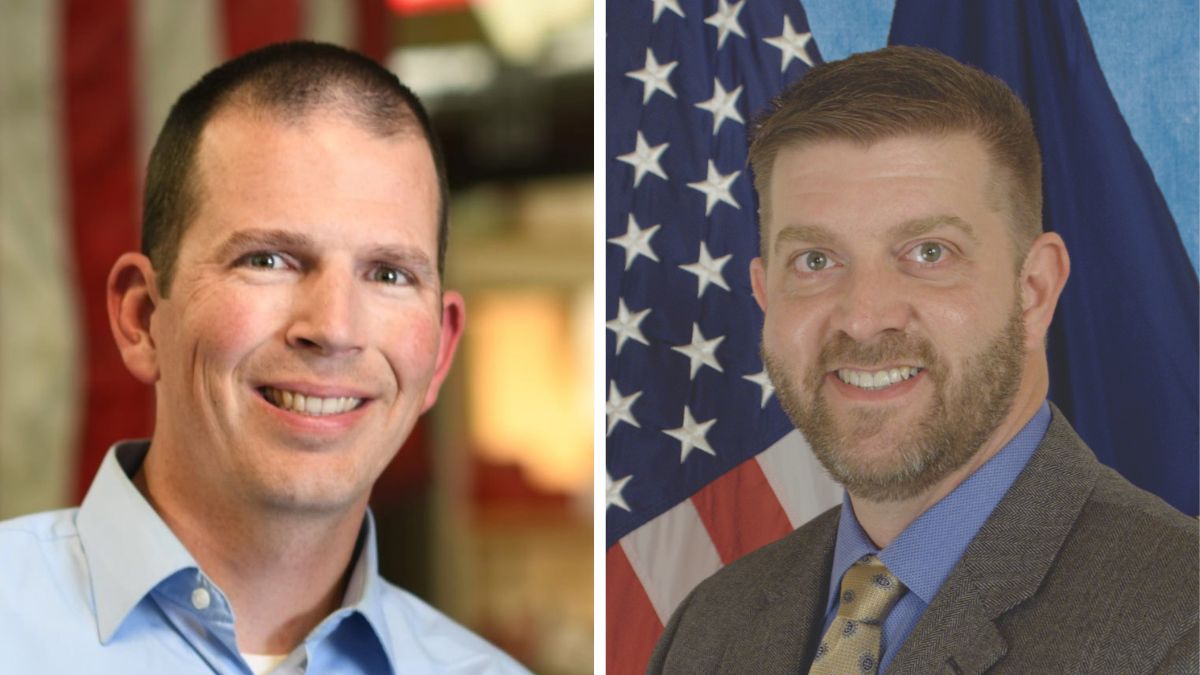
Rep. Brian Bergkamp, a Wichita Republican, is being challenged by a local council member in his district.
Republicans have won this district in the last five elections.
Election Day is Nov. 5. Oct. 15 is the last day to register to vote. Early voting starts Oct. 16. You can find your polling place and the races you vote in here.
Who are the candidates in Kansas House District 93?
Republican Brian Bergkamp (Incumbent)
Bergkamp has served two terms in the Kansas House. He has an accounting degree from Friends University and worked at Koch Industries after college.
Bergkamp volunteers for The Lord’s Dinner and is involved with the Catholic Diocese of Wichita.
“I was elected in 2020 and have worked since then to lower taxes and reduce government regulations in our state,” Bergkamp said. “I believe our friends and neighbors should help solve problems and support others – not the government.”
Bergkamp is endorsed by the Kansas Chamber of Commerce, NFIB-Kansas, the Kansas Farm Bureau, Kansas Livestock Association, Kansas Family Voice, Kansans for Life and the Kansas Rifle Association.
His campaign website is here.
Democrat Justin Shore
Shore is currently the Clearwater City Council president. He was also elected to the Sedgwick County Extension Executive Board and serves on the Program Development Committee for Family & Consumer Sciences.
“I’m a regular volunteer in my community and county, including at my senior center,” Shore said. “I’ve had a three-decade long career in information technology that has taken me around the world, and I still work on the family farm.”
Shore is endorsed by the Kansas branch of the AFL-CIO, the Kansas National Education Association and Game On for Kansas Schools.
His campaign website is here.
If elected, which of these politicians would you most closely resemble?
Options include: Joe Biden, Sharice Davids, Bob Dole, Nancy Kassebaum, Laura Kelly, Roger Marshall, Jerry Moran, Donald Trump or someone else.
Bergkamp: I am a mix of several of these. My voting record is conservative and yet I am able to have productive conversations and working relationships with those who have opposing viewpoints. Everyone has a reason for believing what they do, and I want to understand why others think of issues differently than me. I never want to stop learning and trying to be a better version of myself.
Shore: Senator Nancy Kassebaum, whom I met in 1984 during her first reelection campaign. She was well known for avoiding partisanship and worked across the aisle to pass major pieces of legislation such as HIPAA.
If you could pass any bill, what would it be and why?
Bergkamp: A 3% cap on state expenditure increases. Our FY2015 general budget was $6.3 billion; our FY2025 budget is ~$10.5 billion. This $4.2 billion increase is much more significant than the rise of inflation. If we cannot control our costs, our property taxes and all other taxes will continue to put undue burdens on our state.
Shore: Medicaid expansion. Passing Medicaid expansion immediately provides 150,000 working Kansans with health insurance. This brings funding to rural hospitals and mental health services across Kansas. This funds care for veterans not covered under VA health benefits. It brings an end to medical bankruptcies for unpaid medical bills, a cost that is paid for in higher rates for families that already have medical insurance. And it encourages more providers to come to Kansas, reducing wait times for care for everyone. The impact is broad, immediate, and long overdue.
How would you have voted on the following items? You can vote yes, no or pass.
The Aug. 2, 2022, constitutional amendment on abortion
Voting no meant the state constitution would continue to protect the right to abortion. Voting yes would have meant it can be regulated or banned.
Bergkamp: Yes. I fail to see how the Kansas Supreme Court found in our constitution a right to abortion. Their logic is flawed. The dissenting justice said: “The majority’s decision is so consequential because it fundamentally alters the structure of our government to magnify the power of the state.”
Shore: No. This was an ill-conceived way to force ideology on Kansans and divide us further. However, Kansans from all parties spoke loudly and clearly when they voted this amendment down. The matter has been settled by the voters. It’s time for the government to go back to doing its actual job.
Flat tax on income
A flat tax on income was packaged with property tax cuts and eliminating Social Security income tax. Democrats and Republicans agreed on other parts of the plan, but were at odds over a flat tax. A single rate on income didn’t pass this year.
Bergkamp: Yes. This policy puts Kansas in a competitive position to continue attracting workers while simplifying our tax code. More liberal states such as Illinois and Colorado have enacted a single rate, so there is no reason Kansas cannot get this done.
Shore: No. Flat taxes are regressive, taxing lower income earners a larger portion of their income than higher income earners. It starves the state of revenue to fund the very programs that the lower income earners depend upon. It’s a backdoor way to force small-government ideology on us by bankrupting the state.
Banning transgender women from women’s sports
Banning transgender women from women’s sports. Voting yes would mean athletes have to compete as the gender they’re assigned at birth. This bill was vetoed but the veto was overridden in 2022.
Bergkamp: Yes. This is a logical decision based on fairness. It should not be a complicated issue.
Shore: No. This is a matter that medical doctors and sporting regulatory bodies, experts in their fields, resolved years ago; long before the majority in the legislature decided to have an opinion on the matter.
Banning gender-affirming care for trans youth
Voting yes means children under 18 can’t get puberty blockers, hormone treatment, and in rare cases, gender-reassignment surgery. This bill narrowly failed this year and is expected to come up again in 2025.
Bergkamp: Yes. It is proven our brains are not fully developed until our 20s. It is our duty as a society to protect individuals from making decisions that will alter their life until they are fully capable of doing so.
Shore: No. The legislature forcing their uneducated opinions on the state encroaches on the rights of parents and the rights of their children to make their own medical decisions with doctors. It’s government overreach. Every major medical organization in the US supports gender-affirming care. Simply put, it saves the lives of children.
Chiefs and Royals stadium-financing bill
This bill didn’t spend any taxpayer money to attract the teams, but it did set aside future sales tax dollars from future stadium districts to pay off bonds. This law passed by a comfortable margin, and voting yes opens the door to the Chiefs and Royals in Kansas.
Bergkamp: No. We had limited time to debate and discuss such a massive decision. Nearly all studies have shown stadiums do not lead to economic benefits for the state. I won’t sacrifice taxpayers’ dollars just to one-up Missouri.
Shore: Yes. As a local leader, I would first want to be certain that the local taxing districts accept the redirection of sales tax dollars to support this effort. As long as they are in agreement, and this is a well-vetted, studied and scored proposal. I would support it.
APEX (Attracting Powerful Economic Expansion)
This bill had billions in tax incentives to bring a Panasonic battery plant to De Soto, Kansas. As it was being passed, lawmakers were not told which company would be coming, but were told the bill is necessary to attract large businesses. Voting yes approved a massive tax incentive plan for companies.
Bergkamp: No. Only a few knew what company this was for before voting on it. Again, these subsidies are typically not to the benefit of the state in the long run.
Shore: Yes. I support a well-vetted, studied and scored solution that involves incentives in order to create good-paying jobs and regional prosperity in a reasonable amount of time. Not every proposal meets that standard, though, and each should be studied. Confidential proposals should be shared with caucus leadership for evaluation and recommendations.
Mail ballot grace period
Currently, any mail ballot in Kansas can arrive three days after Election Day and still be counted if it was postmarked on or before Election Day. Voting yes would eliminate that grace period.
Bergkamp: Yes. We should know the election results by midnight of election day. It creates uncertainty in the process when results are not known for extended periods of time. There are plenty of options available to voters to ensure they are able to vote in a timely fashion.
Shore: No. Hailing from rural Kansas, I understand the delays in sending mail around the state. It is reasonable to allow a grace period for receiving ballots that were sent on time. Canvassing and the certifying of the elections doesn’t occur for an additional seven days after the current grace period anyway.
A bill loosening child care regulations
It would expand allowed child-to-staff ratios and allow teenagers to work at these facilities. Voting yes approves the loosened restrictions. Learn more about this bill here.
Bergkamp: Yes. As child care costs and availability continues to hurt our state, we must look to solutions like this to make it more affordable and create additional capacity.
Shore: No. Kansas desperately needs more day care options, but compromising the safety of children is not the way to achieve that goal. This was a poorly conceived bill.
The Parents’ Bill of Rights
This bill lets parents pull their kids out of classes if they are being taught objectionable material. Republicans say it is up to parents to determine what their children should be learning. Democrats say this bill addresses a problem that doesn’t exist.
Bergkamp: Yes. I do not want to put undue requirements on our schools, but parents should have the ultimate say at the end of the day on what material their children are learning.
Shore: No. Parents and teachers have always had the ability to work together on potentially sensitive topics. Here, the legislature is inserting itself into the conversation between parents and educators on a child’s education. The legislature seems to only support local control when it’s politically beneficial to the legislature.